

ML646365086
- 年齡
- 未確定
- 性別
- 未確定
觀察細節
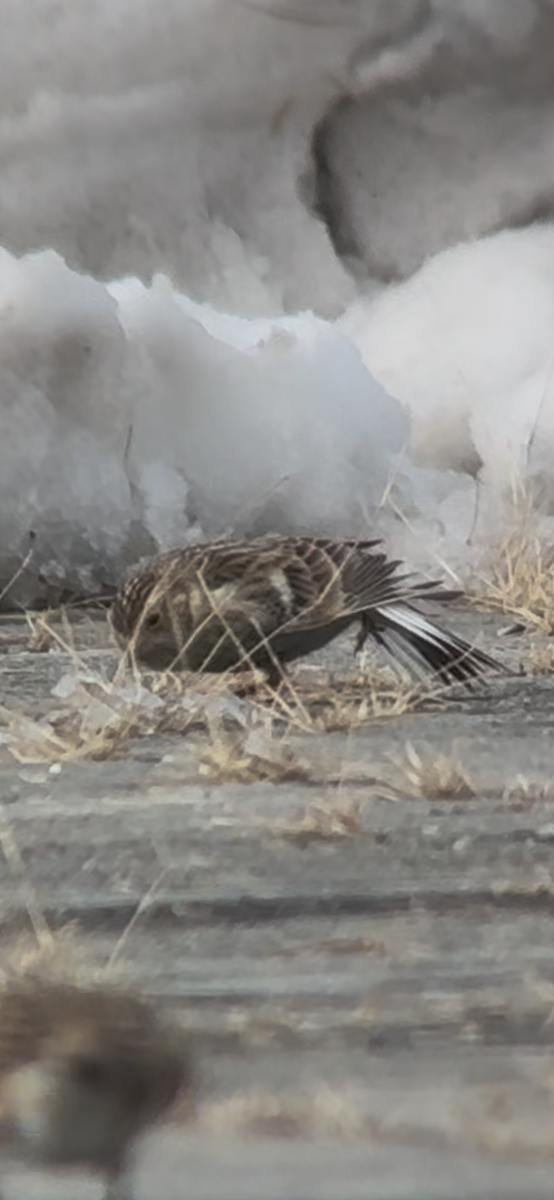
***mega; great find this am by Jon Skinner and well seen by a group of 15+ others. It was declared present when I rolled up, but all the field birds were flying and when they settled it was not in view. There was a close group of larks and Snow Buntings, but it was quickly apparent that it was not among them. the lark flock had clearly split, since the close birds numbered only 25-30 and it took my a while but I finally found them far behind the blue port-a-potties and feeding on the grass at the runway edge. It was very hard, but I finally picked it out, and just when I told those around me the flock flushed and flew towards us. I got on it for a few minutes when they landed and it was at the far left end of the spread out flock, but they flushed again after only a few minutes. This time I was able to pick it up in flight, as it was the only longspur among the larks, and watched it land with ~30 larks. This time it was very close. It foraged there for 15-20 minutes, then jumped a short distance and took another few minutes to refind. Once we did, it was a bit further, with a larger group of 93 larks, a Snow Bunting, and a Savannah Sparrow. I stayed for a few more minutes and then had to head back to the office. Digiscopes, a few SLR photos, and a few videos. One video included a wing stretch, which shows the white lesser coverts well. The identification for this one was straightforward, since it has black bases to most of the belly feathers as well as a very plain buff-brown body, a very plain face, a prominent eye ring, and minimal streaking below. In the wing stretch, the bold white less coverts could be seen, eliminating all other longspurs except Smith's. The tail pattern was also seen in a wing stretch, captured on video and two screen grabs, with extensive white on three outer tail feathers (more than Smith's or Lapland). The greater secondary coverts were sandy brown with only slightly contrasting richer rufous edges, very unlike the cinnamon panel of Lapland. The tertials were long, plain, and a bit worn without prominent cinnamon edges. The primary extension appeared quite short, with maybe three primaries beyond the tertials, two of which were essentially the same length (p10 and p9). The bold eye ring was very distinctive, and unlike Lapland (but similar to Smith's). The bill was far too small and sparrow-like to consider Thick-billed. I am unsure of the age. It must be a male with this much black below, extending all the way to the belly. The bold white lesser primary coverts and black centered feathers elsewhere on the forewing may indicate an adult. I am not sure my images of the spread wing are good enough to determine if there is a molt limit in the lesser coverts, or if it definitely lacking, but BOW mentions that as the best aging feature. Given how plain it was above and how there did not appear to be even an obscured chestnut collar, I am assuming it is a young male, but this requires confirmation since I am not too familiar with the finter points of winter plumages in these birds. MARC has five prior records for Massachusetts, which divide the records equally into two clusters: 23 Oct-4 Nov (3 records) and 4-31 Dec (3 records): 1) Bartlett Farm, Nantucket Co., 25-27 Oct 1979 2) Duxbury Beach Plymouth Co., 23-27 Oct 1991 3) Salisbury Beach State Reservation, Essex Co., 31 Dec 1993 4) Plum Island, Essex Co., 15 Dec 2004 5) First Encounter Beach, Eastham, Barnstable Co., 31 Oct-4 Nov 2020 one sight report at Nauset Heights, East Orleans, Barnstable Co., 15 Jun 2013 was intriguing (there are multiple June records in the East)and may have been correct, but insufficiently documented.
技術資訊
- 原始檔案大小
- 4.11 MB