

ML634710639
- 年龄
- 未说明
- 性别
- 未说明
观察细节
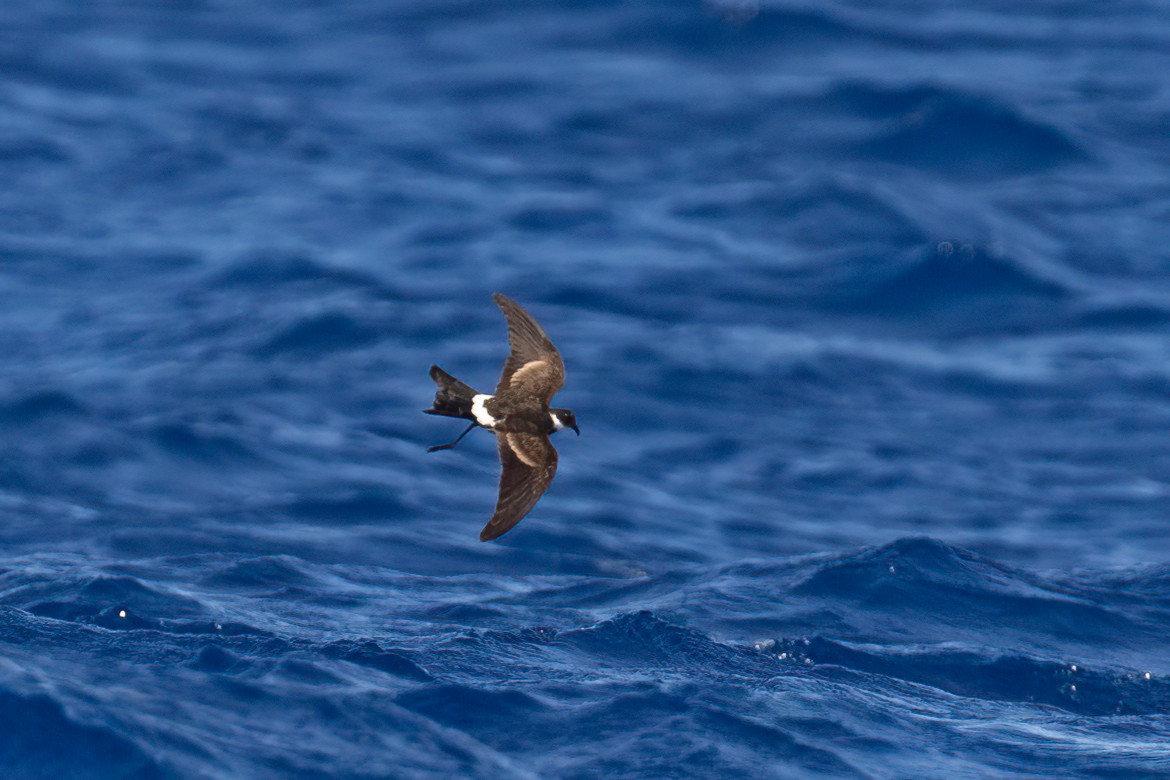
Mega. Sighted on three relatively brief occasions over a 10-minute period. First detected approximately 100 m behind the stationary vessel, about 100 m off the berley trail, and observed for perhaps 20 seconds as it flew into the berley trail before being lost from sight behind a swell. Not seen again for another five minutes or so, when it reappeared at much the same distance, providing slightly better views as it bounded across the sea surface several times before again disappearing. On the third occasion, it was approximately 60 m off the stern, again appearing suddenly near the berley trail and moving out to the starboard side before vanishing from view. An obviously large storm-petrel, perhaps 20% larger than the next-largest storm-petrel present (New Caledonian Storm-Petrel), which it was seen adjacent to on several occasions. While large, it wasn’t necessarily 'huge' and was smaller than one observer (RHC) had expected. Mostly blackish-brown above, with an obvious crescent-shaped white rump. The only other notable feature of the upperparts was thin, curved covert bar formed by pale tips of the greater secondary coverts. Below, an otherwise blackish hood was interrupted by a distinct and obvious white throat. Below the hood (or breast band, given the extent of the white throat patch), the body was mostly white, with distinct dark streaking, especially on the flanks. The vent and undertail were blackish. Wings were broad and triangular. The tail was perhaps less striking than expected, as many rectrices were only half-grown (this perhaps also influenced perception of size). The bird showed a lazy flight style, swinging from side to side, offering alternate views of the upperparts and underparts. Flight was interspersed with bounding actions, with the bird kicking off the sea surface using paired feet, one foot held slightly more forward than the other (as in New Caledonian Storm-Petrel). Photos.
技术信息
- 尺寸
- 1170 pixels x 780 pixels
- 原始文件大小
- 969.69 KB