

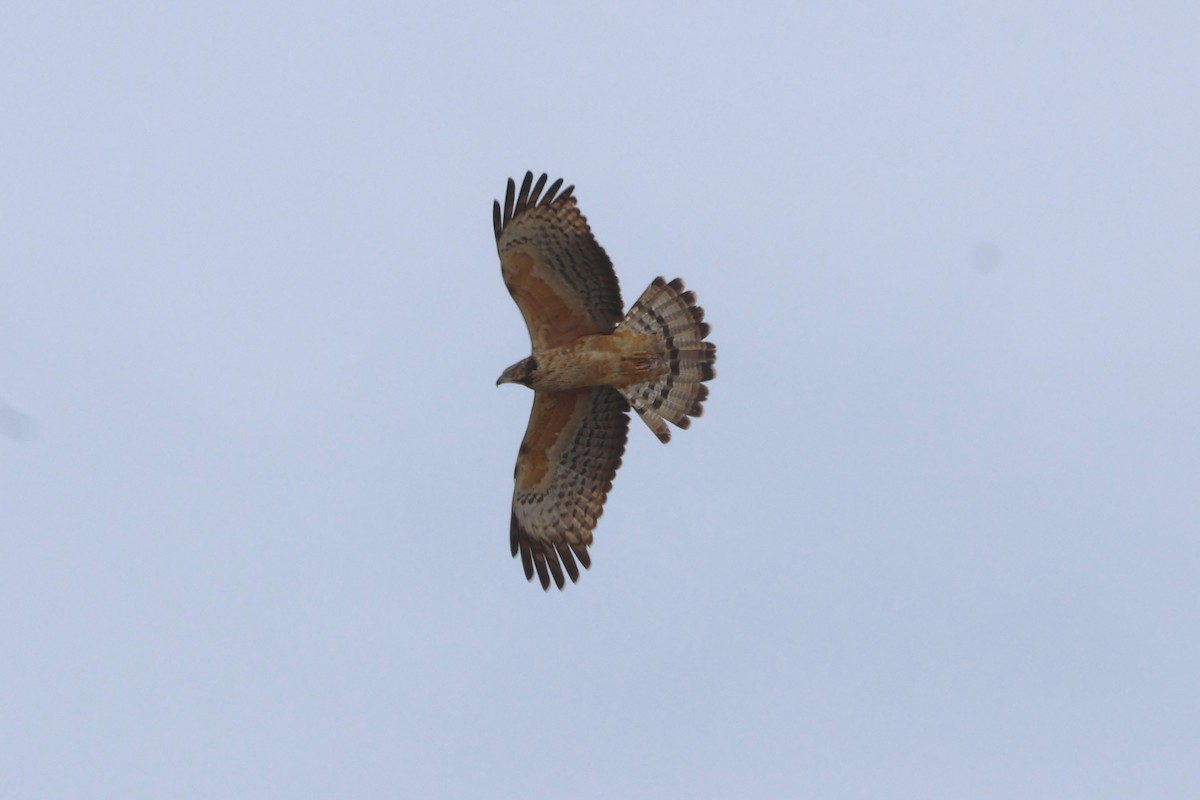
ML621190696
作者
日期
地点
- 年龄
- 未说明
- 性别
- 未说明
观察细节
First North American Record. This bird was seen twice on Memorial Day. The first sighting occurred at the cormorant colony just west of the North Beach Bench. The bird seemed to come off the ground in the cove and circle to gain altitude before moving west along the bluff. While gaining altitude, every cormorant came off their nests and every gull in the area began swarming and calling around the honey-buzzard, clearly disturbed with its presence. We hastily followed the bird as it moved down the bluff into Two Mile Cove where it perched high on the bluff. The bird then flushed again to the west and flew along the top of the bluff until it turned south after it passed North Point. A few hours later, while ZP was checking the bluffs around McDonald Point (which can be productive in the current wind conditions), ZP flushed the honey-buzzard which was hiding in a small cove. Prior to flushing, a Song Sparrow was incessantly alarm calling at it, again, no bid enjoyed its presence. After flushing, it immediately tuned North and out of view for ZP but flew past BB, who was above 50-calibur Beach, and landed on the road at the East Quarry. While the initial sighting was a bit chaotic, we identified the bird as an Oriental Honey-buzzard (P. ptilorhynchus) (Temminck, 1821) as it circled in front of us giving us both dorsal and ventral views. The longish-tailed, small-headed, appearance is diagnostic to this genus, with Oriental Honey-buzzard being the most likely given its distribution and migratory tendencies. However, to ignore probabilities and likeliness, we will eliminate the other Perins species. Honey-buzzards are known for the extensive plumage variation and variation in age and sex. The lack of a prominent dark-tipped secondaries suggests a second-year bird. The non-migratory Sulawesi Honey-buzzard (P. celebensis) Wallace, 1868 and Philippine Honey-buzzards (P. steerei) Sclater, 1919, which were once conspecific with P. celebensis, of SE Asia can be eliminated on plumage. P. steerei can show a plain, unbarred breast and belly, but it is paler and/or blotchier than the clean, uniform orange-rufous undersides of the Shemya honey-buzzard. P steeri also usually show thinner sub-terminal tail bars and more extensive and prominent streaking on the upper-breast (unlike the throat “bordering” on the Shemya honey-buzzard). P. celebensis appears to usually have extensive throat streaking and belly barring or paler undersides like P. celebensis. The migratory European Honey-buzzards (P. apivorus) poses a greater identification challenge with Oriental Honey-buzzard. Given the two species more recently observed zone of overlap in winter and migration and hybridization, there has been more extensive discussions on separating the two and dealing with possible hybrids. Structurally, the prominent six primaries (the six-fingered man) on the Shemya honey-buzzard indicates Oriental as opposed the five prominent primaries on the European Honey-buzzard. The clean rufous-orange undersides extending into the carpal patch (not a dark carpal patch) and heavily barred secondaries is also indicative of Oriental Honey-buzzard. This bird likely originated from Japan or SE Russia which suggests P. ptilorhynchus orientalis Taczanowski, 1891.
技术信息
- 型号
- Canon EOS R7
- ISO
- 100
- 焦距
- 400 mm
- 闪光
- Flash did not fire
- 光圈
- f/13.0
- 快门速度
- 1/250 sec
- 尺寸
- 3131 pixels x 2087 pixels
- 原始文件大小
- 474.22 KB