

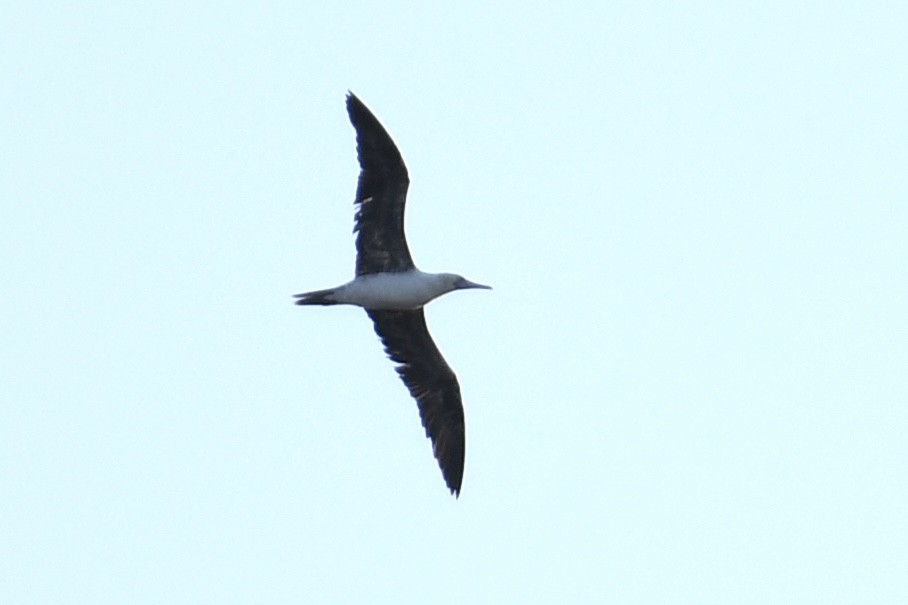
ML622804352
Участник
Дата
Местоположение
- Возраст
- Не указано
- Пол
- Не указано
Подробности наблюдения
I have never been so happy to have woken up for a rooftop stakeout. Initially spotted circling to the immediate north of my building, just above the apartment complex across Astoria Boulevard, at 6:58. Appeared deceptively gull-like at first glance due to its trim build and slender wings, until it banked and revealed the unmistakable pointed head of a sulid. Expletives flowed freely as I hurried to document the bird while it gradually drifted northeast, disappearing out of sight behind a building. I knew in my heart what I believed this bird to be, but I still took pains to rule out all potential confusion species. Special consideration was given to Northern Gannet, our only truly expected local representative of the booby family, which would still be a notably unusual sight at this location and time of year. The structure, plumage, and flight action of this bird just didn’t match up with the familiar aspect of a gannet. The combination of pale body plumage and dark underwings was at odds with the documented range of variation for all age classes. My bird was also far daintier and more delicate, with lighter, easier flight than the lumbering movement of a burly gannet. The most likely vagrant, Brown Booby, was quickly ruled out by the whitish coloration of the head and body and the wholly dark underwings, as well as details of overall structure. Masked Booby, which has not yet been documented in New York State, shows extensive white on the underwings in all plumages and was thus swiftly discounted as a possibility. The pale body, dark underwings, and slim build of this individual are at odds with all other species in the family Sulidae, with the exception of subadult white morph Red-footed Booby. Although this pantropical seabird is rare in the continental United States, the species seems to be having a bit of a moment, perhaps following in the northbound footsteps of Brown Booby before it. Recent years have produced bewildering inland records from New Jersey, Missouri, North Carolina, and Louisiana, with Maine and Massachusetts also picking up first state records from coastal locations in 2023 and 2022, respectively. 2024 has seen a handful of records along both coasts, including birds in Washington, California, and Florida. Most recently, a sighting from Turkey Point, Maryland by Aaron Reb yesterday morning appears to have involved the exact same individual! Details of plumage patterns and feather wear appear to be consistent between both records, meaning the bird covered roughly 150 mile straight line distance in just about 24 hours. Vagrants never cease to surprise! Pending first New York State record and first Queens County record. World lifer for me, and an apartment bird (#126) for the ages. Details submitted to NYSARC. Words cannot adequately express just how thrilled I am to have seen my over 237 cumulative hours of skywatches on the roof pay off in such a spectacular fashion. Peak yardbirding. Birds are incredible!
Техническая информация
- Модель
- NIKON D7500
- ISO
- 320
- Фокусное расстояние
- 500 mm
- Вспышка
- Flash did not fire
- Диафрагма
- f/5.6
- Выдержка
- 1/800 sec
- Размеры
- 908 pixels x 605 pixels
- Исходный размер файла
- 60.08 KB