

ML62859281
Colaborador
Data
Localização
- Idade
- Não especificado
- Sexo
- Não especificado
- Etiquetas
- Ovo(s); Nenhuma ave
Notas sobre o média
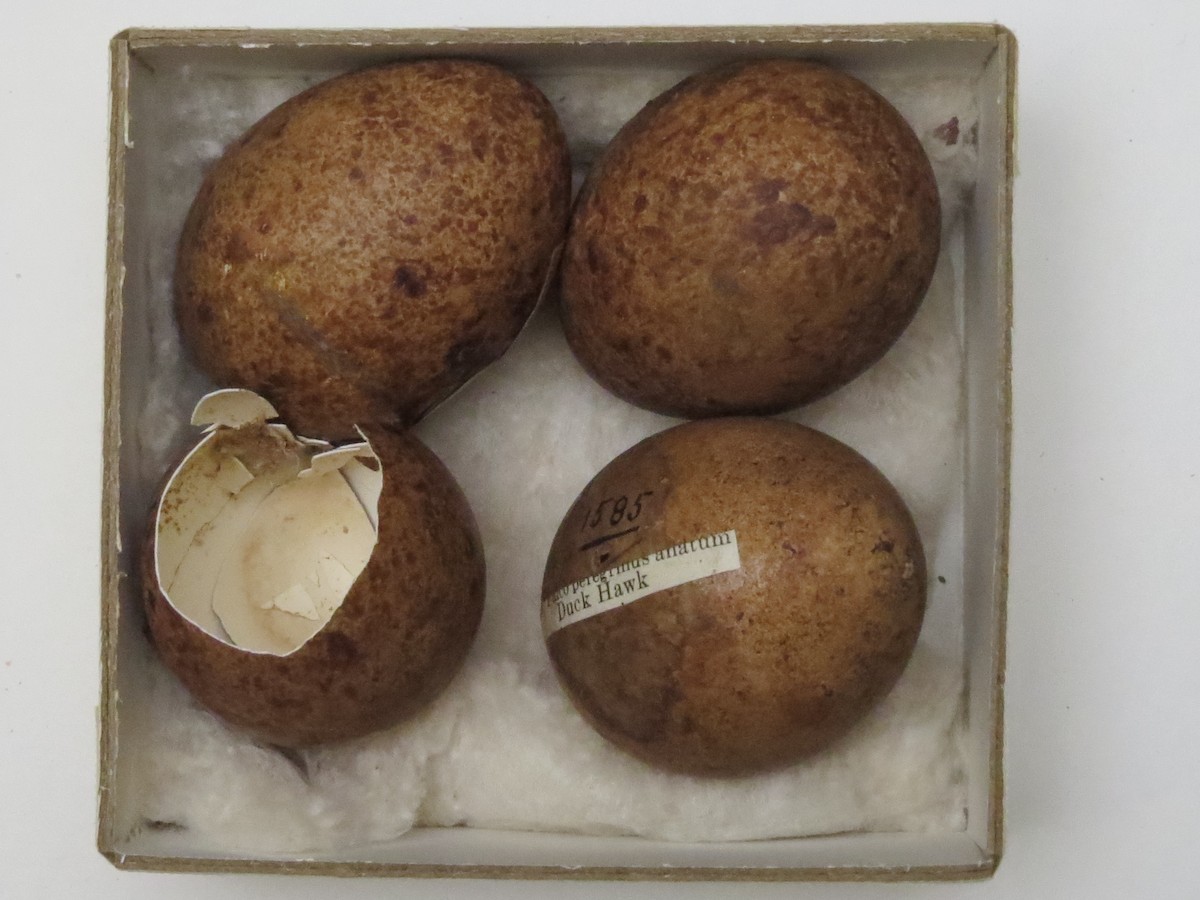
Peregrine Falcon eggs in the collection of the Royal Ontario Museum, #501573.
Detalhes da observação
Original observer: Percy Taverner. Source: Ornithological Notes maintained by Percy Taverner. "May 16 1898 Located the nest on Crown Island again not far from the old one described before. It contained one egg which I foolishly blew and returned to the nest. This nest was much more accessible than the other one and was reached by climbing down the cliff from the top. The ledge was about two feet wide and four feet long and the nest proper was merely a smooth space brushed in the soil that lodged there. Remains of prey were plentiful about this and adjoining ledges. I recognized bones of red squirrels and feathers of blue jays which seem to be their staple article of diet, crow, flicker, and Pileated woodpecker were in evidence in the debris and an adjoining spur of rock was covered with the feathers of a ruffed grouse, a bird much larger than the hawk and which must have been carried some distance." On 20 May Taverner found two eggs in the nest, but the one he had blown was no longer there. On 23 May, he found a full set of eggs, "four beautifully marked ones. In fact all the eggs I have seen from these birds have been of the same heavy, rich markings. Sold them to Fred Dippie but they got broken in transit." In his Ornithological Journal he noted that he also took a photo of the nest. Taverner makes no further reference in his Notes to the Muskoka birds or their nest. There is a set of four eggs in the collection of the Royal Ontario Museum, #501573, which were collected by Taverner, but the collection tag reads "May 24 1899" as the date of collection. A number of historical breeding sites have been documented in Muskoka, including Crown Island, Devil's Face (an 80 foot high cliff) on Skeleton Lake, Honey Harbour, Port Sydney, Echo Rock (a high escarpment) on Solitaire Lake, Fairy Lake, and at least two different sites on Lake of Bays. The Devil's Face on Skeleton Lake was an active nest site for at least 80 years, with a pair of Peregrines using it until 1962. The following year a pair of Common Ravens took up residence (Mills 1981). Historically this falcon nested on cliffs in remote areas near water and in forested areas (Sandilands 2005). It was eradicated as a breeder in Ontario by 1963 because of the effects of DDT and other pesticides. Nesting reoccurred in Ontario in 1986, and the present cliff breeding range is similar to the known historical range, but there are noticeable exceptions, particularly in the southern Shield Region, where the known range has not been reoccupied (Armstrong 2007 Ontario Breeding Bird Atlas).
Informação técnica
- Modelo
- Canon PowerShot SX50 HS
- ISO
- 1600
- Distancia focal
- 10.7 mm
- Flash
- Flash did not fire, auto
- f-stop
- f/8.0
- Velocidade do obturador
- 1/60 sec
- Dimensões
- 4000 pixels x 3000 pixels
- Tamanho do ficheiro original
- 2.35 MB