

ML121350891
Bidragsyter
Dato
Lokalitet
- Alder
- Ikke spesifisert
- Kjønn
- Ikke spesifisert
Kommentarer
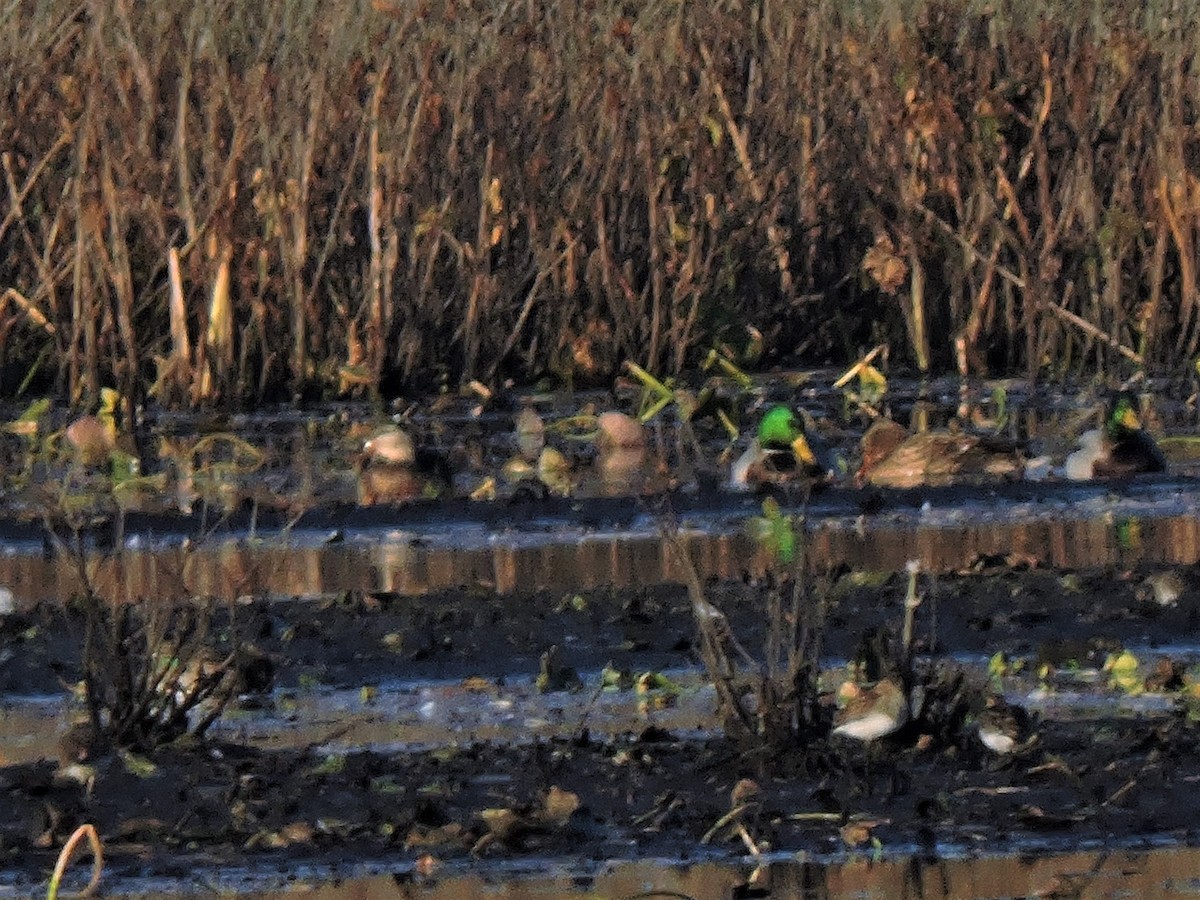
The two at rest at the lower right, with the one showing the dark breastband. Yellow top of leg can be seen against the white belly, with the rest of the leg obscured by the rib-like skeleton of the dark vegetation.
Observasjonsdetaljer
FRS, submitted 10.30.18 Oh goodie. Another rare shorebird at this location. These had a dark upper chestband that abruptly ended in the lower chest and a noticeable white stripe running down the back below/along the scapulars. Close to the size of the Killdeer they were near and larger than the Dunlin foraging on the mudflat behind them. Why are Pectorals rare in St. Joseph County for this week? As shown in the comments both the Pectoral's Frequency and Abundance for this week, for the years 1900-2017, are higher than those of Greater Yellowlegs and Red-necked Grebe (two species which are not listed as Rare on the checklist). Why is a species that is found relatively more often (Frequency) and in higher numbers (Abundance) than non-rare species considered rare? And why does one Red-necked Grebe in 117 years confer non-rarity to that species? And why is White-rumped Sandpiper, which has a higher Abundance than Pectoral Sandpiper, Greater Yellowlegs and Red-necked Grebe and the same Frequency as Greater Yellowlegs and Red-necked Grebe, considered rare this week? Even when you combine Elkhart County with St. Joseph the Pectoral has a higher Frequency and Abundance than both Greater Yellowlegs and Red-necked Grebe for the week of 10.22.1900-2017. The White-rumped has a higher Abundance than both and a Frequency equal to Greater Yellowlegs and higher than Red-necked Grebe. Both birds were mainly resting on the mudflat near some Killdeer.
Teknisk informasjon
- Model
- COOLPIX P600
- ISO
- 140
- Focal length
- 928.8 mm
- Flash
- Flash did not fire, auto
- f-stop
- f/6.5
- Shutter speed
- 1/250 sec
- Dimensions
- 3264 pixels x 2448 pixels
- Original file size
- 1.7 MB