

ML646037297
Хувь нэмрээ оруулагч
Огноо
Байршил
- Нас ба хүйс
- Насанд хүрээгүй Эм - 1
Медиа тэмдэглэл
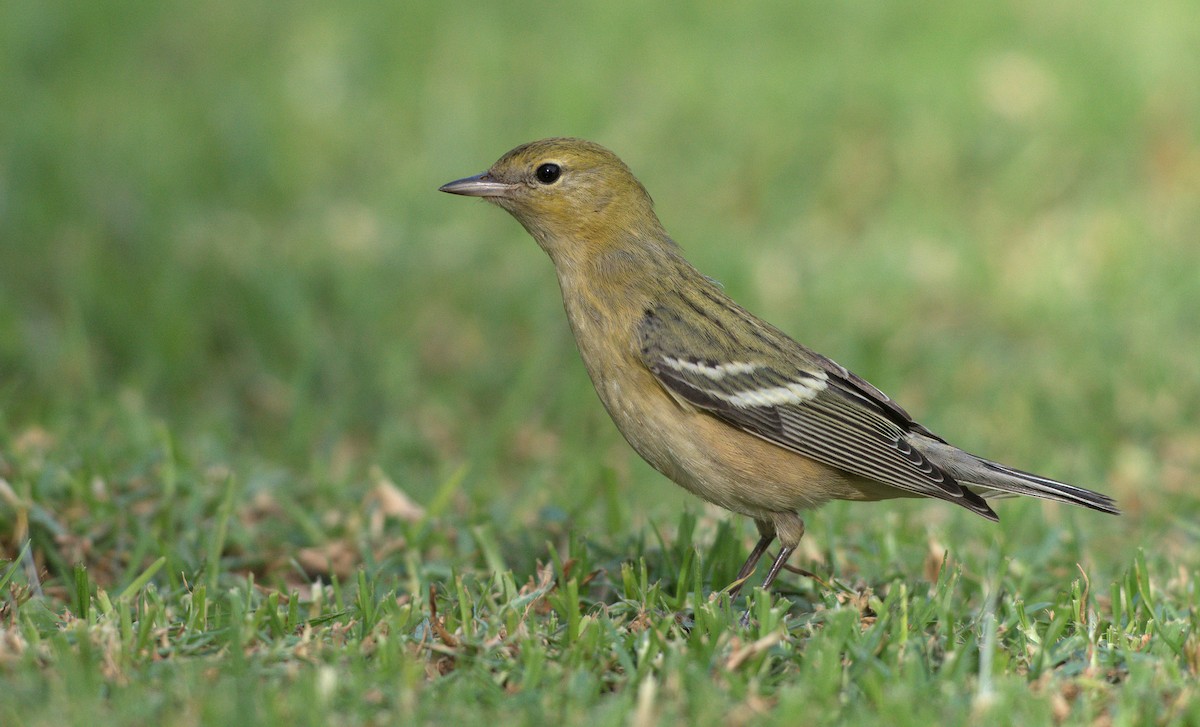
Continuing female Bay-breasted Warbler, present since initially found the previous day, here photographed on 27 November 2025 at Huntington Central Park, Huntington Beach, Orange County, California.
Ажиглалтын дэлгэрэнгүй
Daniels alerted me to the presence of the continuing warbler as I was rounding the east end of the “Island,” after which I joined him, and later Wurster, Auzins, and a few others observing this bird as it foraged on the lawn. Although the warbler flew up into the lower branches of the trees bordering the southern edge of the island, it spent most of its time foraging on the lawn, at times in loose association with one or two Yellow-rumped Warblers. This bird permitted an incredibly close approach, and its confiding behavior while foraging in the open on the lawn reminded me of that of a Canada Warbler at Harbor Regional Park that behaved similarly until it was seen being taken by a passing Merlin. I spent most of my time with this bird taking photos, but I also studied it relatively carefully through binoculars. Despite my spending at least a moderate period of time with this bird, I never heard it vocalize. This was a medium-sized warbler that appeared to be maybe just slightly smaller than the Yellow-rumped Warblers, yet with a shorter tail and more brightly colored plumage. The bill was of medium size for a warbler, and tapering from a base of medium depth to a pointed tip along a culmen that was straight or maybe very subtly decurved. I further thought the bill was not as finely pointed as are those of some warblers, and also that it would have extended backward across the face to a point behind the auriculars, but seemingly not quite as far back as their rear terminus. The forehead was weakly sloping and the crown was more gently rounded than that of a Yellow-rumped Warbler, but on a head that seemed similar in size relative to the body. The neck was short and inconspicuous, and the body was plump, full-chested, and with a posture when the bird was both foraging on the lawn and perched on a branch in a nearby tree that appeared to be maybe not quite as upright as diagonal with the tail generally held downward in the plane of the body, but it was also cocked weakly upward at times. The wings were relatively long, with a primary projection that appeared to be roughly comparable to the entire length of the exposed secondaries, and what I thought were the tips of at least size primaries visible behind the longest secondary in a long, tapered wingtip that I thought reached beyond the tips of the uppertail coverts. I did not study the tail as carefully as I probably should have, but my impression was it was relatively short, and seemingly comparable in length to the body without head and neck. I also thought it was parallel-sided to slightly flared and with a jagged tip, but it would be good to check my photos for confirmation of my impressions of the tail structure. Moreover, given that I saw this bird mostly on the lawn, I was unable to assess the length and shape of the undertail coverts. The legs were at least moderately long and slim, but I failed to notice in the field any further detail on the structure of the legs or feet. This was a relatively colorful and well-marked bird, yet for a Bay-breasted Warbler, its coloration was rather muted. The forehead, crown, and back, and sides of the neck were a reasonably bright shade of olive-green, but without obvious markings on the crown. The face pattern was also rather weak, with no more than a diffuse and inconspicuous supercilium that was only subtly lighter and a more yellowish-green than the crown. I did not think the lores were conspicuously darker than the rest of the face, but I could see a diffuse crescent of yellowish below the eye that was only marginally more conspicuous than the supercilium. The auriculars were about the same shade of olive-green as the crown, and I thought this same color extended forward below the eye to weakly demarcate the above-noted crescent. I thought the darker green of the face and auriculars blended into the paler and dingy-yellow to pale buff color that characterized the throat and the center of the breast, with the latter being especially pale, but I cannot now recall exactly where the line of demarcation was found on the lower part of the face. The sides of the breast were a bit dinger and more grayish than the center of the breast, but the flanks were washed with a rich-buff color that contrasted conspicuously with a more whitish belly despite lacking the clear rufous or bay tones that I associate with young males of the species. When the bird tipped up while on the lawn, I noted that the buff color of the rear flanks extended across the vent region, but also that the undertail coverts were mostly rather white beyond the vent. I never clearly saw the underside of the tail, yet I thought there were white tail-spots to at least some degree. Returning to the upperparts, the back appeared to be about the same shade of greenish-olive as the crown, but the back and sides of the neck appeared to contrast as subtly more grayish, and unlike the crown, the back was conspicuously streaked darker, and with the streaks dusky and at least relatively well-defined. The rump appeared to be about the same color as the back, but it lacked streaking, and the uppertail coverts further contrasted as a medium to dark gray, and possibly with darker shaft-stripes. I did not study the tail as carefully as I wanted, but what I did see was that the rectrices were slate-gray to blackish, but with lighter gray edges that gave the closed tail a striped pattern. I also once saw a moderate amount of white on the inner web of one of the outer feathers when the bird spread its tail. The wings were boldly marked and generally with sooty-gray to blackish centers that contrasted sharply with paler fringes. On the median coverts, I noted black centers that contrasted sharply with broad fringes of white that curved slightly around the tips to create a slightly wavy, upper wingbar. The more elongate greater coverts had similarly dark centers that contrasted sharply with white tips that may have been subtly narrower than those on the median coverts, but also with very narrow edges of light gray that created a pattern of fine striping between the wingbars. The primary coverts stood out as a darker wedge along the leading edge of the closed wing, but again, the mostly blackish feathers appeared to have very narrow edges, and possibly tips, that were whitish to light gray and difficult to see except from close range. The remiges were similarly colored, and again with sooty-gray to dull blackish centers that contrasted sharply with whitish to light gray fringes. On the innermost secondaries, the fringes appeared to be white and somewhat broader than those on the other feathers, but I cannot now recall if they curved around the tips of the feathers. On the remaining remiges, the edges appeared to be narrow, sharply demarcated, and generally light gray, though seemingly with a very subtle olive cast. Further apparent was that the exposed primary tips had similar fringes of light gray that extended the length of the outer edge and around the tip of each feather, which facilitated my differentiation of the various feathers in the wingtip. The upper mandible was mostly blackish, but the lower mandible was paler though I cannot now recall the precise color, or if this paler color also extended along the cutting edge of the upper mandible. The eyes were dark, and at least once I thought I could see brown tones to the irides. The legs and feet were a shade of dark gray that would reasonably be treated as slate-gray, if not even a bit darker.
Техникийн мэдээлэл
- Загвар
- ILCE-7RM5
- Дуран
- FE 400-800mm F6.3-8 G OSS
- ISO
- 800
- Дурангын урт
- 693 mm
- Гэрэл цацруулагч
- Flash did not fire
- Өрцний тоо
- f/8.0
- Өрцний хурд
- 1/800 sec
- Хэмжээсүүд
- 5769 pixels x 3493 pixels
- Анхны файлын хэмжээ
- 20.32 MB