

ML646886851
投稿者
日付
場所
- 年齢
- 指定なし
- 性別
- 指定なし
視聴覚メディア・ノート
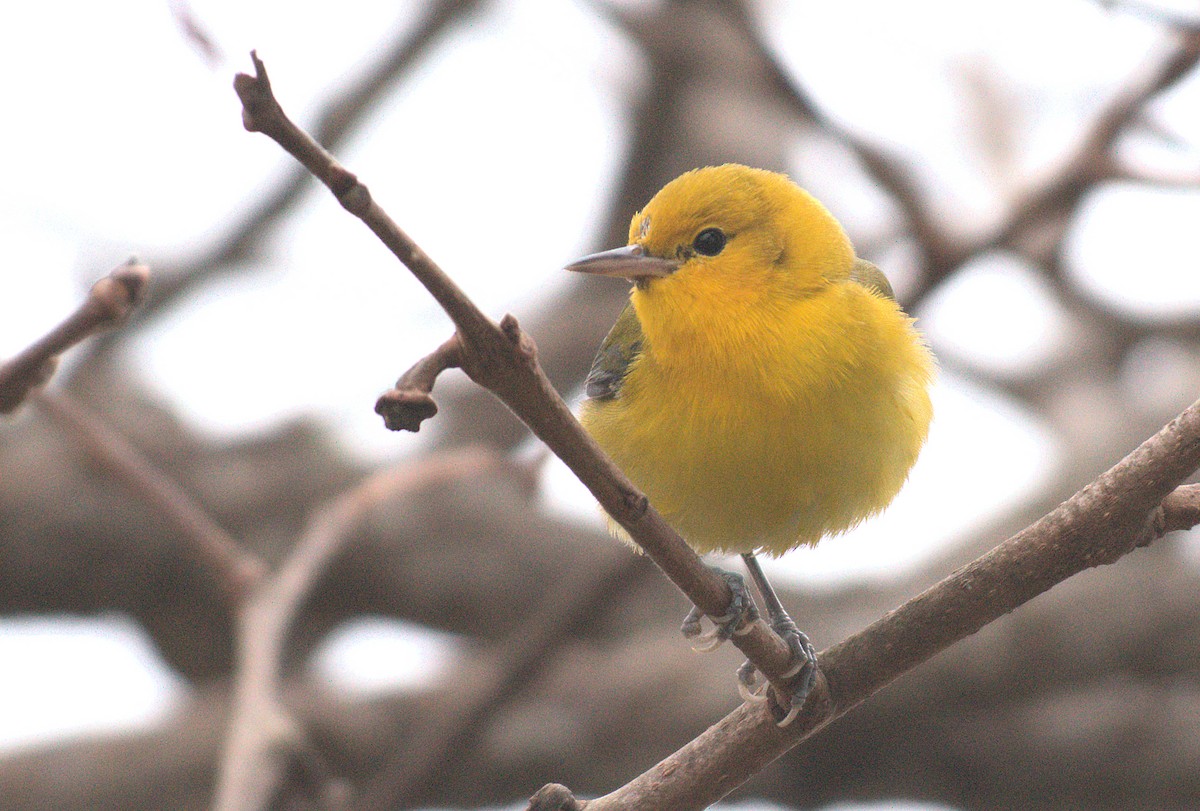
Continuing Prothonotary Warbler, likely a female, present since initially found on 7 December 2025 by Eric Culbertson, here photographed by Curtis A. Marantz on 13 December 2025 in Carpinteria, Santa Barbara County, California.
観察結果の詳細
Although Ballard had seen the continuing warbler shortly before I arrived, it took me a few minutes to locate the bird foraging high amid the foliage of the large Tipuana tipu tree over the southeastern corner of the public parking lot off Cactus Lane. We then followed this bird as it foraged mostly amid the middle and upper branches in this one large tree, but also briefly visited a nearby tipu tree and it twice dropped into a leafless tree in an adjacent backyard that looked like it was probably a persimmon tree, albeit one that lacked fruit. When in the tipu tree, this bird moved almost constantly, yet it was also rather sluggish and not as active as the Yellow-rumped or Townsend’s Warblers that were also in the same tree. When in the tipu tree, the warbler was rarely fully in the open, in that it was usually obscured at least in part by the foliage, but when we saw the bird in the persimmon, it was fully in the open and much lower and closer, which facilitated my getting much better photos. This bird was generally silent, but I once heard it give a clear, “swiip” call when it flew between trees. This was a relatively large warbler that may not have been any longer overall than the Yellow-rumped Warblers, but it clearly had a larger bill and head, a plumper body, and a shorter tail. More specifically, this bird had a notably large bill for a warbler, in that it would have extended backward on the face to the rear edge of the auriculars, if not slightly beyond. I further thought the bill tapered from a base of medium depth to a sharply pointed tip along a culmen that was smoothly, yet only very subtly decurved, though the bill as a whole did not appear to be decurved. The forehead was sloping and the crown was smoothly rounded, both on a head that appeared larger than those of the other warblers. The neck was short and quote stocky, and the body was plump, full-chested, and seemingly with a posture that was approximately midway between horizontal and diagonal with the tail held downward in the plane of the body, at least when the bird perched not much above eye level in the persimmon tree. I did however see it bending down when in the tipu tree, and given that it was high overhead when in this tree, I was unable to see its posture. The wings were quite long, with a primary projection that appeared to be two-thirds to three-quarters the length of the exposed secondaries, yet the tapered wingtips seemed to fall just short of the tips of the undertail coverts. I also thought at one point that I could see the tips of five or possibly six primaries extending beyond the longest secondary in the tapered wingtip, but I could not really see where the wingtips fell relative to the uppertail coverts. The tail was relatively short, yet I still thought it was about as long as the body without the head, and I noted that it was rather broad for a warbler, yet still seemingly parallel-sided, and with a jagged tip. I further noted that the undertail coverts were quite long, and seemingly reaching more than three-quarters of the way out the tail, though this was difficult to see well. The legs were of unremarkable length for an arboreal warbler, but they seemed to be stouter than those of the other warblers. This was a brightly colored bird, but its plumage patterns lacked strong contrast, and even though it appeared rather dull for this species when high above in the tipu, my photos of it in the persimmon appear to show that it was more brightly colored than I thought in the field. When studied in the field, this bird appeared to have the forehead, crown, nape, back and sides of the neck, and the entire face a bright, lime-green to yellowish-green in color, and lacking any internal markings. The dark eye therefore stood out amid a blank face. I further noted that the green color of the face continued down through the submoustachial region before blending into a bright yellow throat that had golden tones. Although what I saw on the bird when I studied it in the tipu tree, was as described above, my photos of the bird in the persimmon tree appear to show the entire head as a more golden-yellow color that contrasted as much or more with the green back than the yellow throat, which if accurate, would suggest that this bird was a male and not a female. As far as I could determine, the throat, breast, and sides were the same, golden-yellow in coloration, but the flanks were a bit duller shade of yellow and with even a somewhat dingy appearance even though at least some yellow tones were apparent back through the rear flanks and even as a diffuse wash across the vent region. The bright yellow faded to a paler yellow by the upper belly, but the lower belly was white, as were the undertail coverts. The underside of the tail was white centrally, but with a narrow frame of black that was probably limited to the outer webs on the outermost rectrices. I as unsure, however, if the black curved around the tip to pinch off the white in the center, but if it did so, I think it did only narrowly. Returning to the upperparts, the more yellowish-green of the crown and back and sides of the neck blended into a more purely lime-green on the mantle and scapulars, but this green merged relatively abruptly with a bluish-gray color on the rump. The upperside of the tail appeared to be sooty-gray to blackish, but with diffuse fringes of light gray, or bluish-gray that gave the tail a subtly striped to frosted appearance. I had a hard time distinguishing the various feather tracts on the wings, but I di not think I ever saw the lesser coverts. My impression was that the median coverts were at least partially visible, and I thought they were either green or washed with green. The greater coverts were clearly a bluish-gray in color and at times I thought I could see a weak contrast between darker inner webs and lighter outer webs, but it is possible that the contrast that I saw instead represented shading. I cannot recall seeing clearly the primary coverts. The remiges clearly contrasted darker and more dusky centers with fringes that were bluish-gray, if not grayish-blue, that were broader and more diffuse on the innermost secondaries, but narrower and better-defined on the remaining remiges, and with no obvious contrast between the primaries and secondaries. The exposed primary tips were quite dusky, yet I saw narrow, yet well-defined, fringes of light gray that allowed me to distinguish the various feathers in the wingtip. I thought the upper mandible was mostly blackish, but with the cutting edges contrasting as quite pale and seemingly flesh-colored. The lower mandible, by contrast, was mostly, if not entirely, a light, flesh color, though it is possible that the very tip was darker. The eyes were certainly dark, and contrasting sharply with the golden-yellow plumage of the face, but I could not see in the field the precise color of the irides. As far as I could determine, both the legs and feet were black.
テクニカル・インフォメーション
- モデル
- ILCE-7RM5
- レンズ
- FE 400-800mm F6.3-8 G OSS
- ISO
- 1600
- 焦点距離
- 800 mm
- フラッシュ
- Flash did not fire
- Fストップ
- f/8.0
- シャッタースピード
- 1/640 sec
- 大きさ
- 2929 pixels x 1980 pixels
- オリジナルのファイルサイズ
- 8.65 MB