

ML609984804
Tufted Duck x Lesser Scaup (hybrid) Aythya fuligula x affinis
יוצר
תאריך
מיקום
- גיל וזוויג
- זכר בוגר - 1
פרטי השורה
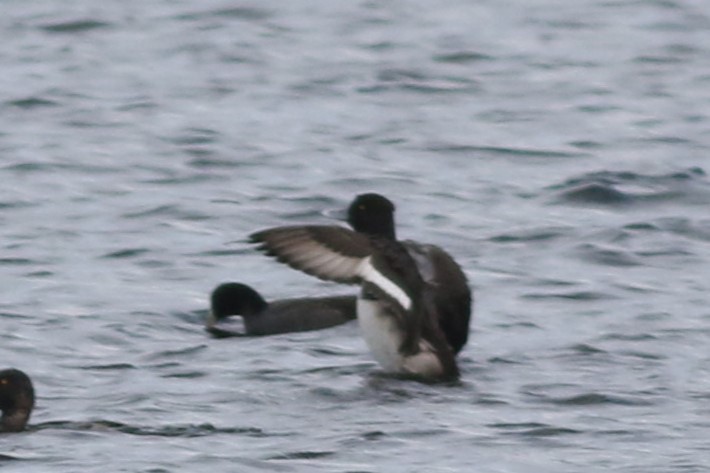
**very rare; originally found by Ben Peters (also thank you to Sebastian Jones for helping to solve this confusing ID). The bird is an adult male in prebasic molt (it appears to be almost fully in basic plumage) by the bright yellow irides and overall black head and body. Younger males would have browner irides and browner head and body in October per Pyle’s Identification Guide to North American Birds. The back is dark gray, contrasting noticeably with the black breast. Pure Tufted Duck would have black feathers here, as would TUDU x Ring-necked Duck in all examples I’ve seen. The dark gray coloration present is consistent with TUDU x Scaup sp. hybrids, though perhaps it is slightly darker on this bird (this darker appearance may just be due to the leftover brown feathers from alternate plumage). Compare with examples of TUDU: ML409653691, ML609818670 The "tuft" itself is short, compact, and regular, as if someone extended the crest of a Scaup or RNDU outward slightly. Pure TUDU would have wispy, hair-like, and often messier feathers that make up the tuft. Many birders argue that TUDU can have shorter tufts, which is true, but the length of the tuft is largely unimportant; the structure of the tuft is what is helpful when determining if an individual is a hybrid or not. Compare with examples of TUDU: ML275492221, ML609892078 Compare with examples of TUDU x Scaup sp.: ML395643061, ML521368671, ML438417451 The “tuft” and part of the crown are browner overall than the rest of the head. The head itself has a greenish iridescence. Iridescence in ducks is variable, especially in hybrids, and is often unhelpful in species ID. There is an area of browner feathers around the base of the neck which I assume to be leftover from alternate plumage. This area of brown seemed oddly consistent with the placement of the iridescent “ring” on RNDU, but upon a quick search of the Macaulay Library I was able to find similar examples in LESC: ML384527021, ML274996331 The bill is unusual to me. The nail at the end of the bill is extremely thin, and the black is restricted to the nail itself which seems very consistent with LESC. TUDU appear to have more black and possibly a wider nail. RNDU certainly have much more black and possibly a wider nail. The end of the bill has extensive white which seems consistent with RNDU (and possibly LESC x TUDU?), though probably not impossible for TUDU and LESC. The bill is small and thin overall. In the field and after reviewing photos, I thought that the base of the upper mandible had thin white/pale lines along the edge. Sam Zhang viewed the bird in better lighting on 10/16 and messaged me "I believe the pale edged look to the bill base is caused by specular reflections. The top of the culmen where it meets the bird’s forehead is at a different angle from the rest of the bill, causing that tiny bit of glare even in soft sunlight." I think this makes sense and seems to be apparent when viewing his photos (S152455046). The coloration of the bill tip is not consistent with any RNDU x TUDU that I can find examples of: ML117822431, ML252434731, ML94159041, ML579597971, ML309995351. The bird seems fairly big-headed, though slightly bulkier than nearby RNDU. It doesn’t quite give me the impression of a scaup in person as much as it did in some of the photos I’d seen. The flanks, although messy from molt, are paler than nearby RNDU. The white of the foreflanks doesn’t jut upwards just before the breast as it does on RNDU and many RNDU x TUDU. The area where the flanks meet the breast is fairly messy though, so maybe a clearer pattern will emerge if this bird stays long enough to be fully in its basic plumage. Many RNDU x TUDU seem to show darker gray on the flanks than this bird does. While the primaries are significantly darker than the secondaries, they still seem whiter than I would expect on pure LESC (compare: ML135168761, ML314923251, ML333947841). However, this doesn't seem entirely atypical for LESC x TUDU (compare: ML215226591, ML220692361). The primaries appear too pale for TUDU. This isn't perfectly apparent in my photos due to lighting, but see S152256069 (compare: ML211724981, ML107670491, ML518331041, ML469872451). The primaries and secondaries are whiter than on RNDU (compare: ML147359561, ML422741121, ML84478921) and I’m not aware of any spread-wing photos of TUDU x RNDU. Finally, the bird was associating with RNDU and these were the only other Aythya on the pond. While this isn’t necessarily indicative of the bird’s ancestry, I think it’s worth noting here. Overall this is an extremely puzzling bird. Since TUDU as one parent is obvious I will list the features which I believe are in favor of either RNDU or LESC for the other parent: RNDU- associating w/ RNDU, overall proportions(?) LESC- back color, bill nail/tip(?), flank color, spread-wing With the knowledge that the "white" at the base of the upper mandible is just a reflection, the current reasoning for RNDU being involved seems very flimsy. I believe the solution is TUDU x LESC. (Also worth noting that pretty much nothing about this bird fits GRSC or GRSC x TUDU, so I don’t feel the need to consider that at all) Even though there might be a few inconsistencies with TUDU x LESC, I now believe that they are very minor. What I'd previously believed to be white at the base of the upper mandible would've been a major contradiction for TUDU x LESC, but now that that is eliminated I feel that TUDU x LESC is a solid option for this bird. I would love input on this bird from others more knowledgeable about the subject, especially regarding the genetics of certain traits in Aythya if anything is known.
מידע טכני
- מודל
- Canon EOS 7D Mark II
- ISO
- 400
- אורך מוקד
- 400 mm
- פלאש
- Flash did not fire
- צמצם
- f/5.6
- מהירות תריס
- 1/2500 sec
- מימדים
- 710 pixels x 473 pixels
- גודל קובץ מקורי
- 62.65 KB