

ML644397325
Contributeur
Date
Site d'observation
- Âge
- Non précisé
- Sexe
- Non précisé
Détails de l'observation
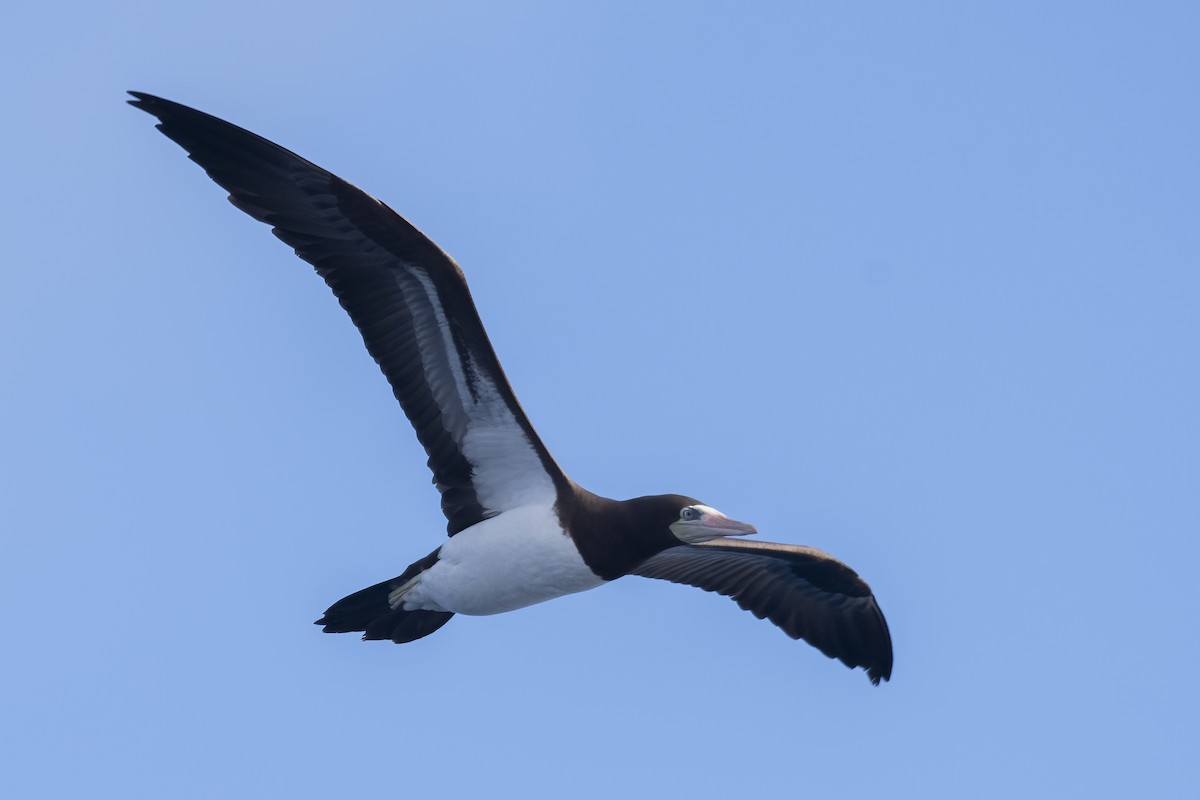
The first of two boobies seen during this period was an adult female that Benson called out when it came in and circled the boat a couple of times before flying off when we were midway between the 279-fathom Bank and Crespi Knoll, 30¼ kilometers southwest of San Mateo Point [33° 13’ 10.5” N, 117° 51’ 01.5” W]. This was the best-seen of the boobies that we encountered today, given its close passes by the boat, but it did not linger for an extended period of time before flying off, so it was difficult to study carefully during this period, especially given that I was trying to get photos of a rapidly moving bird that was circling the boat. I was nevertheless able to see that this was a relatively large seabird that was a bit larger than the gulls, but also with an obviously different shape. The bill was long and conical, tapering from a base that was both wide and deep to a pointed tip along a culmen that was at least relatively straight. I was unable to compare carefully the length of the bill to that of the head, but the two were approximately equal. The head was relatively large and rounded, the neck was of medium length and relatively stout, the body was plump, the tail was moderately long and seemingly tapered, and the wings were notably long, slim, and tapering to pointed tips that were held straight out from the body. I thought the wingbeats were reasonably deep, but the bird spent much of its time gliding as it circled us. On the basis of relatively superficial views, I was further able to see that this bird was mostly a chocolate-brown color about the head, neck, breast, upperparts, and the uppersides of both the wings and the tail. Contrasting with the dark brown of the breast, the belly, flanks, and undertail coverts were gleaming-white and demarcated from the breast sharply along a line that appeared to cut straight across the junction of the breast and belly, and that of the sides and flanks, below which the white underparts were unmarked. The underwings had some white centrally, but also a moderate amount of dark both along the leading edge and seemingly out toward the wingtips, though I was unable to see the pattern more precisely. I thought the bill and facial skin were yellow, or at least yellowish, but I likely would have been unable to discern pink or flesh tones even if they were there, and although I think there was a darker mark before the eye, I cannot recall anything more about it, and I never did see the color of the eyes, legs, or feet. By checking my photos, I was able to confirm both that the bill was distinctly pink and that there was a sharply demarcated wedge of blackish before the eye. Dunn called out a second booby shortly after we saw the first bird, but this bird made only a single pass by the starboard side of the boat and continued south when we were about 31 kilometers southwest of San Mateo Point [33° 12’ 40.6” N, 117° 50’ 58.9” W]. This bird appeared similar to the first individual in its overall size and structure, in that it was larger than the gulls that we had been seeing, and it had the same conical bill, large head, medium-length neck, plump body, tapered tail, and long, slim wings that tapered to pointed tips that were held straight outward from the body. Dunn noted that this was a duller bird than the first, and I agreed that its overall coloration above was a dingier and more grayish shade of brown, but it was still dark brown on the head, neck, upperparts, upperwings, and upperside of the tail, and I noted no obvious contrast, though I did notice an uneven pattern to the upperparts. Like the first bird, this bird’s breast and sides were dark brown, and similar in coloration to the upperparts; however, the belly, flanks, and probably also the undertail coverts were dingy whitish to light gray with dark brown mottling or speckling throughout. I nevertheless noted a relatively sharp demarcation between the uniformly dark breast and the paler and heavily mottled belly, and also that this demarcation appeared to cut straight across the junction of the breast and belly, and that of the sides and flanks. I did not see the underwing pattern overly well, but what I saw appeared to be generally darker than that of the presumed adult female that we saw shortly before. Further apparent was that this bird’s bill and facial skin were a relatively dark gray in coloration. Much as was the case with the first bird, I was unable to see in the field the color of the eyes, and I am not sure I ever saw this bird’s legs or feet.
Informations techniques
- Dimensions
- 3791 pixels x 2527 pixels
- Taille originale du fichier
- 2.76 MB