

ML177569061
Laguntzailea
Data
Kokapena
- Adina
- Zehaztu gabea
- Sexua
- Zehaztu gabea
Behaketaren xehetasunak
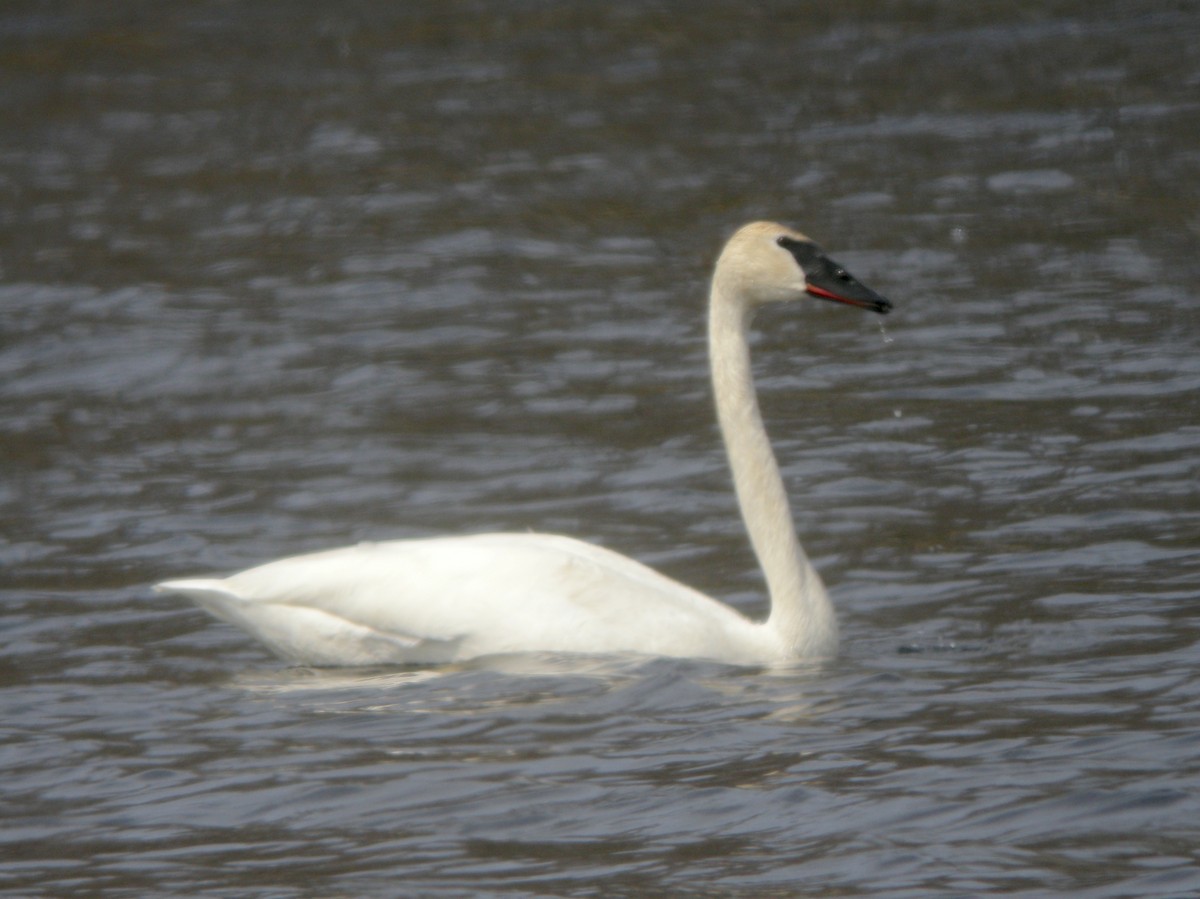
This bird was first reported as a Tundra Swan 8 April. It remained through 15 April. Having been out of town and catching up on this story, I was eager to study this bird today. When I arrived about 1:30 p.m., the swan was actively feeding, and it tipped up much of the time. This offered an opportunity to see the feet. The inner toe of the right foot showed a noticeable greenish-yellow that might have been present on part of the lower leg as well and perhaps the ridge of the middle toe. (I photographed this and got Chuck Homler to try too.) Only Trumpeter Swan shows yellow on its legs and feet as an immature. Tundra Swan has all black legs and feet as a juvenile. Being all white, this swan, if a Trumpeter, had to be older than one year. But given Trumpeter Swans may retain some yellow on the legs and toes until the third year and Tundra Swan legs and feet are entirely black from the outset, I think this character alone eliminates Tundra Swan. Given the bird's immaturity, I think this explains a somewhat puzzling aspect to the only other feature useful in distinguishing Trumpeter and Tundra Swans: the shape of the forehead feathering. In adult Trumpeters, this area is typically a broad 'V' with curved sides. The shape of this feathering develops with age and can be more shallowly curved on young birds, sometimes approaching the broad 'U' typical of Tundra Swan. The less than sharply 'V' shaped feathering on this individual may be individual variation or age related. [As later learned, the missing eye on the left side contributed to the facial shape.] The bill profile shows a classic Trumpeter Swan bill shape and with broad connection to eye. The head shows a peak at the rear crown, also like Trumpeter. Origin: The origin of this bird and those now recorded in Connecticut and Massachusetts is likely from introductions beginning in the late 1980s and 1990s in Ontario and New York. The New York breeders stem in part from a private effort. These are not "reintroductions" to the historic breeding range in a strict sense because it is uncertain if migrants to the Northeast ever occurred with certainty in historical times. The history of these introductions--and controversy over the historic range--are described in articles published the New York State Ornithological Association's journal The Kingbird: Sherony and Bolsinger 2007, Rising 2001, and Carroll and Swift 2000. Connecticut's Avian Records Committee recently dealt with the question of natural occurrence. In that state, there were no definitive records for migrants or wintering birds in historic times, and some recent records from spring have been regarded as of uncertain origin, e.g. December 2000 to January 2001 and spring 2010. In Massachusetts, recent reports, also for spring, have been relegated to a supplemental list. True introductions to the historical breeding range in the upper Midwest, e.g. Wisconsin, have been successful since the 1980s, and a portion of birds there have begun meagre short migrations from Wisconsin to s. Illinois. Whether birds from these introductions could reach Maine and the Northeast is uncertain and seemingly unlikely. That said, movements like this could develop in the more easterly introduced populations, and thus be the source of the Maine bird. Addendum: This bird's damaged and withered left eye allowed it to be tracked on its wanderings from Maine north to Prince Edward Island in May and thence to western Quebec in June.
Informazio teknikoa
- Eredua
- COOLPIX P5100
- ISOa
- 64
- Distantzia fokala
- 18.6 mm
- Flasha
- Flash did not fire, auto
- f-stop
- f/4.8
- Obturadorearen abiadura
- 1/250 sec
- Dimentsioak
- 3514 pixels x 2634 pixels
- Fitxategiaren tamaina originala
- 1.58 MB