

ML646336965
Contribuidor
Fecha
Localidad
- Edad y sexo
- Macho de edad desconocida - 1
Comentarios
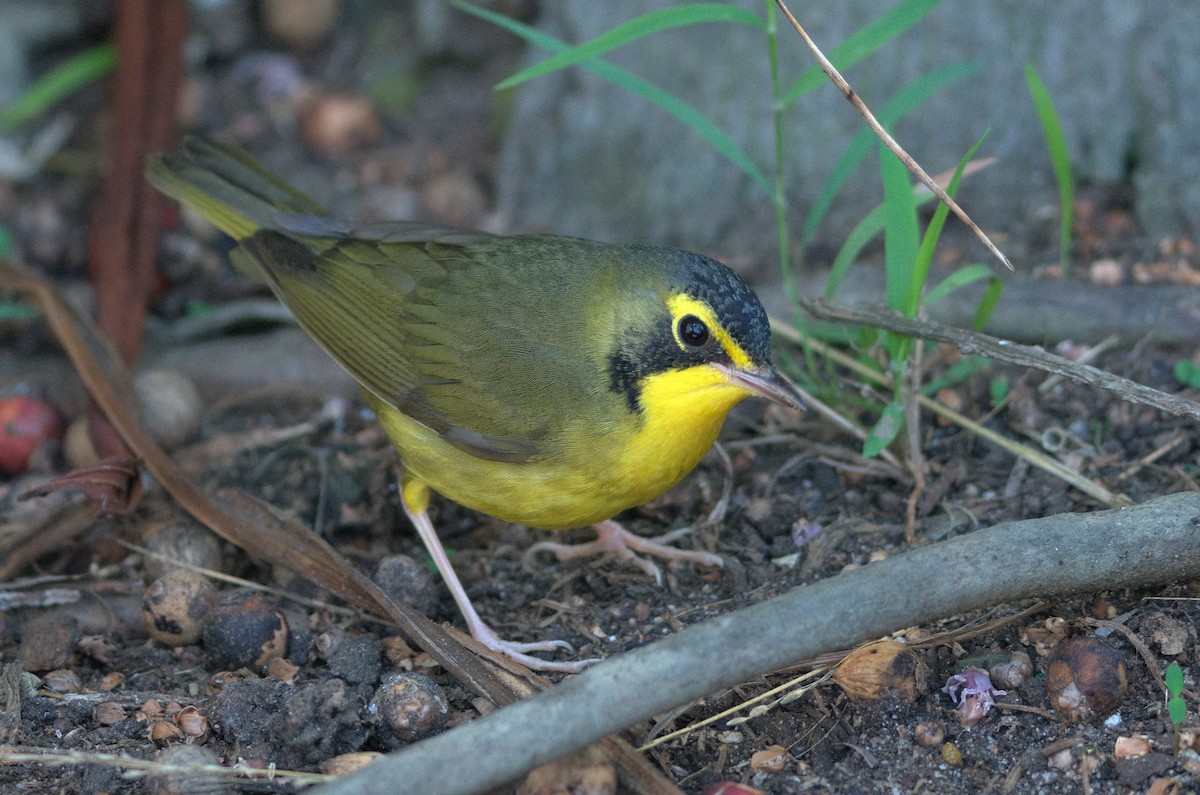
Continuing male Kentucky Warbler, present since 23 November 2025, when initially reported by eBird users "Liz & Kev," here photographed by Curtis A. Marantz on 2 December 2025 at the Paradise Point Resort and Spa on Vacation Isle in Mission Bay, San Diego County, California.
Detalles de la observación
We wandered around the site for quite some time before Jackson called me over after relocating the continuing warbler near the small waterfall located near the lobby entrance. A small group of us then observed this bird and took photos as it moved about the rocks and the understory immediately to the west of the fountain, where we obtained good views and photos at close range as it hopped about, often on the open ground in the dense shade. After an extended period of time in this area, the warbler flew across the lake into the gardens to the northwest, where it spent the rest of the time that I was present, again hopping on the ground in the open, but also moving up into the lower branches of the trees and shrubs, at times reaching a couple of meters above the ground. The warbler approached within three or four meters of us, possibly closer, and it was often fully in the open, but rarely in the sunlight. Complicating my ability to study this bird carefully was that it almost never stood still, and even when it perched amid the branches, it rarely sat still for long. Although the warbler was typically quiet, it gave several bouts of loud, “choip” calls that I immediately recognized as those of this species, in that they were “sweet” chips that were both louder and deeper in frequency than the calls of a Yellow Warbler, and in some ways intermediate between the calls of Yellow Warbler and the flatter “chup” of a Hermit Thrush. This was a relatively large, heavy-bodied warbler that looked almost thrush-like in its shape. The bill was large for a warbler, though not exceptionally so, and it tapered from a base of medium depth to a pointed tip along a culmen that appeared to be straight. I further thought the bill would have extended backward on the face to a point between the middle and rear edge of the auriculars. The forehead and forecrown sloped moderately upward to a weakly rounded peak on the crown that appeared to be above and slightly behind the eye, from which the nape and the back of the neck sloped downward to the back. This bird’s head appeared large for its size, but not unusually so, and the neck was short and stocky. The body was plump and somewhere between full-chested and pot-bellied, with a posture that was not quite as upright as diagonal. Most of the time the tail was held downward in the plane of the body, but it was also held cocked weakly upward on occasion. The medium-length wings had a primary projection that was about two-thirds the length of the exposed secondaries, and the tapered wingtip appeared to reach the tips of the uppertail coverts. I further thought the wingtips reached to about the tips of the undertail coverts. The tail was rather short, in that it appeared to be no longer than the length of the body without the head and neck, and it was jagged at the tip. My impression was that the closed tail was held parallel-sided to slightly flared, and I did not think it was particularly slim. The undertail coverts were tapered and at least relatively long, though I had only an impression that they reached somewhere in the range of one-third to halfway out the tail. The legs were rather long, but also slim, and they were quite conspicuous given their pale coloration. This was a colorful bird with a boldly marked head and face, but overall, the patterns were rather nondescript. The forehead was black, but admixed with paler and seemingly gray tips to the feathers, which gave the crown a finely barred or speckled appearance that increased up to the peak of the crown, where the black and gray ended and a greenish to grayish color continued across the nape and a short way down the back of the neck before blending into the green that characterized the back. The striking pattern on the face was dominated by bright-yellow spectacles that began at the base of the upper mandible as a narrow, yet well-defined, supraloral-stripe that connected with a similarly colored eyering that expanded somewhat behind the eye, but contrary to my impression during my previous visit, today I noted that the rear terminus of the eyering was rounded and not pointed. The yellow also extended forward from the rear part of the eyering under the eye narrowly to a point just below the eye where ending abruptly. As a result, the eyering was incomplete and the lores were solidly black from the base of bill back to the leading edge of the eye below the yellow supraloral-stripe. The black in the lores extended down to the gape, from which the lower edge of the “mask” extended straight backward below the eye along the lower edge of the moustachial region before expanding across the front portion of the auriculars, which were likewise black. My impression in the field was that the black on the auriculars extended around behind the rear edge of the spectacles to connect with the dark coloration of the crown, but my photos show this not to be the case, and instead that the olive color from the back of the neck extended forward to meet the rear edge of the spectacles between the auriculars and the crown. I was more confident that the black on the front part of the auriculars merged with green rearward, but I was not quite sure what percentage of the auriculars was black versus green. Not only did the black mask extend across the forward portion of the auriculars, but it also curved downward sharply along the side of the neck and onto the side of the breast, where tapering to a pointed tip just before the shoulder and serving to frame the bright yellow throat. Demarcated sharply by the black mask and “sideburns,” the throat was a bright, lemon-yellow from the chin down across the throat and onto the breast. I further thought the breast, belly, and undertail coverts were lemon-yellow and unmarked, but the flanks (and possibly also the sides of the breast below the sideburns) were washed extensively with olive on a yellow background. The underside of the tail was uniformly dark. Returning to the upperparts, the speckled blackish color extended up the forehead and crown to the peak, but the back and sides of the neck behind the mask appeared to have a subtle suffusion of gray that appeared to be mixed with olive or green. The back and secondary coverts were uniformly green, and even though they appeared to be olive-green when seen in the shade, they seemed to be more purely green when briefly seen in the sunlight. The median coverts appeared to be the same shade of green as the back and essentially unmarked. The greater coverts were similarly colored, and again appearing rather plain, but I could see somewhat darker centers on one or two of the innermost feathers. The remiges were again similar in color, with at least edges of the same shade of green as the back, but I did notice a finely striped pattern that appeared similar on the primaries and secondaries, and which presumably reflected the green edges contrasting with somewhat duskier centers to these feathers. The exposed primary tips were a bit duskier than the rest of the wing, but they lacked obvious markings. The innermost secondaries did not contrast strongly with the other remiges, but my impression was that they had green on the outer webs of the feathers that blended to a darker color on the inner webs. I further noted today that the upperside of the tail was a sooty-brown, but with edges of green that appeared to be rather diffuse, and creating a subtly striped pattern. The bill was mostly dark, but I again thought the lower mandible was paler at least basally, though I again had a hard time seeing either the precise color or extent of the pale coloration. I noted in the field only that the eyes were dark. The legs and toes were a bright flesh to pinkish-flesh in color, which accentuated the legs and feet under the dark conditions. The claws were pale, and not contrasting strongly with the toes, but I failed to notice their coloration.
Información técnica
- Modelo
- ILCE-7RM5
- Lente
- FE 400-800mm F6.3-8 G OSS
- ISO
- 3200
- Longitud focal
- 400 mm
- Número f (o Apertura del diafragma)
- f/6.3
- Velocidad de obturación
- 1/250 sec
- Dimensiones
- 4611 pixels x 3054 pixels
- Tamaño original del archivo
- 14.3 MB