

ML639958177
Contribuidor
Fecha
Localidad
- Edad
- No especificado
- Sexo
- No especificado
Detalles de la observación
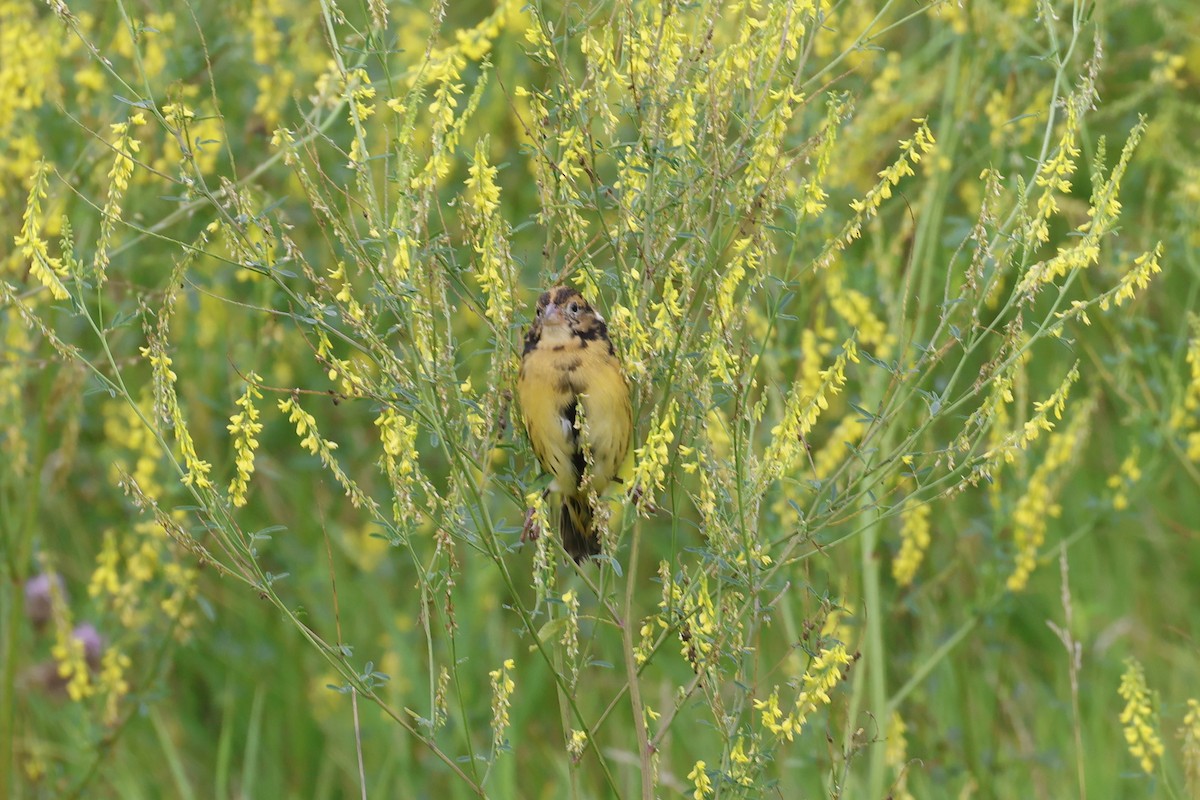
This bird really puzzled me as to what species it was. It flew into sweet clover and it was the right size to be a bobolink or dickcissel, and both of those species are quite at home in sweetclover. I was able to grab these three quick photos that I planned to study later before adding it to the checklist. Initial views of the photo show a prominent central crown stripe, a light yellowish chin patch, and black around the lower neck and central breast and belly. In deciding which species it was,I looked extensively through August to November photos in the McCauley library for similar photos of bobolink and dickcissel. No dickcissel photo I reviewed shows a central crown stripe, but bobolinks do, including fall males. Bobolinks rather quickly undergo a complete molt before migrating to South America. Yet, a photo of a male in transition from the summer plumage to fall plumage is remarkably rare in the McCauley photo library. Perhaps this is because they hide in heavy cover while molting Checklist S71941917 has a photo close to the one shown here. Note that the beak is heavy and consistent with either species, as is a hint of an eyering. The black on the breast and belly, and lower neck are there because molting is not yet complete. The NG guide by Dunn and Alderfer, 6th edition , makes note of pointed tail feathers which this bird has.
Información técnica
- Modelo
- Canon EOS R7
- Lente
- RF100-500mm F4.5-7.1 L IS USM
- ISO
- 250
- Longitud focal
- 500 mm
- Flash
- Flash did not fire
- Número f (o Apertura del diafragma)
- f/8.0
- Velocidad de obturación
- 1/160 sec
- Dimensiones
- 3173 pixels x 2116 pixels
- Tamaño original del archivo
- 1.89 MB