

ML617198641
Contribuidor
Fecha
Localidad
- Edad
- No especificado
- Sexo
- No especificado
Detalles de la observación
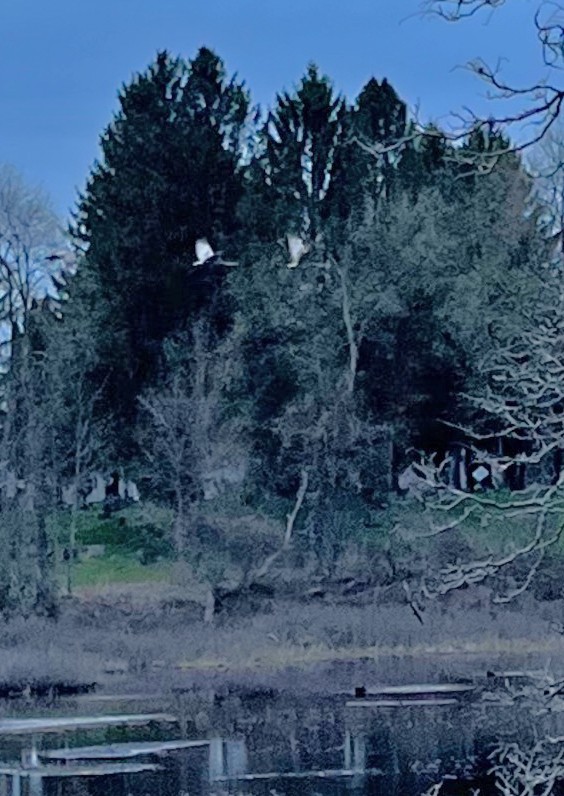
As told to me, James Hill, by Annette Smith, who called me all excited in mid-chase. She was pulling out of the driveway at 506 Erie Street on Rt. 99, looking out towards Greenpoint, where one of the local, breeding, adult Bald Eagles was perched, and she saw three huge birds fly off to the south, then circle and land in the "Cove", which is the marsh on the south edge of the Edinboro Cemetery. Annette followed them, parking in the cemetery and hiking over to "Lincoln's Lookout", the new bird observation platform on Goodell Gardens & Homestead. Just then some children were playing outside, loudly, across the Cove, and the birds flushed to the northeast. Annette was able to capture this cell phone photo. She said their plumage was brownish, more than grayish. Sandhill Cranes stain their gray plumage a rust color using muds containing iron oxides this time of year for help with camouflage during the breeding season. According to Birds of the World: “Back, breast, and abdomen feathers and upperwing coverts margined pale gull-gray. Plumage becomes stained adventitiously for camouflage through application of soil to plumage or an oxidation process (Taverner 1929, Drewien 1973, Nesbitt 1975a, Pyle 2008); results in plumage ranging from drab-clay to cinnamon-rufous (ferric oxide). Stained feathers occur below mid-neck and are particularly apparent among upperwing primary and secondary coverts and upper breast feathers.” Gerber, B. D., J. F. Dwyer, S. A. Nesbitt, R. C. Drewien, C. D. Littlefield, T. C. Tacha, and P. A. Vohs (2020). Sandhill Crane (Antigone canadensis), version 1.0. In Birds of the World (A. F. Poole, Editor). Cornell Lab of Ornithology, Ithaca, NY, USA. https://doi.org/10.2173/bow.sancra.01
Información técnica
- Dimensiones
- 564 pixels x 796 pixels
- Tamaño original del archivo
- 365.25 KB