

ML611104577
Contribuidor
Fecha
Localidad
- Edad y sexo
- Macho adulto - 1; Macho de edad desconocida - 1
- Comportamientos
- Buscando alimento o comiendo
- Etiquetas
- Hábitat
Comentarios
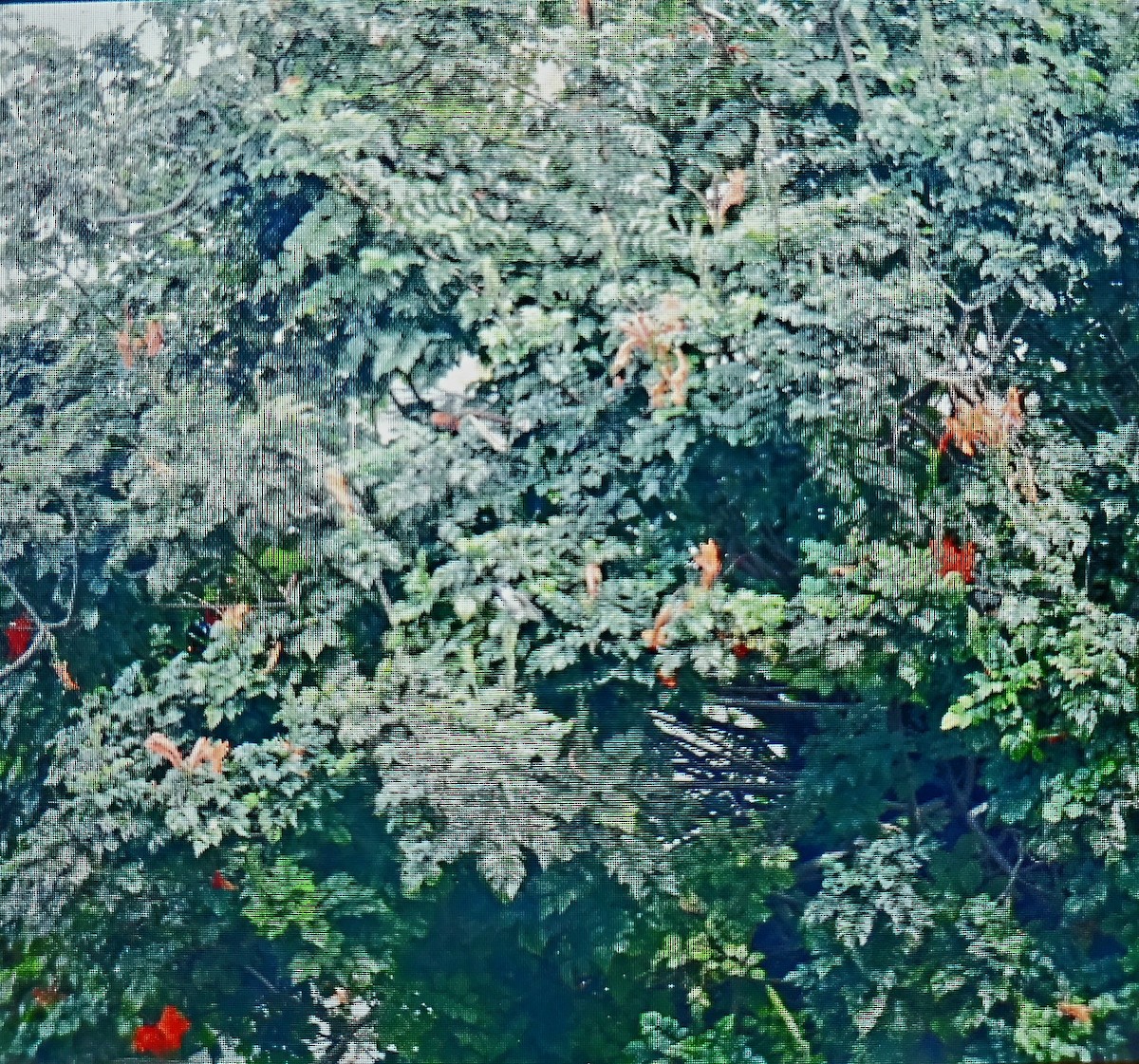
Photo of Cape Honeysuckle (Tecomaria carpensis) where this rare Costa's Hummingbird has made its home in residential Berkeley. Yes, there "is" a Costa's Hummingbird in this shrub. Though not a true honeysuckle, the Cape Honeysuckle is native to southern Africa. I have a Cape Honeysuckle in my backyard in Oakland and it is a magnet for Anna's Hummingbirds which I see throughout the year. They love its nectar.
Detalles de la observación
Immediately upon arriving at what has been dubbed a “stakeout”, I parked my car on the quiet street in site of the shrub which has attracted this Costa Hummingbird for many months. Soon, I saw an adult-size hummingbird flitting at the top of a Cape Honeysuckle shrub (Tecoma capensis), sipping nectar from its brilliant red flowers. No hummingbird feeders in sight. Because the hummer was only in silhouette, I could not immediately determine what kind it was. It flew away. After about 20 min, a hummingbird appeared back again hovering in front of the numerous Cape Honeysuckle flowers. It took awhile to determine what kind of hummingbird it was: because of the shadows in the shrub, its gorget looked black. I understand that this is common for Costa’s (the gorget needs to be directed toward sunlight for the brilliant purple to disclose). I took a photo. With patience, I was able to get three effective photographs: one displaying the gorget as being “black”, the other two showing its defining brilliant purple head and long extended gorget. I was by myself, so I needed photographs to confirm my sighting. This Costa Hummingbird was male, and small (approximately 3 1/2”). One photo shows a "gap" between the feathers of it's gorget and its body. Amethyst purple crown and throat, extending down the shoulders (picture a British judge's wig falling down their shoulders. I understand that Costa's Hummingbird is rare in Berkeley anytime of year. They do not appear on any range map for the species. According to "Birds of Northern California," there had been a “subtle northern advance of Costa’s Hummingbirds into the region. Once restricted to desert washes and dry hillsides, these tiny birds are now increasingly attracted to the exotic flowering trees and shrubs common in parks and neighborhoods." This Costa Hummingbird has definitely found a comfortable winter home. I will return to try get sound recordings. Why the name "Costa's Hummingbird"? It was named after French statesman, Louis Marie Pantaleon Costa de Beauregar, because he was fond of collecting hummingbirds (1804-1864)
Especies adicionales
Información técnica
- Modelo
- SM-G973U1
- ISO
- 320
- Longitud focal
- 4.3 mm
- Flash
- Flash did not fire
- Número f (o Apertura del diafragma)
- f/2.4
- Velocidad de obturación
- 83/10000 sec
- Dimensiones
- 1779 pixels x 1662 pixels
- Tamaño original del archivo
- 4.88 MB