

ML407862121
Contribuidor
Fecha
Localidad
- Edad
- No especificado
- Sexo
- No especificado
Detalles de la observación
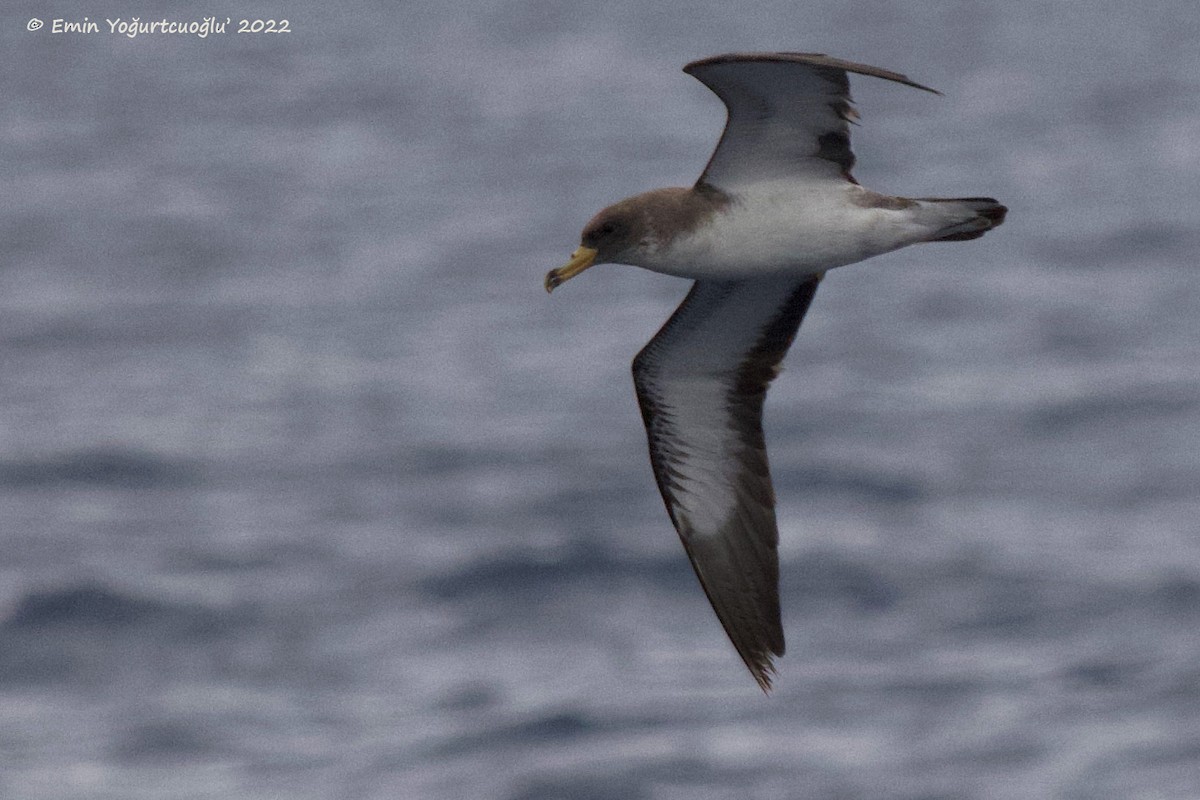
Added to list on 20th of January. Photographed. 1st record of this taxon confirmed by a few specialists, more soon. Potential 1st for Turkey (as they are not split on Ebird yet but split in many others.) Added notes on 20th of January: Actually during that pelagic, we were all in the shock of Sooty Shearwater and when we saw this bird, we said "well, Cory's??" But that one coma left us in questions and we decided to ID it later. After long hours waiting from some experts, all were well satisfied by Cory's and also special thanks to Bob Flood, he made final statement. Bob Flood's email: "Hi Emin, Based on current knowledge, this is borealis. The wholly dark under primaries is diagnostic. The percentage of borealis with one dark greater primary covert, 'one dark spot', is about 40%, so no problem. The extent of dark in the lesser secondary coverts is score 3 or 4, quite typical of borealis. The most recent taxonomic work based on DNA etc recognises borealis and diomedea as good species. Hope this helps. Kind regards, Bob" Killian Mullarney's message: "Hi Emin! I have had a careful look at the photos now, and I have to say, if this is not a Cory’s, it has to be the most unusual Scopoli’s ever! The apparently all-dark inner webs to all of the outermost primaries seems to be outside the range of variation known in Scopoli’s, and looks much better for Cory’s, as does the rather heavy bill and quite dark, brownish head ( though I am unsure as to how reliable these differences in head-colour are...). The single dark spot on the outer greater primary coverts ( underwing) is associated more with Scopoli’s ( and it seems to be very rare for Scopoli’s to have two dark spots) but according to Flood, Fisher and Gale ( Shearwaters) about 40% of Cory’s have just one dark spot on these coverts. My only concern is that the outer three primaries are very worn, and I don’t know if there is any potential for very worn, old outer primaries in Scopoli’s to lose the distinct white tongues on the inner webs. It certainly appears to be a good candidate for Turkey’s first Cory’s, but it would be good to get Bob Flood’s opinion." Also a few good birders Daniel Lopez Velasco, Pierre Andre Crochet and Yoav Perlman commented the same ID.
Información técnica
- Modelo
- Canon EOS 90D
- Lente
- EF70-300mm f/4-5.6 IS II USM
- ISO
- 500
- Longitud focal
- 300 mm
- Flash
- Flash did not fire
- Número f (o Apertura del diafragma)
- f/5.6
- Velocidad de obturación
- 1/2000 sec
- Dimensiones
- 1569 pixels x 1046 pixels
- Tamaño original del archivo
- 767.65 KB