

ML642936013
Beitragende/r
Datum
Ort
- Alter
- nicht spezifiziert
- Geschlecht
- nicht spezifiziert
Beobachtungsdetails
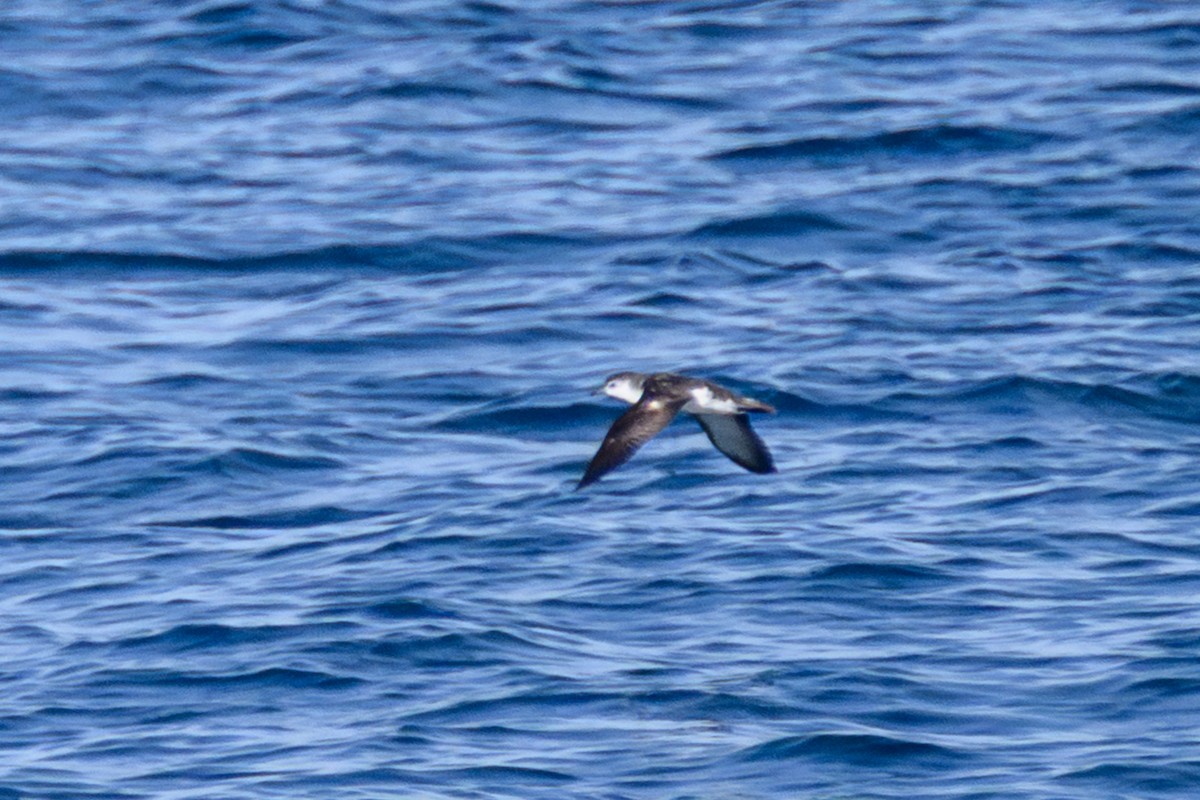
***mega; this small shearwater flew of along the port (left) side of the bow and was initially called out as a small shearwater, possibly a Sargasso Shearwater. Leaders got images from the bow immediately and we gave chase to the bird for the next few minutes, with it tacking left and right at about the eleven o’clock position on the boat, best seen form the front. After a couple minutes the better images were checked and we all agreed it was a confirmed Barolo Shearwater and we doubled-down on the chase, with Captain Joe Huckemeyer stating on the bird as best he could. It sat briefly on the water once, but flushed immediately again. Unfortunately the bird was 10-15% faster than the boat and it gradually slipped away from us. It also seemed to *intentionally* fly into the sun, presumably knowing that a threat from behind (e.g., predator) would have trouble spotting it in the sun (we saw this behavior in 2007 too). It was a real struggle to keep the bird in sight and we eventually lost it in the glare and swell towards the horizon but decided to slow down and approach gradually. This was a good decision, although the tiny shearwater was unfortunately very hard to spot at a distance. By the time we noticed it ahead of us, we only had time to slow the boat and call it out on the water before it flushed again and repeated the chase again: we followed, it flew to 11:00, and flew into the sun, and eventually gained on us and we lost it. This time the slow down and hope to find it on the water did not succeed. In the field it was a small shearwater quite close in size and shape to Audubon’s Shearwater, but maybe with a shorter and less paddle-shaped tail. Its flight was very rapid with quick flaps and short glides and short banking movements. The critical ID criteria rest upon the photos, which clearly show: 1) most importantly, a very white face with the dark eye totally isolated in the white of the face; this is diagnostic for P. baroli; 2) white under tail coverts, which eliminate Sargasso and Boyd’s Shearwater; 3) somewhat silvery sheen to the greater coverts; 4) a narrow line of whitish tips on the greater coverts; this is typical of Barolo and very rare or absent in Sargasso Shearwater. This remains one of the most mysterious birds off New England. Given how hard they are to detect and identify and the fact that there are 10+ records in the past 15 years, it seems likely to be somewhat regular but clearly very rare and thinly distributed. It remains an ABA Code 4 bird (indicating an extreme rarity with 5+ records), and that is appropriate. It is the third ever found on a BBC pelagic trip. The first that we found on these trips was the first United States record (following a specimen from Cape Sable Island and a credible sight record from the Grand Banks off Newfoundland). That first BBC record was 25 Aug 2007 first BBC record was 25 Aug 2007 and was just 21 miles NNW of this bird and in similar water depth and bathymetry, being in what we often consider a “dead zone” inshore of the shelf and canyons. So it was an interesting coincidence to find another there on this trip. Our second BBC record was at anchorage, also on the shelf, and just W of Oceanographer Canyon on 26 Aug 2012 . Massachusetts has several others from experienced seabirds working on research vessels at or beyond the shelf edge. This species is less tied to warm water than other specialties, as evidenced by our bird in 69 F water and by the lone record from Maine, far up on the shelf, and the Canadian records. We suspect that the east edge of Georges Bank (which is very hard to reach on a pelagic trip) might hold promise in searching for this species. As of this moment, the reports of up to 15 from the Continental Shelf waters of Massachusetts and east to New Jersey should be considered unconfirmed—the only phots that have been available have shown Sargasso Shearwaters or have been inconclusive.
Technische Angaben
- Modell
- NIKON Z 9
- Objektiv
- NIKKOR Z 100-400mm f/4.5-5.6 VR S Z TC-1.4x
- ISO
- 1100
- Brennweite
- 560 mm
- Blitz
- Flash did not fire
- Blende
- f/8.0
- Belichtungszeit
- 1/2000 sec
- Abmessungen
- 2400 pixels x 1599 pixels
- Größe der Originaldatei
- 1.98 MB