

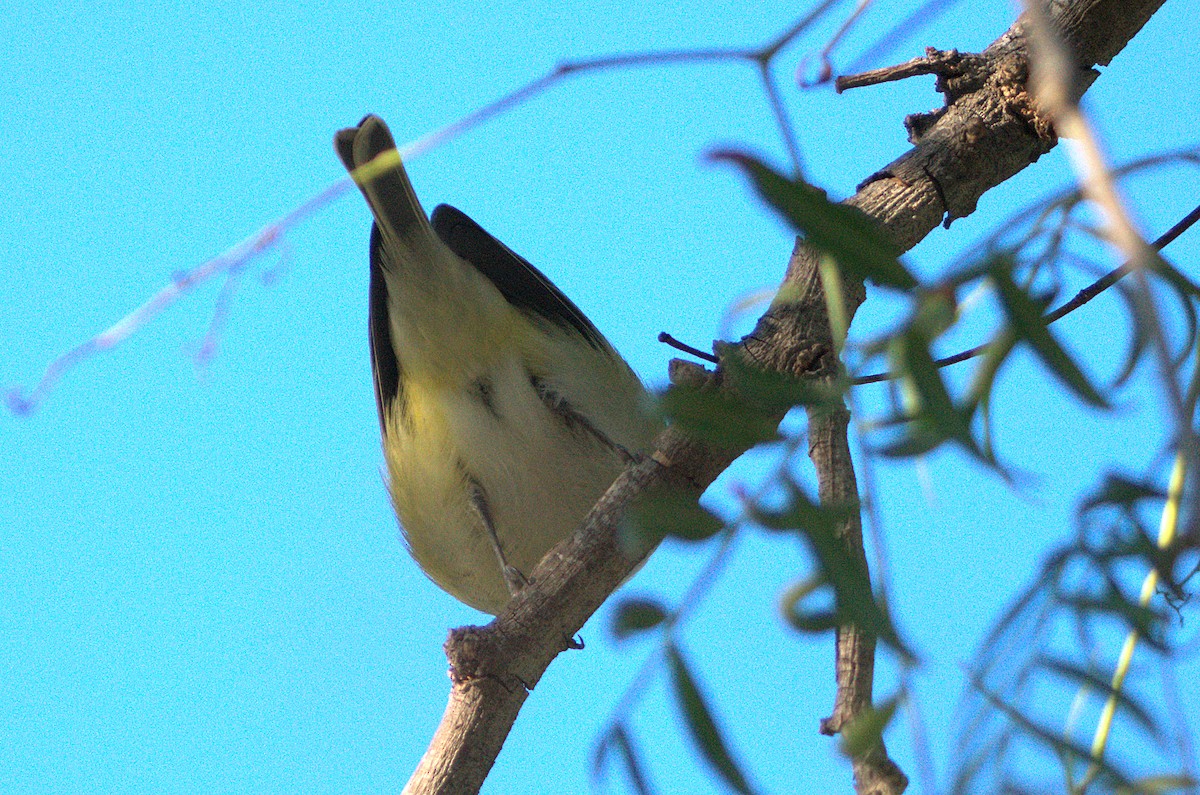
ML646390256
Cassin's/Blue-headed Vireo Vireo cassinii/solitarius
Přispěvatel
Datum
Lokalita
- Věk
- Nespecifikováno
- Pohlaví
- Nespecifikováno
Poznámky
An apparent Blue-headed Vireo that was initially found on 30 November 2025 by John Bruin, here photographed by Curtis A. Marantz on 2 December 2025 at Azalea Community Park in San Diego, San Diego County, California.
Podrobnosti k pozorování
I arrived on the hillside at the upper end of the park just as Patton relocated the continuing vireo in the Peruvian Pepper tree in which it was apparently first found two days earlier. We then observed this bird moving about actively amid the middle and upper branches of this tree before we thought it flew off; however, given that it was relocated back in the tree a few minutes later, I suspect it never flew off this first time. Unfortunately, for us, the vireo indeed flew out of the pepper and into the neighborhood a few minutes later, and despite our expending a moderate amount of effort, we were unable to relocate this bird. When in view, the vireo moved more actively than I usually associate with this species, and even though the tree was not overly large, it was densely vegetated, which made the bird difficult to follow. I managed to get a few mediocre photos, but my views of this bird were sufficient only to note its structure and patterns rather superficially. Not surprisingly, we never heard this bird vocalize, and to my knowledge, nobody else had either. Although my views of this bird were reasonably good, the light was not ideal and my observations were sufficiently brief that I doubt anything on this bird was sufficient to separate a reasonably dull Blue-headed Vireo from a brightly colored Cassin’s Vireo, so based exclusively on my observations and photos of this bird, I am entering it as a Blue-headed/Cassin’s Vireo. This said, photos taken by others would suggest that this is a Blue-headed Vireo, mostly on the basis of the bright coloration overall combined with the extent of white along the inner webs of the outermost pair of rectrices. This was a small passerine that was nevertheless a bit larger, larger-headed, and heavier-bodied than the warblers that were in the same area. I further noted that the bill was relatively short, stouter than that of a warbler, and with what appeared to be a blunt tip, but I was unable to determine its length relative to field-marks on the face or note the finer details of its structure. The forehead was sloping and the crown was rounded, both on a head that was larger for the bird’s size than that of a warbler. The neck was also short and sticky, and the body was plumper than that of a warbler. I thought the tail was slim, parallel-sided and relatively short, but again, I failed to notice its length relative to the body, or note the shape at the tip. I think the undertail coverts were reasonably long relative to the length of the tail, but I was unable to discern the structure of the wings, legs, or feet. This bird’s patterns were typical of a Solitary-type Vireo, but my views were sufficient only to note the overall patterns and not the finer details of the plumage patterns. The head was gray, seemingly from the forehead back through the crown and down across the face. I noted the white spectacles that combined a supraloral stripe with an eyering, and also that both were relatively narrow, yet well-defined, but I could not see if the eyering was broken before the eye, or either the location of sharpness of the demarcation between the dark gray face and the white throat. I was confident that the throat, beast, and belly were white, or at least whitish, but the flanks were conspicuously washed with a relatively bright, lemon-yellow color. I also noted a band of yellow through the vent region, but I thought the undertail coverts were white. I was unable to determine if the yellow on the flanks had an olive suffusion. The underside of the tail was generally dark, but I di see at least a narrow band of white extending the length of the inner web on what I thought was the outermost pair of rectrices. Returning to the upperparts, I thought the cap was gray and that the back was at least reasonably green, but I was unable to see where exactly the demarcation was between gray and green, or even how sharp this demarcation was. The wings were darker than the back, and they had two relatively bold wingbars that appeared to be well-defined and whitish, though it is possible that they were yellow, given that the light was not very good when I best saw this bird. I also thought the remiges were edges paler, which gave the rear part of the wing a finely striped pattern, but I was unable to discern the color of the edges, the pattern on the innermost secondaries and wingtips, or if the edges differed on the primaries and secondaries. I thought the eyes were dark, at least relative to the eyering, and that the bill likely was as well, but I have no further recollection of the soft-part colors. I typed my description of tis bird in the early-morning hours of 5 December 2025, yet my views of this bird were sufficiently superficial that I did not have a difficult time remembering the details that I did see on this bird.
Technické informace
- Model
- ILCE-7RM5
- Objektiv
- FE 400-800mm F6.3-8 G OSS
- ISO
- 1600
- Ohnisková vzdálenost
- 400 mm
- Blesk
- Flash did not fire
- Clonové číslo
- f/6.3
- Expoziční čas
- 1/640 sec
- Rozměry
- 2863 pixels x 1897 pixels
- Původní velikost souboru
- 11.14 MB