

ML641532633
Přispěvatel
Datum
Lokalita
- Věk
- Nespecifikováno
- Pohlaví
- Nespecifikováno
Podrobnosti k pozorování
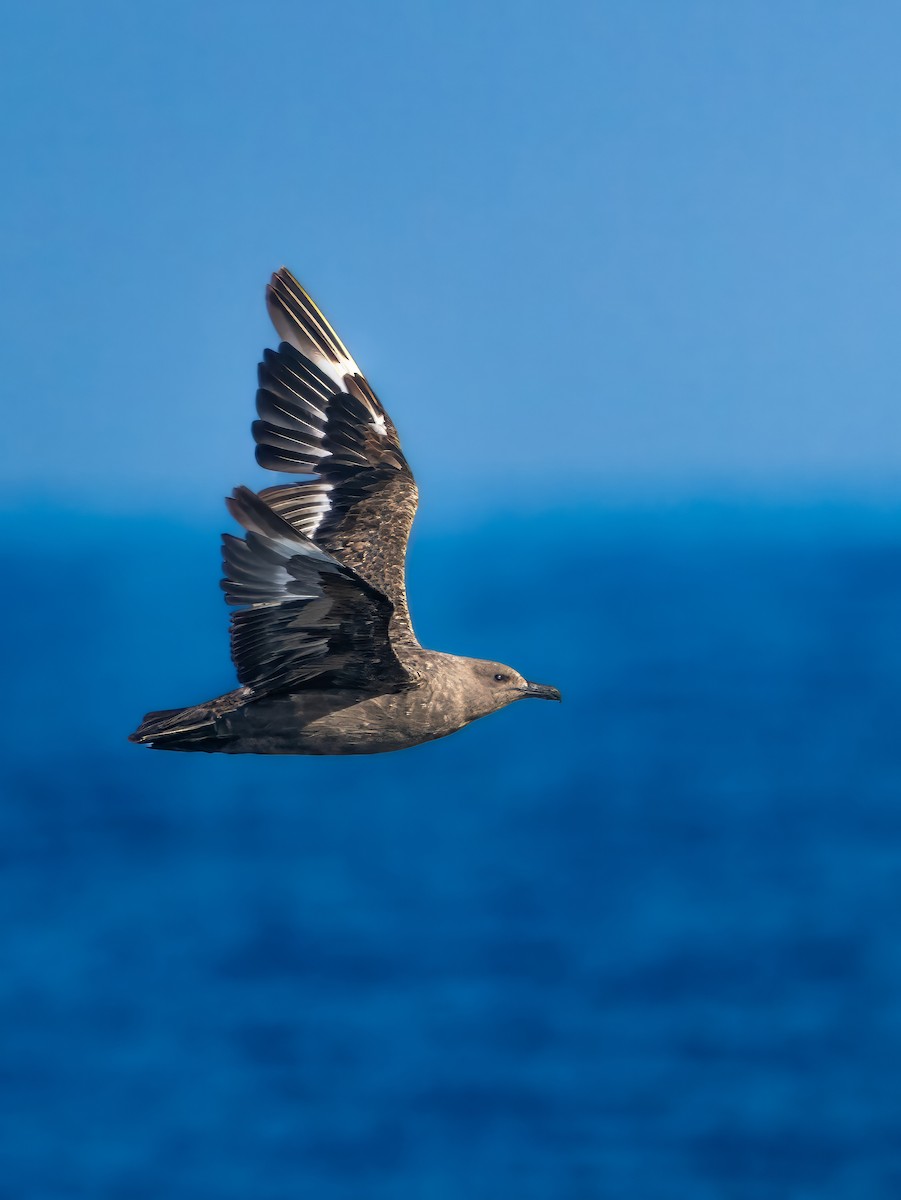
Jaeger on steroids. Bulkier than a Pomarine Jaeger, mostly dark brown with a paler head and large white wing patches at the base of the primaries, though it also appeared to be molting its wing coverts. Seen approximately 14 km southwest of Dana Point (33.33578, -117.75351) with a small group of Western Gulls. Additional details from CAM: I was in the back of the boat when Matt Grube initially pointed out a possible skua sitting on the water amid a small flock of Western Gulls on the inshore waters about 14¼ kilometers south-southwest of Dana Point at 33° 20’ 11.05” N, 117° 45’ 13.72” W. I made my way to the front of the boat as we approached this bird and confirmed that it was indeed a skua that permitted a relatively close approach before it took flight, but atypical of skuas, it landed on the water again a short distance away, so we again approached it for good views and photos before it flew off a second time. I think it again landed not too far away, but we did not pursue it further. Our views of this bird on the water were quite good and from a distance that was closer than I often see skuas, and in direct comparison with the Western Gulls, which sat on the water in close proximity without being disturbed. I concentrated on getting photos when the bird took flight, but I did study it through binoculars when it was at a sufficient distance that I could not get good photos, but also from which I had a hard time seeing fine details of the plumage. This was a large, gull-like bird that in direct comparison with Western Gulls of various ages appeared to be roughly comparable in size, albeit with a subtly different shape and a seemingly plumper body. The bill was relatively stout throughout its length, but also seemingly parallel-sided rather than having an expanded tip. My impression was that the culmen was straight for most of its length before curving downward to a blunt tip that lacked an obvious hook. The forehead was sloping, but the crown was smoothly rounded, both on a head that appeared roughly comparable in size to those of the gulls. I did think this bird had a somewhat shorter neck that was stockier than those of the gulls, and this was particularly so in the case of the lower part of the neck. The body was notably plump and just a bit bulkier than those of the gulls, but it did not sit any lower on the water than those of the gulls. Despite our close proximity to the bird, I had a hard time seeing the finer details of the structure of the closed wings, which did not appear particularly long, but I could not discern in the field the primary projection or see if the wingtips reached beyond the tip of the tail. The tail was short. I failed to note its length relative to the body, but I did notice when the bird flew off that the tail appeared to be weakly wedge-shaped as opposed to being square-tipped like those of the gulls. I suspect I saw the legs and feet when this bird took flight, but I cannot now remember anything about them. Apparent when the bird flew off, was that it was a large, gull-like bird with a conspicuously plump body, a stocky neck, a short tail, and wings that tapered from relatively broad bases to pointed tips. Also evident on the flying bird was that the wings had a rather ragged appearance with patches of white extending inward from the primaries, but I cannot recall seeing obvious gaps in the remiges. This bird was a relatively dark, chocolate-brown color overall, but it was not an exceptionally dark individual. I further thought I could see a hint of buff on the back and sides of the neck, but again, this was not as obvious as it is on some skuas, and quite possibly indicative of its not being fully adult. I saw an uneven appearance to the upperparts and wings, but not any crisp scaling or obvious mottling, and my impression was that the upperparts and underparts were at least roughly comparable in coloration. Then the bird took flight, the white patches in the wings were obvious, and the white was not limited to an irregular band across the bases of the primaries. Although I was unsure of the exact placement of the white in the spread wing, my impression was that the white continued inward through the middle part of the wing, possibly into the bases of the secondaries, which may have been visible given misplaced or missing greater coverts. The overall appearance was of a somewhat ragged upperwing with a white band that extended inward from the leading edge across the bases of the primaries into the middle of the wing, but also an uneven appearance overall to the wing that likely reflected both molt and wear even though I noted in the field no obvious gaps in the remiges or rectrices. The bill was entirely black, and the eyes were sufficiently dark as to appear effectively black in the field. As noted above, I cannot recall noting the legs or feet when the bird took flight, but they may be shown in my photos.
Technické informace
- Model
- OM-1
- Objektiv
- M.300mm F4.0 + MC-14
- ISO
- 500
- Ohnisková vzdálenost
- 420 mm
- Clonové číslo
- f/5.6
- Expoziční čas
- 1/2000 sec
- Rozměry
- 2252 pixels x 3000 pixels
- Původní velikost souboru
- 1.19 MB