

ML640740848
Přispěvatel
Datum
Lokalita
- Věk
- Nespecifikováno
- Pohlaví
- Nespecifikováno
Poznámky
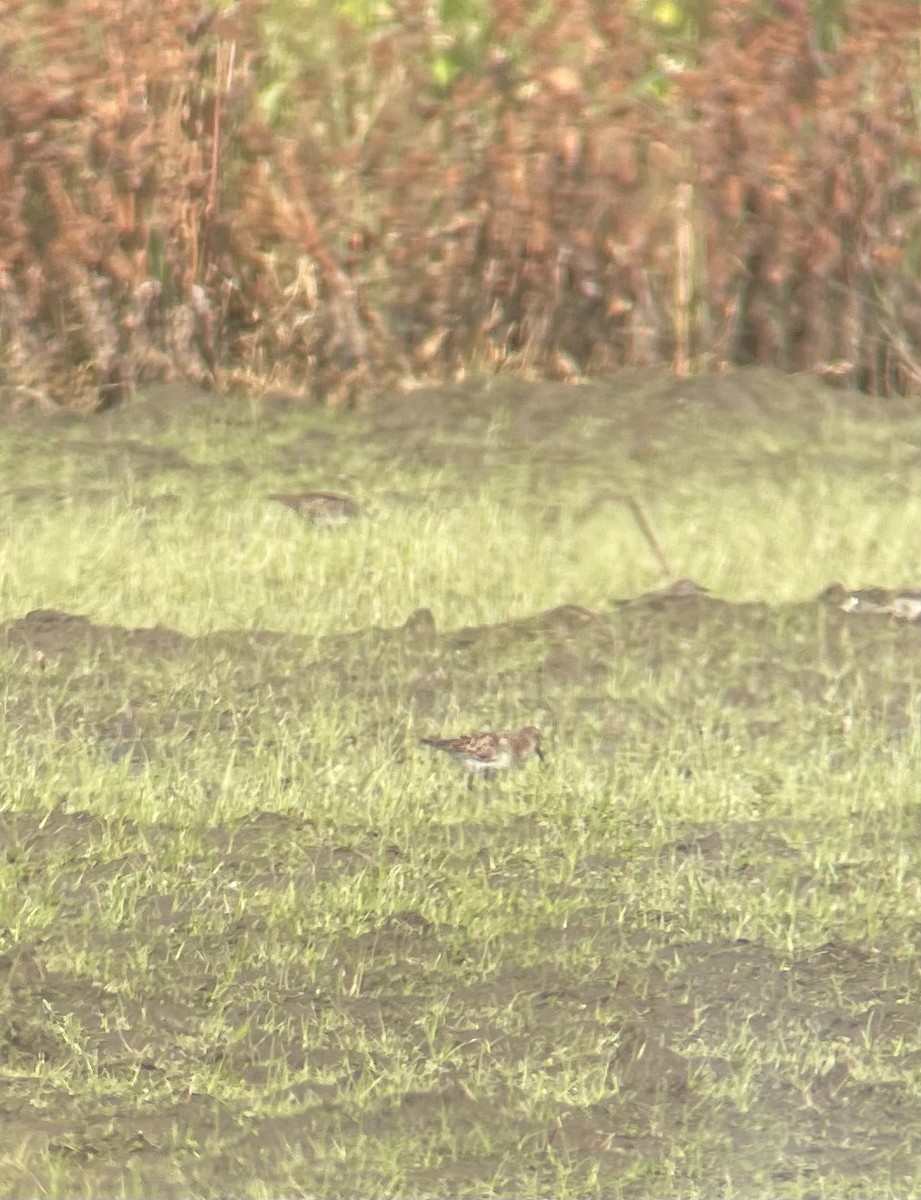
One of my initial digiscopes showing the rufous on its back and neck.
Podrobnosti k pozorování
**2nd County Record!** After failing to find the reported Franklin's gull in the Rice Point gull roost, I drove down to the corner field south of Lot C that contained many peeps during my last visit 4 days ago and began scanning from the road. The field was much drier but still held several hundred peeps, mostly leasts but also a few westerns. Within 5 minutes, I picked out an interesting peep near the back of the field around 38.536641, -121.618960. The bird looked extremely bright with black and rufous markings as well as white lines on its back, and my first impression was a juvenile least sandpiper. However, I began to notice several attributes that pointed away from my initial assumption. The first was its size: notably larger than any nearby leasts and much closer to the size of a western sandpiper. Then, I realized that the bird was actually an adult with very worn plumage, especially on the scapulars. I tried getting a look at the color of its legs which was very challenging given the distance and emerging grass in the field, but the few glimpses I got of its legs all appeared to be dark. From that distance, it also appeared to have a rufous "necklace" around the base of its neck. At this point, my excitement had built considerably as I realized I had a potential stint and attempted to take a few shaky digiscopes. I considered a very early molting juvenile least or a weird molting adult western, but all juvenile leasts I had seen were still in crisp, fresh plumage while the very few adult westerns remaining had all nearly completed their molts to full basic. The peeps all eventually flushed and resettled, and I took the opportunity to sit in my car, calm down, and send a few of the digiscopes to Zane Pickus who happened to already be birding in the bypass. Zane found the photos to be inconclusive but showed potential for a Little Stint and pulled up with Julian Johnson and Ethan Monk to search for the bird. After a tense 20 or so minutes, it was first refound by Zane, but it was extremely difficult to see through the tall sunflowers and cockleburrs blocking the way. The birds eventually flushed and reshuffled again, and we decided to walk closer through the weeds. Zane refound it once again, and everyone was able to get their first good looks. Throughout the evening, the bird proved to be a challenge to refind and study given its distance and the grass in the field that would frequently obscur it. However, everyone was able to eventually get good looks, and each time we would uncover more field marks. Through great effort, we determined that this was a small calidris noticeably bigger than any least, and slightly smaller than the westerns. It had long, dark legs that made it appear even larger than it was with a bill that was thick at the base but tapered to a fine point, approaching the length of a short western sandpiper bill. It would also appear elongated at times, almost like a Baird's or a Red-Necked Stint, due to its long primary projection. Its plumage showed a faded orange hue, especially around its scapulars, wing panel, and neck along with dark centers to its covert feathers. This along with its bright white throat helped distinguish it from Red-Necked Stint. A very stressful yet exhilarating bird to try documenting. Huge thanks to Zane, Julian, and Ethan for their skill in refinding the bird and knowledge in identifying it. Really glad it showed well to those who chased it the next day.
Technické informace
- Model
- iPhone 12
- Objektiv
- iPhone 12 back dual wide camera 4.2mm f/1.6
- ISO
- 32
- Ohnisková vzdálenost
- 4.2 mm
- Blesk
- Flash did not fire
- Clonové číslo
- f/1.6
- Expoziční čas
- 1/673 sec
- Rozměry
- 1058 pixels x 1379 pixels
- Původní velikost souboru
- 989.15 KB