

ML624117818
Přispěvatel
Datum
Lokalita
- Věk
- Nespecifikováno
- Pohlaví
- Nespecifikováno
Podrobnosti k pozorování
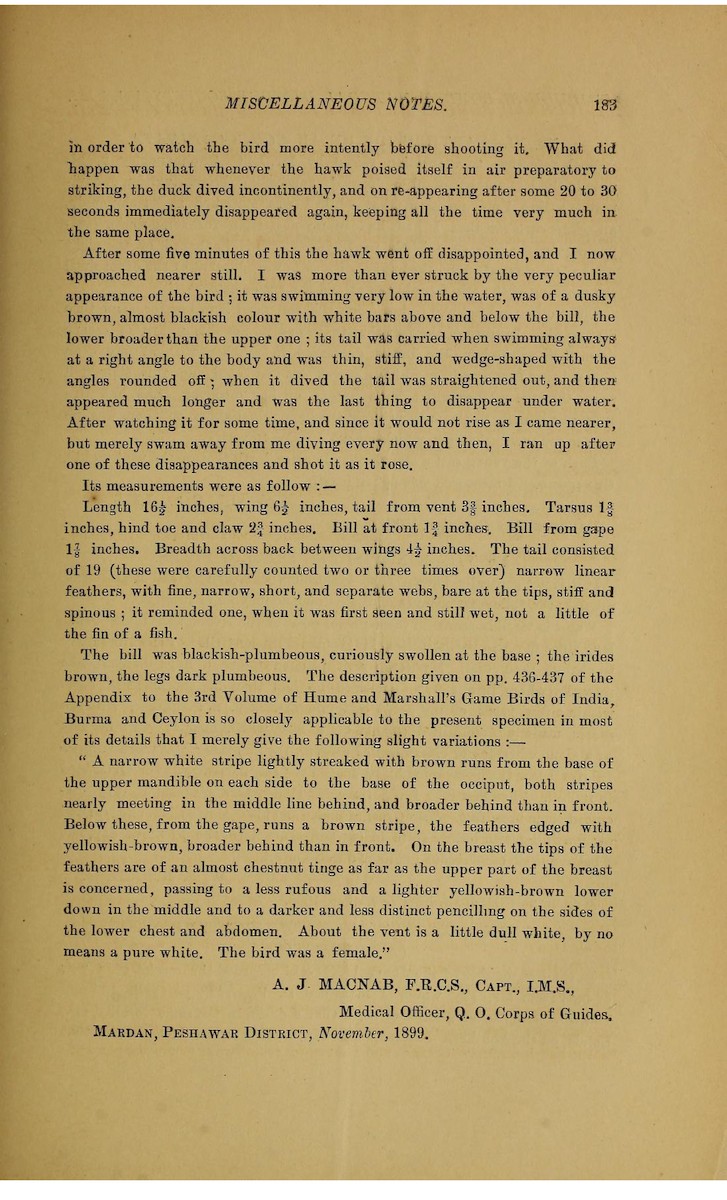
On November 12th, 1899, on a favourite haunt of Duck some three miles from Mardan, known as the Long Pond, I shot an extraordinary looking bird, which, directly I had it in my hand, I knew to be a specimen of the White-faced Stiff-tail Duck (Erismatura leucocephala). I was riding in the morning along the side of the nullah (for this so-called Long Pond is in reality a nullah some 600 yards long of varying width and winding course, with groups of rushes here and there at its bends) and had just drawn a favourite corner blank, when I saw a solitary bird in the middle of the pond that looked in the distance more like a pochard than anything else. On getting closer, however, though its head and the carriage of its neck gave it the appearance of a duck, its tail, which it carried cocked at a right angle to its body, and its habit of constantly diving and remaining under the surface for a considerable time, led me to doubt whether it was a duck at all. Without dismounting for a nearer inspection I rode off to tie up my pony, determined to return and shoot it for the sake of identification. On coming back I found the bird very much in the same place; but as I approached a hawk came on the scene and hovered over it evidently imagining that it had found its breakfast, and I sat down to see what would happen and in order to watch the bird more intently before shooting it. What did happen was that whenever the hawk poised itself in air preparatory to striking, the duck dived incontinently, and on re-appearing after some 20 to 30 seconds immediately disappeared again, keeping all the time very much in the same place. After some five minutes of this the hawk went off disappointed, and I now approached nearer still. I was more than ever struck by the very peculiar appearance of the bird; it was swimming very low in the water, was of a dusky brown, almost blackish colour with white bars above and below the bill, the lower broader than the upper one; its tail was carried when swimming always at a right angle to the body and was thin, stiff, and wedge-shaped with the angles rounded off; when it dived the tail was straightened out, and then appeared much longer and was the last thing to disappear under water. After watching it for some time, and since it would not rise as I came nearer, but merely swam away from me diving every now and then, I ran up after one of these disappearances and shot it as it rose. Its measurements were as follow : - Length 16¹/² inches, wing 6¹/² inches, tail from vent 3³/⁸ inches. Tarsus 1³/⁸ inches, hind toe and claw 2³/⁴ inches. Bill at front 1³/⁴ inches, Bill from gape 1⁷/⁸ inches. Breadth across back between wings 4¹/² inches. The tail consisted of 19 (these were carefully counted two or three times over) narrow linear feathers, with fine, narrow, short, and separate webs, bare at the tips, stiff and spinous; it reminded one, when it was first seen and still wet, not a little of the fin of a fish. The bill was blackish-plumbeous, curiously swollen at the base; the irides brown, the legs dark plumbeous. The description given on pp. 436-437 of the Appendix to the 3rd Volume of Hume and Marshall's Game Birds of India, Burma and Ceylon is so closely applicable to the present specimen in most of its details that I merely give the following slight variations : - "A narrow white stripe lightly streaked with brown runs from the base of the upper mandible on each side to the base of the occiput, both stripes nearly meeting in the middle line behind, and broader behind than in front. Below these, from the gape, runs a brown stripe, the feathers edged with yellowish-brown, broader behind than in front. On the breast the tips of the feathers are of an almost chestnut tinge as far as the upper part of the breast is concerned, passing to a less rufous and a lighter yellowish-brown lower down in the middle and to a darker and less distinct pencilling on the sides of the lower chest and abdomen. About the vent is a little dull white, by no means a pure white. The bird was a female." A. J. MACNAB, F.R.C.S., CAPT., I.M.S., Medical Officer, Q. O. Corps of Guides, MARDAN, PESHAWAR DISTRICT, November, 1899.
Technické informace
- Rozměry
- 4584 pixels x 7567 pixels
- Původní velikost souboru
- 13.34 MB