

ML647160291
Contributor
Date
Location
- Age
- Not specified
- Sex
- Not specified
Observation details
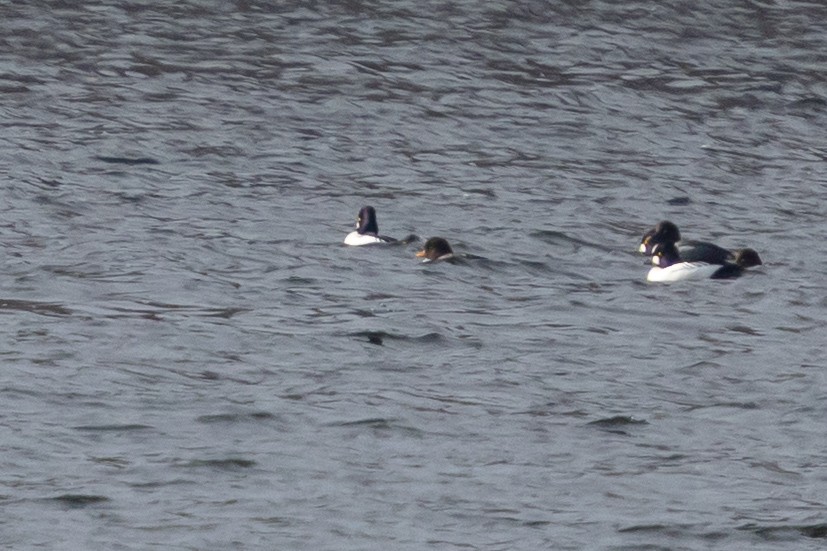
*Very rare; essentially absent in Westchester despite being annual along the CT coastline (including at Greenwich Pt Park, which is four miles from the Edith Read as the Goldeneye flies), both the north and south shore of Long Island, and the Hudson River between Esopus and Kingston Pt. At this point, it feels like we're being mocked by BAGO each year as they envelop Westchester on all sides but never deign enter the county's water (things felt particularly insulting when there were *five* together on the upper Hudson two winters ago). Indeed, it seems fitting that with the Hudson River and Long Island Sound sandwiching both sides of the county, the first Westchester BAGO in over a decade ignores both and shows up on an inland reservoir, which eBird records show to be a highly unusual location for one in NYS (the two closest records are Kenozia Lake (Ulster Co.) in 1980 and Cannonsville Reservoir (Delaware Co.) in 2024. This is the 8th/9th Westchester record -- depending on whether this is treated as a returning bird from the this past winter (which seems extremely likely) -- and before this year, there hadn't been a county record since 2011. It's also worth noting this is the first record for the county that wasn't found along the Rye coastline. Since it's expected that this bird is a returning individual from this past February, I'll start there. Charlie Roberto found a female within the wintering COGO flock on Feb 12 near the large island, and it was seen on-and-off until Feb 26. Excited by the chance to chase a BAGO in Westchester for the first time in my post-elementary school life , I came down from college on Feb 14 to chase it, but I got skunked as the bird bait-and-switched itself out with an infuriating yellow-billed COGO (https://ebird.org/checklist/S213329486). For no rational reason besides blind faith, I was pretty sure this bird was going to return this winter, and I was planning on stopping by sometime this week to search for it. Thankfully, Stu Landesberg beat me to the punch, finding the COGO flock yesterday at their favored island along Croton Lake Rd, and with them the female BAGO! Thrilled, I decided I would head over this morning, and upon waking up, I saw Larry's positive report and headed on over. I assumed this would be an easy chase, but given this bird 's tendency to disappear in the blink of an eye, I should've known better. When I arrived at the pumphouse bridge, I started scanning for goldeneye in case they moved. I had no goldeneye leading up to the large island, so when I arrived to still find no goldeneye, I started worrying. To fast forward this narrative, I birded the Croton Lake Rd side of the reservoir, scanning to the far side as well, for 1.5hrs with no luck. I bumped into Charlie and Teatown folks doing CBC scouting, and between the two us, not a single goldeneye could be found, which was confusing given that Karalyn and Barbara had seen them not more than 30 minutes before my arrival. After feeling fairly certain I had scanned all possible spots, I had thrown in the towel and assumed I was going to miss this bird once again. But evidently the story can't end there because this report has 27 COGO and their western friend. As I was driving out the way I came, I stopped here to scan one final time: 41.235789, -73.825665. Remarkably, after only failures, I spied a distant group of promising white ducks in a corner of the reservoir that could not have been farther from me. Binocular views confirmed at least some were drake goldeneye and now I knew I had likely found my bird. Within 30 seconds of getting the scope out, the pastel orange beak and round dark brown-black head of the female Barrow's popped out among the many female COGO and I was jumping for joy. After getting my fill of the bird from this vantage point, I drove to a field along the NW corner of the reservoir and hiked out to the water's edge (41.244888, -73.822073), where I was afforded much better views that showed the bulkiness of the head, which was mostly rounded but with a clear peak in the front and a very steep forehead and puffy "nape." The body also seemed a tad darker (or at least more uniformly dark) than the female COGO. Viewing from here was a bit challenging since the winds kept pushing the birds out of view, but I had the bird twice before Sean arrived and once more after Sean arrived. As appears to be consistent now during my breaks when I return home, a new county bird showed up within a few days of my return and I was lucky enough to connect with it. Being one of my favorite North American ducks, this was a delightful treat to have so close to home, and a worthy 300th species for my paltry NYS list! Photos to come
Technical information
- Model
- Canon EOS R5
- Lens
- RF100-500mm F4.5-7.1 L IS USM
- ISO
- 640
- Focal length
- 500 mm
- Flash
- Flash did not fire
- f-stop
- f/7.1
- Shutter speed
- 1/2000 sec
- Dimensions
- 827 pixels x 551 pixels
- Original file size
- 272.57 KB