

ML647002006
Contributor
Date
Location
- Age
- Not specified
- Sex
- Not specified
Observation details
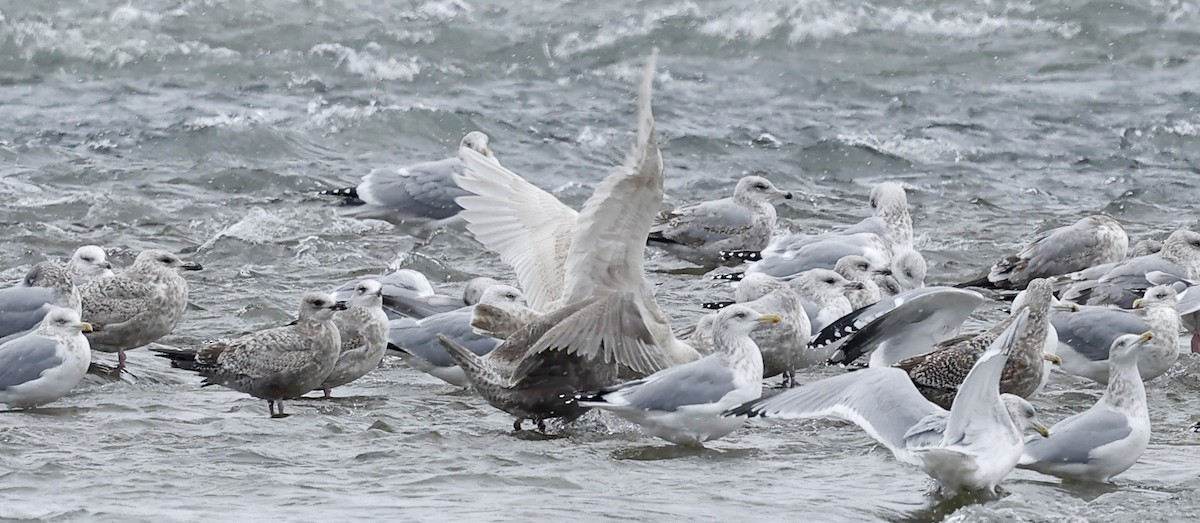
First cycle, found late this morning by Tom Kerr. First for the Niagara River. When we arrived, the bird had not been seen for an hour. It was 45 minutes before I spotted it, loafing with the many other gulls in the shallows here. We had decent views of the gull, which was mostly in full profile at a distance of perhaps a bit more than 100 yards. It was heavily overcast and snowing occasionally. I knew immediately it was the bird that Tom had found, from having viewed his photos on my phone. It was the size of a large AHGU but with short wings, with the primaries projecting much less beyond the tail tip, which was easily seen and compared. In comparisons with several AHGUs, I could see that the bill was slightly thicker than all of them and also had a stronger gonydial angle. The body was clearly stockier than most of the AHGUs. It was, however, smaller than the nearby GLGUs. The plumage was strikingly uniform and a muddy gray-brown color. There was relatively little white checkering and edging with the most prominent of this showing on the upper and under tail coverts. The throat, nape, and lower side of the head were also whitish and there was an obvious large smudgy darker patch around each eye. As pointed out to me by others, the bird did seem to appear beady-eyed. The smoothness of the muddy plumage color was especially striking on the tertials which were entirely that color except for the feather tips. The uniform muddy color extended to the wingtips, as can be seen on the upperwings in one of my photos where it and a landing Glaucous Gull are both showing a spread wing. In addition, in the video, the GWGU is preening its outer primaries, the undersides of which were quite uniformly pale, appearing whitish to my eye, and pretty much the same as a Kumlien's Iceland Gull. After reviewing Amar Ayyash's gull book, I think this is a good GWGU, though I am aware that hybridization in this species is extensive in much of its range and that close scrutiny is necessary to rule out a hybrid. After watching the bird for about half an hour, it lifted up and flew pretty much directly away from us toward a large group of feeding gulls. I lost it quite quickly through the trees and did not see any additional details in this brief view. I moved to the east end of Goat Island where there are some larger openings in the trees, hoping to find it among the feeding gulls but the visibility was deteriorating and I was unable to locate it. It was not too long after this that Josh Vandermeulin found the bird on the breakwall, close to the Ontario side of the river. Photos and video. Postscript: Alvaro Jaramillo has brought up that this bird is quite dark and that it shows structural characters similar to Slaty-backed Gull. Unfortunately, I was only able to find two photos of two individual putative first-cycle SBGU x GWGU hybrids. I am also not familiar with the range of variation in darkness for first-cycle GWGUs, other than what I see in photos but comparing this bird to photos does make me agree it is pretty dark.
Technical information
- Model
- Canon EOS R6m2
- Lens
- RF100-500mm F4.5-7.1 L IS USM
- ISO
- 1000
- Focal length
- 500 mm
- Flash
- Flash did not fire
- f-stop
- f/7.1
- Shutter speed
- 1/800 sec
- Dimensions
- 1907 pixels x 831 pixels
- Original file size
- 1.13 MB