

ML646949013
Contributor
Date
Location
- Age
- Not specified
- Sex
- Not specified
Media notes
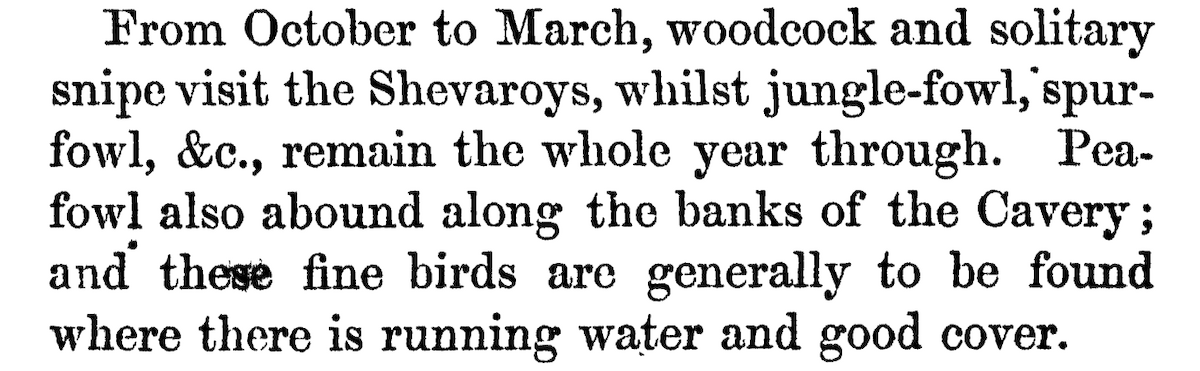
Screenshot from the book, page 8
Observation details
Reference: Dykes, J. W. B. (1853). Salem, an Indian Collectorate. Wm. H. Allen & Co. -------------------------------------------------------------------------- “When the first ‘Annotated Checklist of the Birds of Tamil Nadu and Puducherry’ was released (not published) in 2015 at the Tamil Birders Meet, that’s when I first came to know about the record of Eurasian Woodcock record from Salem; it was mentioned as ‘Specimen from Shevaroys in the Madras Musem.’ Since then, I’ve been trying to track at least the year or name of the collector of that specimen but in vain. On 14 December 2025, while searching for the nth time about Woodcock from Salem, I finally managed to get a breakthrough as I found the book: Salem, an Indian Collectorate written by J.W.B. Dykes, published in 1853. I was absolutely thrilled because, other than the specimen in Egmore Museum, there was no other report of this species from Salem but I managed to find one in this book: “From October to March, woodcock and solitary snipe visit the Shevaroys...” I got three things now at my disposal—seasonality, publication year of the book and solitary snipe. First let me clear the solitary snipe record. Back then, I believe the term ‘solitary snipe’ was loosely used in literature and does not necessarily correspond to the modern Solitary Snipe Gallinago solitaria. Given the known wintering of Wood Snipe Gallinago nemoricola in the hills of southern India and the lack of long-distance migratory behaviour in G. solitaria, this record is best interpreted as referring to Wood Snipe or another snipe species rather than the modern Solitary Snipe. I’m thankful to Dr Ashwin Viswanathan for his guidance to treat this record. Oh, and G. solitaria was described in 1836 only. So, I don’t think people would have got accustomed to the bird’s identification in a short span of time, given the bird’s elusive nature and other factors. Now, let’s get back to the Eurasian Woodcock. The preface of Dykes’ book is dated 22 March 1853. The manuscript must have been completed well before March 1853. Final edits of a 400+ page book would have occurred weeks to months earlier. Therefore, the observation of Woodcock is likely to be before the 1852-53 winter. Why not between October-December 1852? Yeah, falls safely before the publication date but assumes the author was actively adding recent observations late in the writing process. Acceptable but seems too optimistic to me. Do note that the observation is present in page 8, the introduction part of the book itself. The tone of the text too, feels like it was based on the experience over multiple winters and not a single recent event. We know Woodcocks and Wood Snipes historically wintered in southern India. So, all the more reason for the justification that it is better not to enter the record between Oct 1852 to Mar 1853. By the way, I am not saying that no Woodcock records happened during this time in Shevaroys. I am providing a reasoning for the choice of my date. Alright, so this leaves us with Oct 1951 to Mar 1952, the previous winter. This is a safe choice as it eliminates the time for publication lag, writing, editing and compilation. It aligns with the practice of marking a record from past experience rather than recent sightings. Though it moves the record one winter earlier than it is strictly necessary, I think it is a methodologically robust option as well. Hence, this record is entered in a mid-winter date, that is January 1852. Delighted to bring in Eurasian Woodcock record to Salem's eBird list.” - Ganeshwar.
Technical information
- Original file size
- 147.32 KB