

Contributor
Date
Location
- Age and sex
- Adult, Unknown sex - 1
Media notes
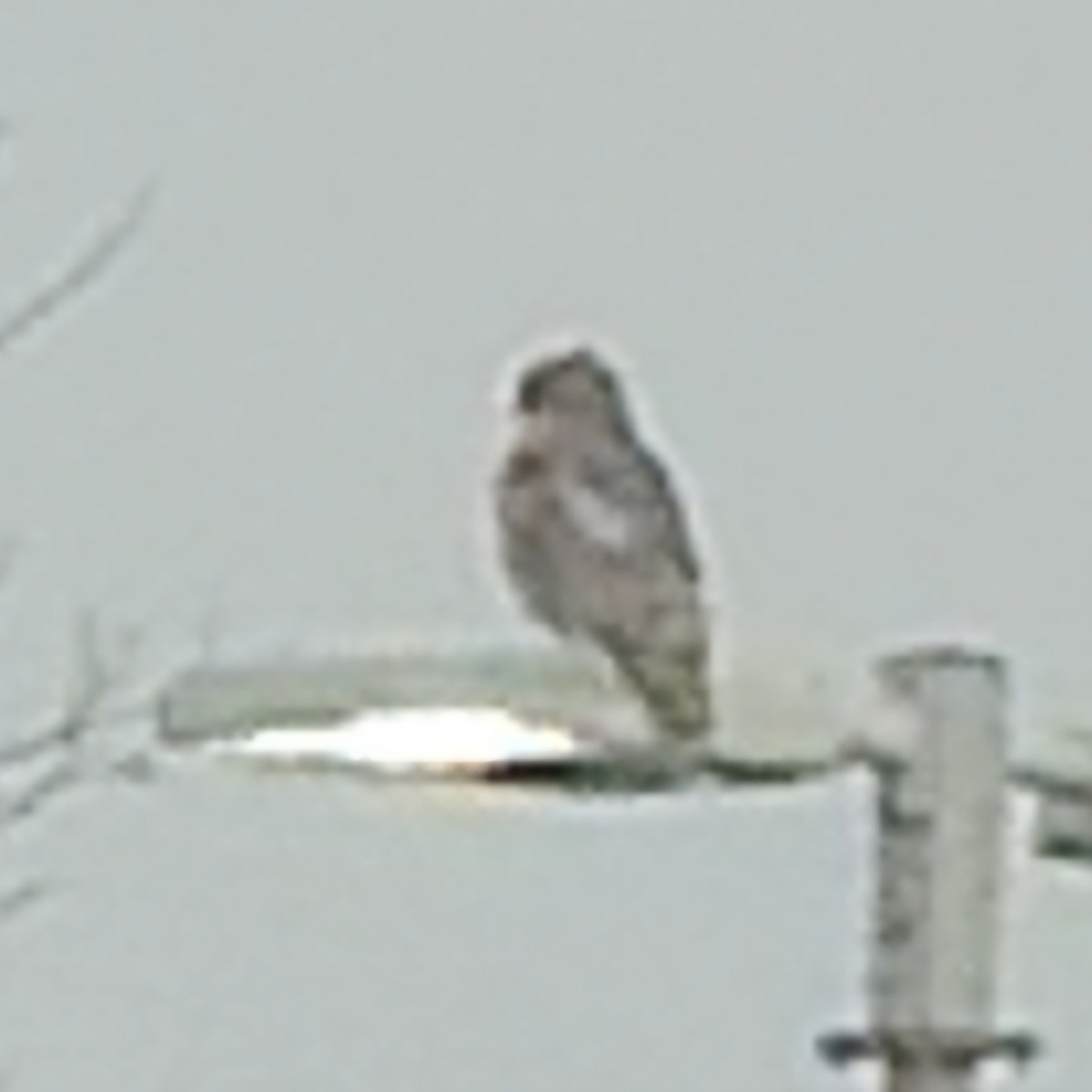
Cropped from matching pboto from Samsung S23.
Observation details
Lifer! =:-D (Photos, too, though they are poor.) This bird gave me a truly memorable birding experience. After being in the cold for about 45 minutes and not seeing anything new, I checked to see what my Merlin had recorded. Before I could confirm any of the birds it reported, my screen went dark as the phone tried to conserve the minimal charge remaining. So, I headed back to my nearby car to leave. As I was turning my car around, I saw a moderately small hawk on a light pole nearby. I drove closer to it and observed from different angles as I drove around it. I didn't know for sure what it was, but it was a great view. But that was just the nice start. The bird flew to another pole right where I had parked, so I drove back to take a picture. My phone had been charging in the car during this time, so the screen came back on. I first took two distant pictures to make sure I got something, then drove closer. As I raised my phone to take a picture, the phone battery died! Then the hawk flew off, dropping behind some tall grass and heading in the direction of Newark Academy across Eisenhower Parkway. I had cause to be bummed. Not only did I lose the photo, Merlin had crashed, too, losing all the calls I had wanted to replay and confirm (including a Hermit Thrush). Since the new Merlin updates, the app doesn't save your obs by default. This is the price for that design decision. After this bad stuff happened, something good happened. I drove out of the lot to head home and finish reporting my obs. As I turned onto the road, immediately ahead of me, sitting on a road sign was the same hawk! It was sitting atop a sign by the curb that said, "No Stopping or Standing". Well, clearly it knew something about the rules that I did not, so I drove right up and stopped directly next to it! The road is a high-speed road, and the hawk was not bothered by the cars, so my stopping didn't seem to phase it. I opened my sunroof and was looking at it right there, 5-6 feet away face-to-face. If I had been carrying a passenger, that passenger probably would have been worried about getting scalped. The hawk was that close. I smiled at it, and it gazed back at me. My dead phone couldn't take a photo. (Can you imagine the fun of getting a selfie, through the sunroof, with a wild hawk?) So, I sat there, savoring every second of the beautiful plumage of the bird and trying to take in the details. After a long 8-10 seconds at least, maybe even close to 30, the hawk had enough and flew off to another light post. AMAZING. I think it likes me. I think the bill changed shape and smiled. That's my story and I'm sticking to it. What a way to see a lifer! =:-D Anyhow, here are the "deets". I got two poor photos of the dorsal view of the bird, including the white-and-gray back. I also got a photo of the sign the hawk perched on. The hawk was about the same size as the sign, IIRC. It had a seemingly small (or short-necked), dark head (including dark nape, cheeks, chin, and throat [unlike Coops/Sharpies I've seen]), lacked a back-of-head crest (like a Coop/Sharpie) except for when a breeze lifted the rear crown feathers (when it looked like a "Harpy Hawk"). The beak seemed relatively petite, not suited for tearing up larger prey. It had a *gorgeously* rufous breast and belly, including dark streaks. When the bird's breast was exposed to the sunrise, the plumage was spectacular for me. I normally have trouble perceiving rufous color, and that's why it was so special to me to experience it so richly. I did not see any red plumage on the wings or on the neck above the shoulders. I was concerned this invalidated the possibility of it being a RSHA, but later I saw in online photos that this was not uncommon, at least not for adult RSHAs in NY/NJ from Nov to Mar. The back and upper wing feathers had a complex pattern of dark gray with white spots and spots/streaks/bars oriented every which way (maybe including completely white feathers?). Normally, I would expect some sort of consistent striping. barring or scalloping, but I couldn't perceive a pattern. Perhaps the white features seemed unordered due to either unusual feathers being exposed by the breeze or else molting. The primaries extended somewhat past the rump, but not much. However, the tail was short enough so the primaries may have still covered half of the margins of the tail. From a rear view, I could still see between the wingtips up to the rump, where the tail stripes ended. The tail had was short, broad, and generally blocky with a straight end. (The photo I took shows the tail feathers more closely aligned. I suppose the hawk was changing the degree that the rectrices splayed out.) The dorsal and ventral views both revealed a tail with at least three transverse alternating pairs of stripes, colored gray and pale white-gray. I could see the backlighting from the sky coming through the lighter tail bands. The tail was so short I thought this hawk might be a different species than I had ever ID'd, so I was not surprised to confirm later that this must have been a Red-Shouldered Hawk. The legs remained hidden due to plumage cover (unlike some views of Coops/Sharpies I've had). The talons and yellow toes had moderate to small thickness (from what little I could see). I did forget to note the iris eye color or if the ends of the individual tail feathers were squared off (versus the whole tail). I also can't remember what color the cere was.
Technical information
- Model
- Galaxy S23
- ISO
- 25
- Focal length
- 5.4 mm
- Flash
- Flash did not fire
- f-stop
- f/1.8
- Shutter speed
- 17/5000 sec
- Dimensions
- 2344 pixels x 2344 pixels
- Original file size
- 295.87 KB