

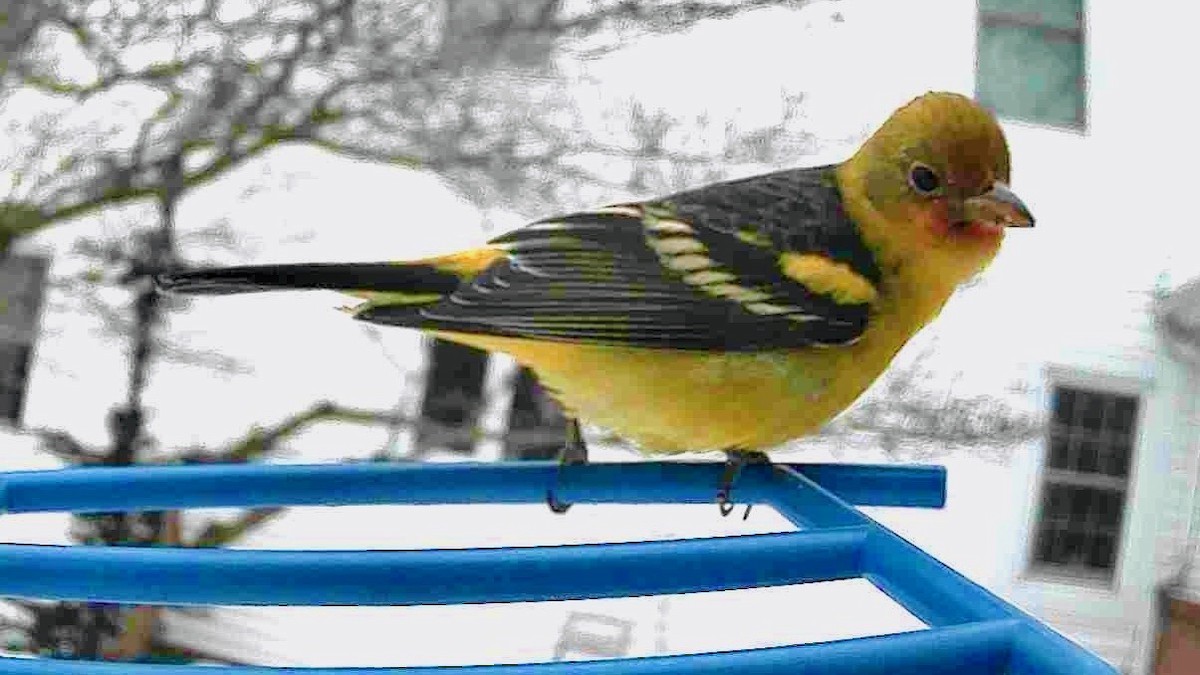
ML646632775
Contributor
Date
Location
- Age and sex
- Adult Male - 1
- Behaviors
- Foraging or eating
Media notes
Adult male Western Tanager
Observation details
This Western Tanager was present at the camera bird feeder of Mark and Kara Murphy, on multiple days: the 26th and 27th of February 2025, then again on March 1st and March 2nd, 2025. Interestingly, it showed up again at the Murphy’s feeder on 12 April 2025, after a 41-day absence. They reside at 1107 Chestnut Hill Drive in Millcreek, PA. See Mark Murphy’s eBird images of the Western Tanager from 12 April 2025 here: https://ebird.org/checklist/S273899274 Interestingly, another (or the same?) Western Tanager was photographed at a nearby feeder (just 0.8 miles away = 4250’) on 4-5 January 2025 (see composite photo, above and the following eBird checklist. https://ebird.org/atlaspa/checklist/S209168763 Due to the extreme rarity of this species in Erie County, PA, initially, some of us in the local birding community thought both of these Tanager observations 8 weeks apart were likely the same bird, but with the observed plumage differences just due to possible molt changes between 5 January and 26 February of 2025. To get a definitive answer on this molt question, James R Hill III contacted Western Tanager expert, Dr. Jocelyn Hudon, Curator of Ornithology at the Royal Alberta Museum (and author of the Western Tanager species account for Cornell's Birds of the World), because of his knowledge on molt in this species. He informed us that both of these two tanagers seen 8 weeks apart were actually of TWO DIFFERENT BIRDS OF TWO DIFFERENT SEXES! Here is what Dr. Hudon wrote: "Yes, the brighter bird is an ASY male in mostly Basic plumage. I would expect the amount of red on the bird’s head to be increasing these days, as the bird undertakes its pre-Alternate molt. The drabber bird is indeed a female. I first thought it might be a SY female, but upon closer examination it could be an ASY female in Basic plumage. The bright tips of the median wing coverts, though fairly light in color, appear to be of decent size, suggesting an older bird." [SY = second year. ASY = after second year.] This is only the third record in Erie County, PA, of a Western Tanager (with the January female being the second). What are the odds that TWO DIFFERENT Western Tanagers would show up at feeders just under a mile apart during the same winter! Perhaps even more remarkable, Erie, PA, received over 125" of Lake Effect snow during this time period and one or both of these birds seem to have survived these harsh conditions!
Technical information
- Dimensions
- 1205 pixels x 678 pixels
- Original file size
- 174.15 KB