

ML646630735
Contributor
Date
Location
- Age
- Not specified
- Sex
- Not specified
Observation details
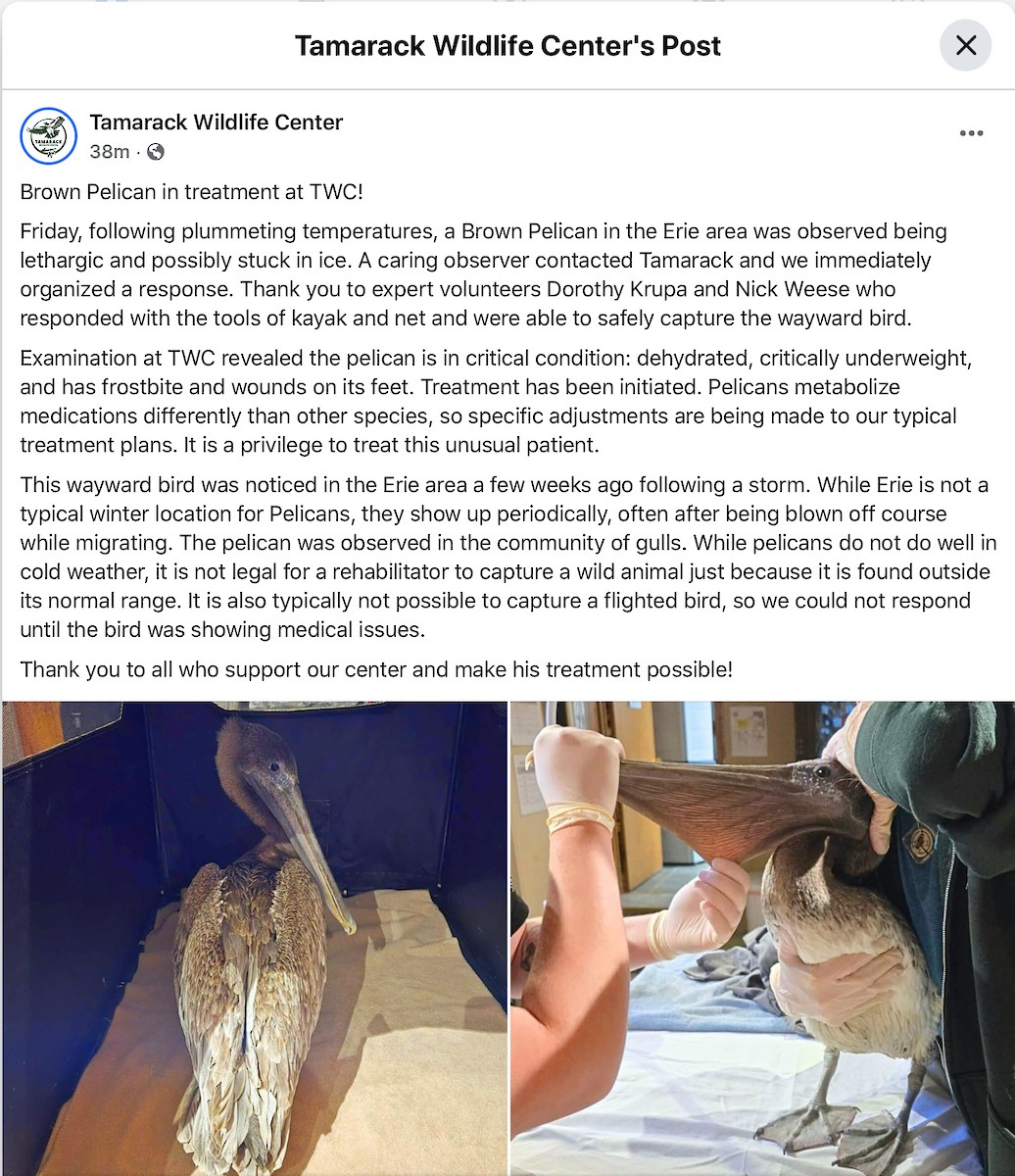
This Brown Pelican, which was reported on eBird off and on from 18 November 2025 through 5 December 2025 in areas between Dobbins Landing and the South Pier, was in distress today, unable to fly, near Perry’s Landing Boat Marina on Presque Isle Bay. In the past several days, there has been a lot of snow that fell, extreme winds, and temperatures into the low teens. Ice was starting to form on the edges of the Bay waters. Tamarack Rehabilitation Center was called and volunteer members of their team were able to capture the distressed bird using a kayak and a net in an area with a mixture of open water and ice. The bird is now in rehab. See the photo article from Tamarack's Facebook page, attached. The link to the birds' first sighing on 18 November 2025 is here: https://ebird.org/checklist/S285765263 [Update from Tamarack 10 December 2025]: “ We are sorry to share that the Brown Pelican in care at TWC passed last night. This unique bird stole the hearts of every TWC staff member and volunteer, and countless more members of the public who had been following her saga. She was admitted critically underweight and suffering from second-degree frostbite and wounds on both feet. Emaciation treatment protocols, wound care, and other treatments were initiated immediately. While she initially perked up with treatment and warm housing, the damage done to her internal organs as a result of emaciation proved to be too severe. She passed peacefully. We take comfort in knowing she was comfortable, warm, receiving professional medical care, and very much loved in her final moments. Thank you to all who followed her story and wished her well. We estimate this was a two-year-old female, based on her molt pattern and size. Female Brown Pelicans are smaller than males. They can spend summers along the Atlantic coast, as far north as Maine, and then migrate south for winter. In warm climates, they can be year-round residents. This bird was likely migrating south when a storm or solar flare caused her to lose her way. Solar flares disrupt the Earth’s magnetic field and can lead to migrating birds becoming disoriented since many navigate by sensing the magnetic field. October was an active month for solar flares. A Brown Pelican matching her description was sighted near Cleveland on October 30. We suspect this is the same bird that we have been treating. The pelican was sighted in the Erie area for several weeks. She gathered a following since it is not common to see a pelican in Erie waters. The TWC team has been concerned about this wayward bird since she arrived in our area, but we legally cannot capture a wild bird just because it is outside its normal range. It is also very difficult and sometimes impossible to capture a flighted bird. With the help of photographers, including Karen Bukowski, we have been monitoring her health status, looking for signs of frostbite or other injuries, and waiting for an opportunity to assist. Friday, December 6th, we got a call that she was lethargic, possibly trapped in ice near Perry’s Landing. TWC immediately mobilized trained and licensed capture volunteers Dorothy Krupa and Nick Weese. Water-based wildlife rescue in cold weather must be done carefully to ensure the safety of the rescuers. Kudos to Dorothy and Nick. Using a kayak and net, the bird was successfully captured and immediately transported to our center for treatment. Examination showed the bird was critically emaciated, dehydrated, hypothermic, and had frostbite on her feet. A treatment protocol was begun, including fluid therapy, rewarming, medications, and treatment of her feet. Pelicans are particularly sensitive to certain drugs, so the standard treatment plan was adjusted for this species. Concurrently, we consulted with veterinary specialists from across the country who have experience treating pelicans for cold injury. Pelicans are very susceptible to frostbite in their large throat pouch, portions of their wings, and on their feet. This bird exhibited second-degree frostbite and wounds on her feet and no apparent other cold damage. Medically, our first priority was to see if she could recover from critical emaciation. Emaciation causes abnormally low metabolic activity, so feeding too much, too quickly, is fatal to these patients. A carefully developed protocol, developed in consultation with our supervising veterinarian, is followed to prevent this. Even so, it is common for these patients to appear to improve in the first 3-4 days and then die suddenly due to cascading effects of damage to internal organs. Stabilization from emaciation takes approximately 10 days. If she had been able to stabilize, then we would have pursued transferring her to a colleague at a facility with the best tools to treat her frostbite. Recovery from frostbite can take weeks or even months, as the body slowly heals and determines which damaged tissue can recover and which will naturally be shed. Pelicans can survive well in the wild even if they lose significant portions of webbing or even a digit. It appeared she had a good chance of her feet healing sufficiently for release. If she were ultimately cleared for release medically, a release time and location would have been selected where it was normal for Brown Pelicans to reside: either in the south, where they overwinter, or on the coast after pelicans have returned for the summer. We hold deep gratitude to all who have sent good thoughts for this pelican, and the many professionals across the country who have shared their expertise to ensure she received the best possible care. It was a privilege to treat this charismatic bird. All hail the traveler.”
Technical information
- Dimensions
- 1754 pixels x 2031 pixels
- Original file size
- 1.5 MB