

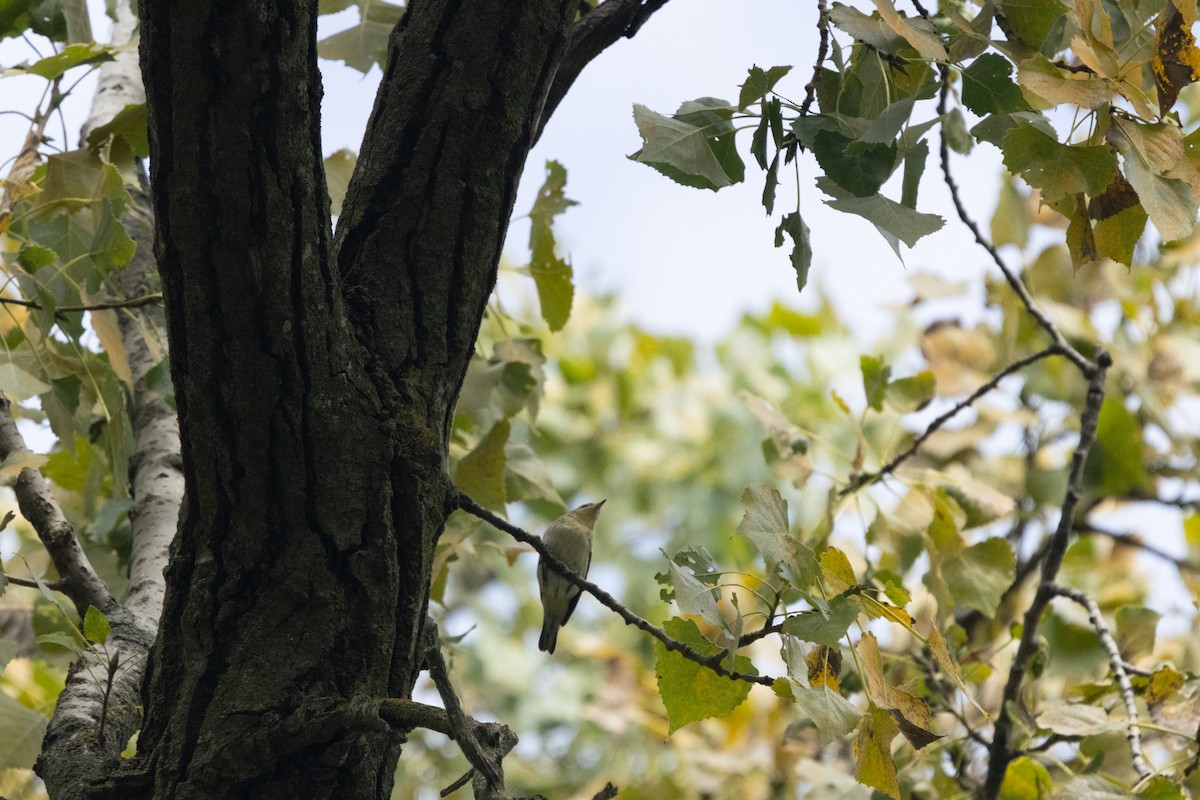
ML646256359
Contributor
Date
Location
- Age
- Not specified
- Sex
- Not specified
Observation details
Warbler remained high in the canopy and difficult to photograph but showed strong white wing bars on dark wings and had bold, pale-to-buff supercilium, plus very faint streaking below. Upperparts greenish overall. (revisiting this as of 2025-12-02) A reviewer informed me that this would be only the second eBird-approved September record of this species (Setophaga cerulea) in Dane County and requested that I upload all the photos as well as further notes on how I identified it. Unfortunately, the bird presented no dramatically more-informative angles than those in the original two photos I had added, and it made no noises. The aspects on which I based my identification were: 1) two wide, bold, and distinct white wing-bars 2) very little streaking below 3) bold, pale supercilium that seemed widest just behind the eye 4) overall greenish-blue hue to the upperparts 5) dark legs 6) cheek darker than throat; border sharp 7) refusal to descend from the highest part of the canopy 8) seen in early September Other potentially useful features I notice as I look back at the photos: 9) buffy throat and breast, whiter belly, buffy again on the undertail coverts, then white on the underside of the tailfeathers 10) overall pattern of dark & light on tailfeathers When I tried to identify this bird, I did not at first think cerulean. I considered Cape May, blackpoll, bay-breasted, pine, and especially Blackburnian. After careful study, I ruled out most of these: pine warbler (Setophaga pinus) arguments for: wing bars, distinct cheek v. throat against: brow too bold — this ruled out pine bay-breasted (Setophaga castanea) arguments for: wing bars, buffy undertail coverts against: no obvious streaking above, brow too bold — this ruled out bay-breasted Cape May warbler (Setophaga tigrina) My bird has two wide, bold and distinct white wing-bars rather than a patch or two narrow bars, almost no streaking below, and a bolder supercilium than most pictures of Cape Mays I have seen. The buffy brow on mine seems widest just behind the eye rather than directly above it. blackpoll warbler (Setophaga striata) No part of the legs appeared orange or yellow. The brow on my bird seems too bold for blackpoll and is wider behind the eye. My bird had very little streaking. Overall color of mine was bluish-green above. From comparing the photos I have to ones I can find online, the pattern of white on the undersides of the tailfeathers does not seem to match blackpoll. Of these possibilities, Blackburnian (Setophaga fusca) is the only one that still bugs me, as my guide (National Geographic’s Field Guide to the Birds of North America, 6th ed.) warns that the immature females are easily confused. I settled on cerulean because: a) In the field, the bird had a greenish-blue hue to the upperparts without streaks on the back. b) The pale supercilium did not seem to curve around to meet the sides of the neck (though the angle may be inconclusive). c) The auricular patch did not seem particularly dark, though it was distinct from the throat. One piece of potential counterevidence in favor of Blackburnian might be if this bird has pale mantle lines, but I cannot tell whether the bird shows such lines nor whether that would outweigh any of the above evidence.
Technical information
- Model
- Canon EOS R7
- Lens
- RF100-500mm F4.5-7.1 L IS USM
- ISO
- 3200
- Focal length
- 500 mm
- Flash
- Flash did not fire
- f-stop
- f/9.0
- Shutter speed
- 1/2500 sec
- Dimensions
- 2500 pixels x 1667 pixels
- Original file size
- 2.78 MB