

ML646037326
Contributor
Date
Location
- Age and sex
- Immature Female - 1
Media notes
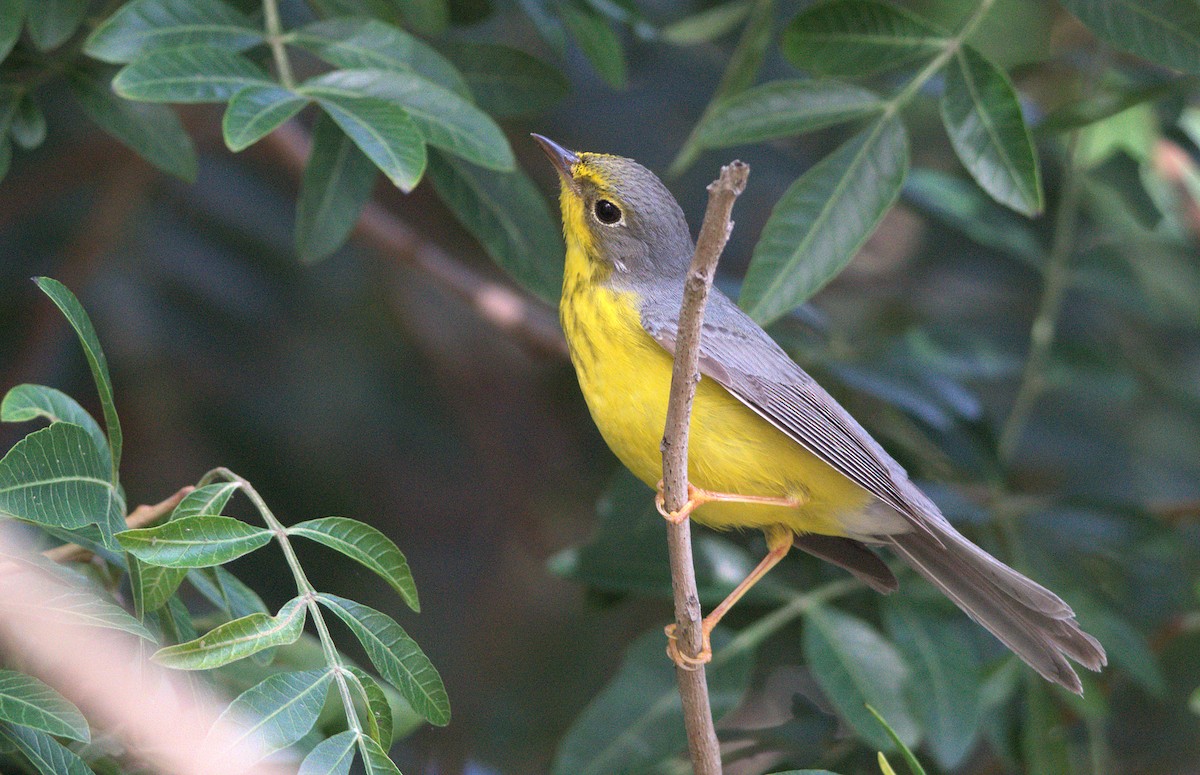
Continuing female Canada Warbler, present since initially found on 22 November 2025 by Steve Ellis, here photographed on 27 November 2025 at Huntington Central Park, Huntington Beach, Orange County, California.
Observation details
I arrived this morning to find others having just seen the continuing warbler foraging amid the large Brazilian Pepper tree that was growing over the southern edge of the pump station located south of the Park Bench Café in the eastern part of the park. We then observed this bird and took photos while it foraged actively amid this and nearby trees, and at one point while it foraged on the ground in a planter just north of the pump station. The warbler was extremely active in its movements as it moved about the trees or hopped on the ground, which made it difficult to photograph, or even to study, but I was able to get a few reasonably good photos. When I looked down, it vanished and it took me a few minutes to locate those who were following it, with it now moving among trees to the northeast across the open lawn. We continued to follow this bird while it moved among various trees along the western shore of the lake, eventually moving to the south back toward the original location, but disappearing before it reached these trees. I returned to this area late in the day and again saw the warbler in the pepper tree in which I had initially seen it, but given the lower light levels, I instead tried to study this bird as best I could before I lost track of it. Despite its active behavior and the extended period of time that I spent with this bird, I heard it give only a single, dry “chip” call that sounded about like that of a Lincoln’s Sparrow. Although I saw this bird quite well, the combination of its active behavior and the fact that I was trying to get photos, resulted in my not seeing clearly some of the characters and especially those of the bird’s structure. This was a small to medium-sized warbler with a plump body but also a rather long tail. I noted that the bill was slim and short, but I was unable to discern in the field the precise length or the finer details of its shape. The forehead was sloping and the crown was rounded, both on a head that was unremarkable in size for a warbler. The neck was short and inconspicuous, and the body was plump, full-chested, and with a posture when the bird was on the ground that appeared to be about diagonal, with the tail held downward in the plane of the body as far as I can remember. I cannot recall ever seeing in the field the details of the wing structure, but it is likely that this will be shown in my photos. I likewise noted that the tail was quite long, slim, and parallel-sided, but I was unable to compare its length relative to that of the body or note the shape at the tip. I did think the undertail coverts were quite short and rounded, but I also wondered if it may have been missing some of the longer feathers because the undertail coverts appeared a bit too short. The legs were rather long and slim, but their shape may have been accentuated by their conspicuously light coloration. This was a well-marked bird, but I had a hard time seeing some of the finer details on the upperpart pattern given that most of my views were from below when I was trying to study the bird. Overall, this bird was slate-gray above and on the wings, and a bright, lemon-yellow below, bit also with some intricate markings on the face and breast. More specifically, the crown, nape, back and sides of the neck, and the back were slate gray with no internal markings evident on the upperparts as far as I could determine. The face pattern was dominated by a narrow, yet well-defined eyering that was mostly white in coloration, but also with a broader and more diffuse supraloral stripe that was bright yellow. What I could not determine in the field was whether the yellow blended into the front part of the eyering or if the yellow and white were separated just before the eye. Demarcating the eyering and supraloral stripe was a black wedge in the lores that was relatively narrow, given that the lower edge of the black extended backward from the gape along the lower edge of the moustachial and auricular regions. I thought the auriculars were the same shade of slate-gray as the crown and with the gray continuing uninterrupted from the crown down through the superciliary region through the auriculars to their lower edge. The back and sides of the neck were similarly colored, so there was no separation between the face and back. Below the line that extended backward from the gape along the lower edge of the face and auriculars, the throat was a bright lemon-yellow from the chin down across the throat, breast, belly, sides, and flanks to the vent region. The yellow also extended upward through the malar and submoustachial regions to the lower edge of the dark face without any internal markings. Clearly apparent on the upper breast, was a band of short streaks that were grayish and relatively diffuse, yet sufficient to produce a weak breast-band. Although the belly and flanks were bright yellow to the vent, the undertail coverts were white, though apparently somewhat less extensively so that I would have expected because the undertail coverts were not as long, nor as tapered, as I would have expected. As far as I could determine, the underside of the tail was blackish and lacking any pattern. Returning to the upperparts, the back and wings appeared to be the same shade of slate-gray as the crown and neck. I did not see any markings on the back, though I did not see it exceptionally well. I further thought the secondary coverts were uniformly gray as seen in the closed wing, but I cannot recall seeing clearly the primary coverts. My views of the remiges were not exceptional, but what I could see appeared to contrast slate-gray edges to feathers that appeared darker internally, which resulted in a finely striped pattern to the rear part of the closed wing. I did not see a different pattern on the innermost secondaries, but I also did not see them overly well. I have minimal recollection of the pattern on the upperside of the tail, but my impression was that it did not contrast strongly with the wings in either its pattern or coloration. I thought this bird had a bicolored bill, with the upper mandible mostly, if not entirely, black, but the lower mandible seemingly orange or yellowish-orange, possibly to the tip. The eyes were dark, but I was unable to discern the precise color of the irides, and the legs and feet were bright orange, and probably similar in color to the lower mandible. I did not notice the claws in the field, but they are probably shown in my photos.
Technical information
- Model
- ILCE-7RM5
- Lens
- FE 400-800mm F6.3-8 G OSS
- ISO
- 1600
- Focal length
- 572 mm
- Flash
- Flash did not fire
- f-stop
- f/7.1
- Shutter speed
- 1/250 sec
- Dimensions
- 4158 pixels x 2687 pixels
- Original file size
- 18.37 MB