

ML643333621
Contributor
Date
Location
- Age
- Not specified
- Sex
- Not specified
Observation details
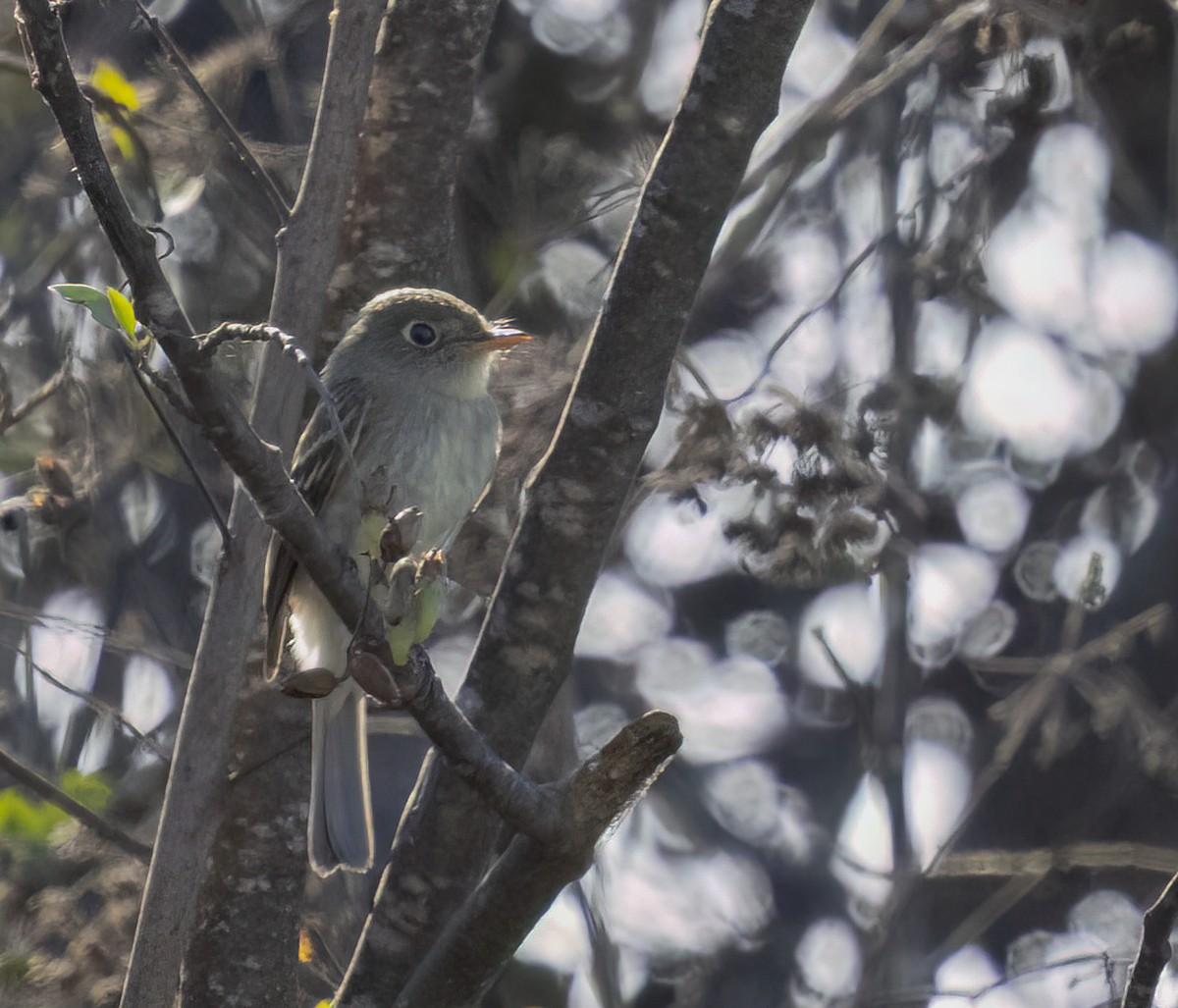
Same location as Magnolia Warbler found by Matt Brady and others. An Empidonax flycatcher that didn’t strike us as a Western Flycatcher on our initial brief looks. The lighting was terrible and was not a cooperative bird. When we did observe it, it would actively forage from perches up to 4 feet off the ground but generally 1-3 feet. It appeared somewhat large and round-headed with a noticeable eyering, small stubby bill with completely orange lower mandible and dark upper, primaries looked short, and wing panel with contrasting dark tertials and coverts with light edges, throat appeared white-ish contrasting with mostly gray underparts fading into light yellow belly area. Reviewing photos in the field we tentatively identified it as a Least Flycatcher. Shortly after we heard it vocalize “Che-bek”. It eventually vocalized this again. It was clearly audible, but not loud. I didn’t know they would vocalize this call in Fall migration. I never did hear a “whit” call that I assumed would be a more typical vocalization, but maybe we missed it. Dave Pereksta happened to arrive to look for the Magnolia Warbler and just as the flycatcher went MIA. Fortunately it did vocalize “che-bek” one more time for us three to hear while it was hidden from our view. Lastly, reviewing the guide to North American Flycatchers by Cin-Ty Lee and Andrew Birch, the primary spacing matches Least Flycatcher.
Technical information
- Model
- Canon EOS R7
- Lens
- RF100-500mm F4.5-7.1 L IS USM
- ISO
- 1600
- Focal length
- 500 mm
- Flash
- Flash did not fire
- f-stop
- f/7.1
- Shutter speed
- 1/1250 sec
- Dimensions
- 1213 pixels x 1038 pixels
- Original file size
- 1017.6 KB