

ML642499818
Contributor
Date
Location
- Age and sex
- Unknown age, Unknown sex - 1
- Behaviors
- Foraging or eating
Media notes
Nikon P900, Manual mode, white balance "Daylight (0)"
Observation details
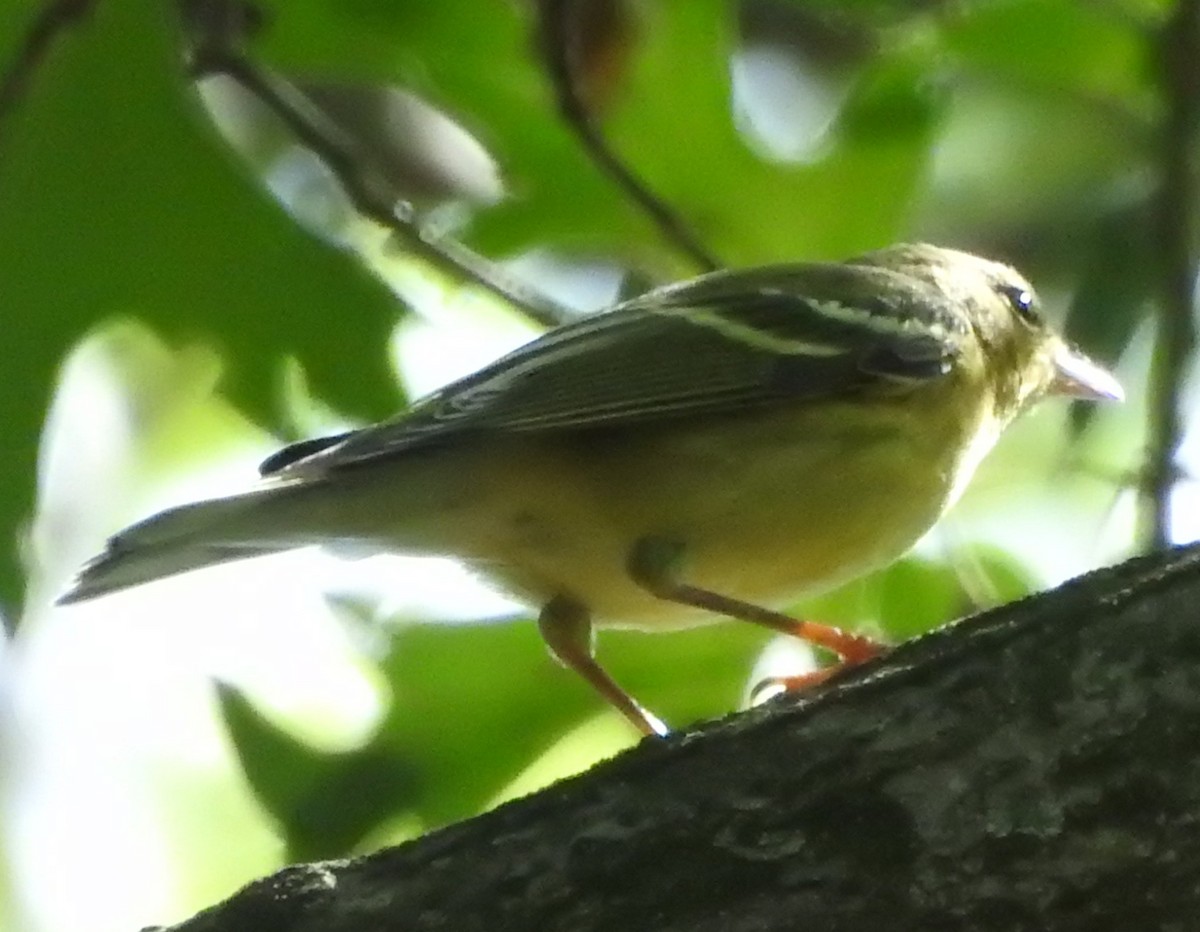
Yellowish wood warbler seen high, in the upper 1/3rd of a tall oak tree. Observation through binoculars was difficult, so I tried my camera and got one photo. Then I tried the bins again, but I mostly saw obscuring leaves and branches. It's occasional foraging movements on high branches first caught my eye. After relocating the bird's silhouette and acquiring the full-color abird in my bins field of view, my attention was drawn to the yellow wash on throat and breast, and the overall yellowish-green the impression I got. The bird was hard to view, but not because it moved a lot. It simply kept stopping out of my view a lot. During foraging, it went upside down under a horizontal branch at one point, demonstrating an ability to hold on inverted. Throat, breast and upper belly appeared yellow (or maybe yellowish green, since I don't see green well). [Note: the color in the photo is not as bright as what I felt quite certain to perceive, possibly due to excessive exposure of the photo.] The wings and rump seemed olive-brown or olive (though a finding of brown would not have been a surprise). I didn't note wing bars at the time, but I could have easily missed them, as I was busy just trying to follow the bird and not get blinded by the nearby sun. I didn't perceive streaks or spots on the breast or belly when viewing it through binoculars, but I never was able to pause and gaze. The colors were not strongly contrasting, despite the colors grabbing my attention. I didn't get a dramatic impression of patterns on the bird's face (like with a male Blackburnian Warbler in spring) and certainly I don't recall bright eye arcs or a bold eye ring, but I also can't say the head had no reasonably distinguishing features. I didn't hear it vocalize at all, so that was a disappointment. I didn't observe any other warblers around. So, it didn't seem to be socializing with a wave of other birds. Additional details revealed in the photo: 1. Orange "socks", with a color breakpoint just above the ankle on the tarsus. 2. Short tail, white underneath, with long white UTCs. Dark edge of tail feathers are so narrow as to be barely noticeable, as compared to dark club-like bands seen in guide books. Also, the tail seems to have no visible black outer edge, although these birds are expected to have a dark, thin edge on the tail (e.g., ref. The Warbler Guide, "Eastern Undertails" section). 3. Long wings (which I perceived in the birds general profile as it moved). I note that the wingtips seemed to hug the body and didn't seem to leave a gap, as a robin's drooping wings do. 4. White wing bars, along with primaries exhibiting white edging (at least on their visible ends). 5. Beak is a bit short, but robust. 6. No dramatic eye stripe, though the lighting washes out the visibility of any weaker form of any eye line. Ageing/Sexing: F or Yr1 M?
Technical information
- Model
- COOLPIX P900
- ISO
- 1600
- Focal length
- 499.8 mm
- Flash
- Flash did not fire
- f-stop
- f/6.5
- Shutter speed
- 1/640 sec
- Dimensions
- 2109 pixels x 1638 pixels
- Original file size
- 388.71 KB