

ML641277538
Calidris sp. Calidris sp.
Contributor
Date
Location
- Age
- Not specified
- Sex
- Not specified
Observation details
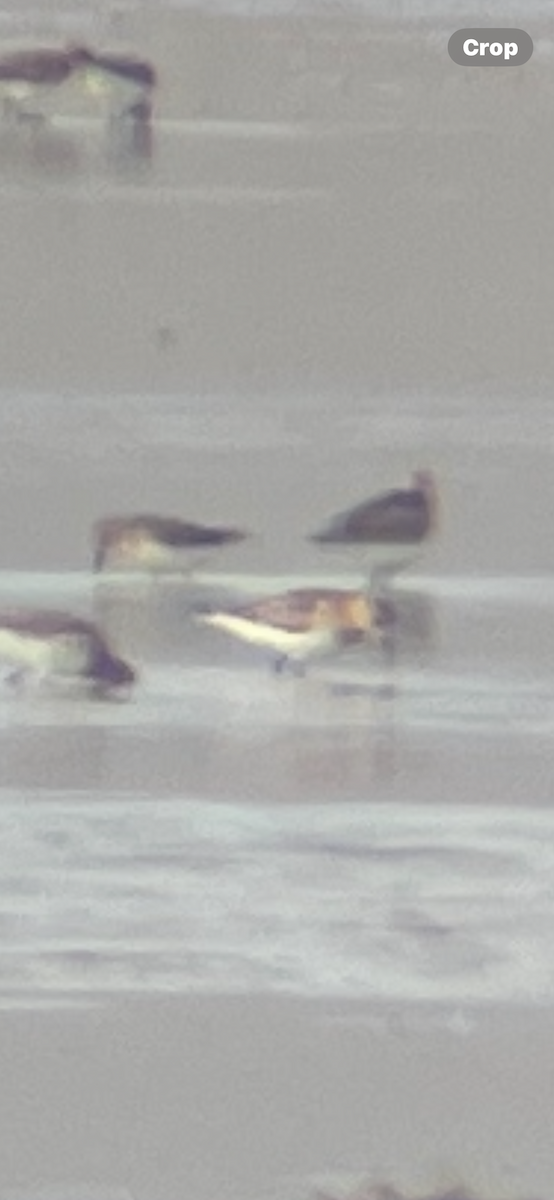
Possible stint. Zack pointed out a peep to me and asked if it could be a Least. I didn’t think the coloration on the head/breast was dark or extensive enough. The middle of the breast/throat appeared paler, unlike Least which should be solidly patterned across the throat/upper breast. The bird had a strong eyebrow with a very clearly pale forehead. The sides of the breast were a little buffy and overall the bird's back appeared warm-toned. We quickly realized that it did not fit well for Least, Semipalmated or Western sandpipers, despite clearly being a smaller peep. At this point, I started to look at stints on the Sibley app. I threw out Red-necked, though Zack thought it looked better for Little. Zack tried to get some digiscoped photos but the bird was at least 100 yards out and the photos are inconclusive at best. Conditions were challenging, hot and increasingly hazy throughout the late AM, and our viewing / documenting equipment was not up to the challenge. Equipment was a 15-45x65 spotting scope, a Vortex 20-60x85 spotting scope, and an iPhone 12 mini. Digiscoped photos were obtained freehand with no eyepiece rig. Below is a cleaned up version of our notes from the field, mostly Zack’s thoughts as recorded in a voice memo while scoping the individual: "So we have a peep sized shorebird mixed in with a couple semipalmated sandpipers and a few Baird’s. It stood out for not having the posture or the overall dingy but kind of bright, colorful look of a least. The top of the head matches the dominant color of the back and the scapulars. It's got a strong white line or two white lines going down from the scapulars. The forehead, when it's directly facing, is decidedly pale and there is a clear eye stripe (eyebrow). The breast coloration is dingy, but not significantly dark and very much restricted to the upper breast and neck. Sides are pale and clean, belly is white and clean. Body feathering on underwing is bright white. Beak is maybe ever so slightly decurved, but barely at all. Not as broad based as semipalmated sandpiper and the overall size appears to be maybe a little bit smaller than the semipalmated sandpipers around it. The coloring on the sides of the neck appears to be very slightly buffy or warmer-toned (not grayish or dingy). It's got a rusty undertone, which gives the bird an overall warmer colored plumage. There's a lot of contrast between the warm colored plumage and the white undersides." Post-observation: After studying this bird for a while, several shorebirds lifted off, seemingly including this bird, as we weren’t able to refind it after that. We both agree that this bird did not fit for any of the expected peeps (Least, Semipalmated, Western), but we collectively have very little experience with stints. Overall the bird seemed to forage and move in a more upright position than Least and was not as dark on the breast or as small-billed as that species. Compared with Semipalmated and Western sandpipers this individual does not seem to be a clean match in any plumages that we have observed for those species. Another note is that while we observed the bird it shared the same scope-view with Baird's and Semipalmated sandpipers and it consistently appeared warmer and more rusty-toned on the upperside (cap and across the entire back) without being dark and "scallopy" as with Semi or Baird's. It was approximately the same size as Semi, and definitely smaller than Baird’s with shorter primary projection as well. We did not pick up on any notable differences in behavior or foraging style and were too far to discern leg color definitively. The beak always appeared straight on the upper beak and never with as decurved upper or lower mandible as typical Western. That said, from our observations, we now think that Little stint may be the best fit, especially because of the prominent cap color, strongly contrasting eyebrow, and apparent white braces, all visible even given the subpar viewing conditions and pushing the limits of our spotting scopes. We believe with ~95% certainty that this did not fit for our common North American peeps, but our immediate post-observation feelings had us with Miles only about 60% certain of Little stint and Zack around 75%. We have included the digiscoped shots in this report, and have solicited opinions of other experienced birders, though I think it is unlikely we will be able to call this anything other than “Calidris sp.” or “the one that got away.”
Technical information
- Original file size
- 2.32 MB