

ML634928366
Contributor
Date
Location
- Age and sex
- Adult Male - 1
- Behaviors
- Flying
- Tags
- Field notes/sketch
Media notes
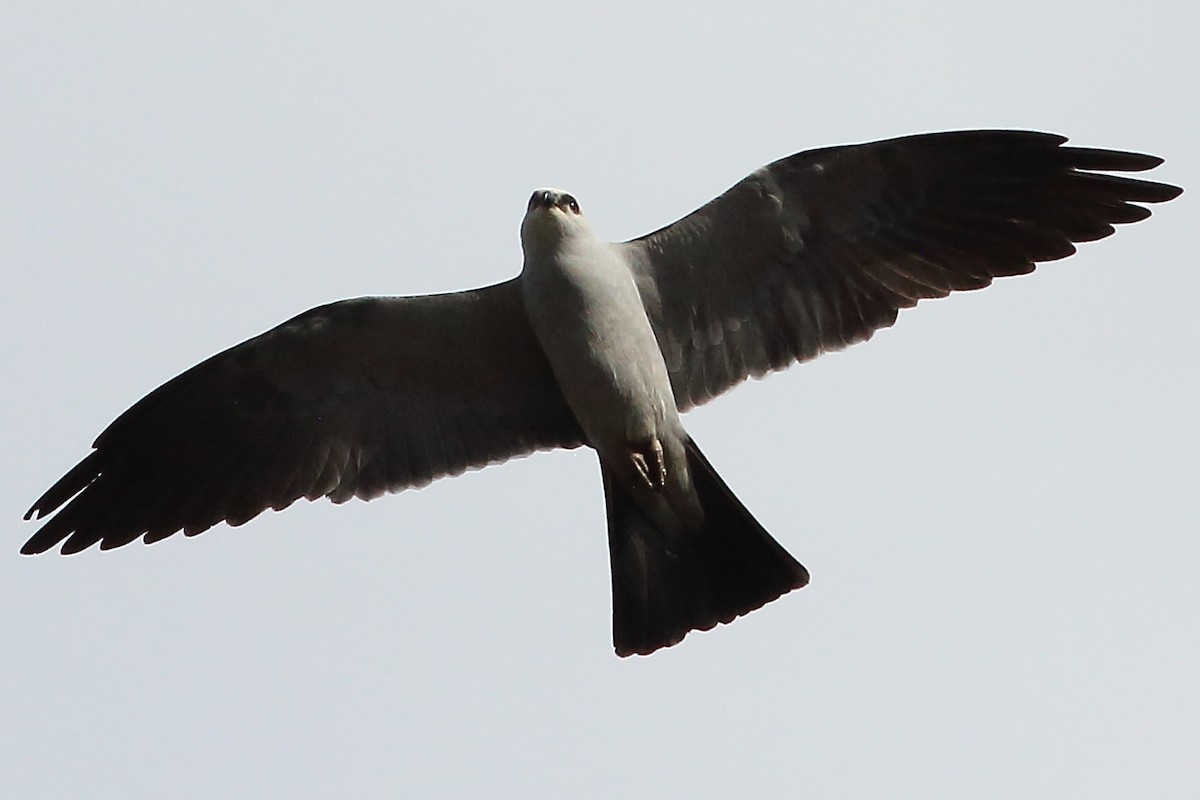
Adult male. Some educational minutiae re image: * p10 being short is common or the norm in raptors. With MIKI, p10 is extremely short, really a stub, or as Wheeler said "the outermost primary (Pl0) is considerably shorter than the longest primaries (P9 is longer, and P8 is the longest)." (Wheeler 2004) * right above the bill in this photo a very thin portion of the crown is visible appearing as a thin bright white line. The male's crown is pale/brighter than the female's. Note the brightness of this crown compared to the greyish to the left side of the head (portion not in shadow). * this male shows a uniform underbody. The region just forward of the tarsi/feet to the crissum is uniform without any markings. This is where the female shows considerable differences from the male. Wheeler (2004) describes three different patterns in the adult female UTC. Some of my past sightings of adult females have such high contrast in the markings in the UTC area the female can be easily ID'd in the field. Of course, always easier to sex with decent quality images. * Wheeler also describes three different patterns in the adult female ventral tail that, like the UTC, can sex a male from a female. Here in this male, the right r6 is in shadow but the left r6 shows a faint greyish rachis in the basal region. Wheeler (2004) states "note that all females have all-white feather quills on the outer rectrix set, which are distinct even at a moderate viewing distance)." I have seen this in my past images of adult females where the white in r6 is bold unlike the male's and extends nearly the full length of the feather, unlike the male's that limits the grey to the basal region. * tail tip is flat, no notch, no bulge. A key trait is the outwardly flared tail. In this photo, the tail is not fanned wide yet we can still see the outward flare on r6. When fanned wider, the outward flare is bold and is a trait that can ID a MIKI in a flash instant.
Observation details
Always rare for this location per eBird. Adult male. Part I, Educational Minutiae, adult male Mississippi Kite (UPD ...Tomorrow the female). * p10 being short is common or the norm in raptors. With MIKI, p10 is extremely short, really a stub, or as Wheeler said "the outermost primary (Pl0) is considerably shorter than the longest primaries (P9 is longer, and P8 is the longest)." (Wheeler 2004) * right above the bill in this photo a very thin portion of the crown is visible appearing as a thin bright white line. The male's crown is pale/brighter than the female's. Note the brightness of this crown compared to the greyish to the left side of the head (portion not in shadow). * this male shows a uniform underbody. The region just forward of the tarsi/feet to the crissum is uniform without any markings. This is where the female shows considerable differences from the male. Wheeler (2004) describes three different patterns in the adult female UTC. Some of my past sightings of adult females have such high contrast in the markings in the UTC area the female can be easily ID'd in the field. Of course, always easier to sex with decent quality images. * Wheeler also describes three different patterns in the adult female ventral tail that, like the UTC, can sex a male from a female. Here in this male, the right r6 is in shadow but the left r6 shows a faint greyish rachis in the basal region. Wheeler (2004) states "note that all females have all-white feather quills on the outer rectrix set, which are distinct even at a moderate viewing distance)." I have seen this in my past images of adult females where the white in r6 is bold unlike the male's and extends nearly the full length of the feather, unlike the male's that limits the grey to the basal region. * tail tip is flat, no notch, no bulge. A key trait is the outwardly flared tail. In this photo, the tail is not fanned wide yet we can still see the outward flare on r6. When fanned wider, the outward flare is bold and is a trait that can ID a MIKI in a flash instant.
Technical information
- Dimensions
- 1484 pixels x 989 pixels
- Original file size
- 700.15 KB