

Contributor
Date
Location
- Age
- Not specified
- Sex
- Not specified
Observation details
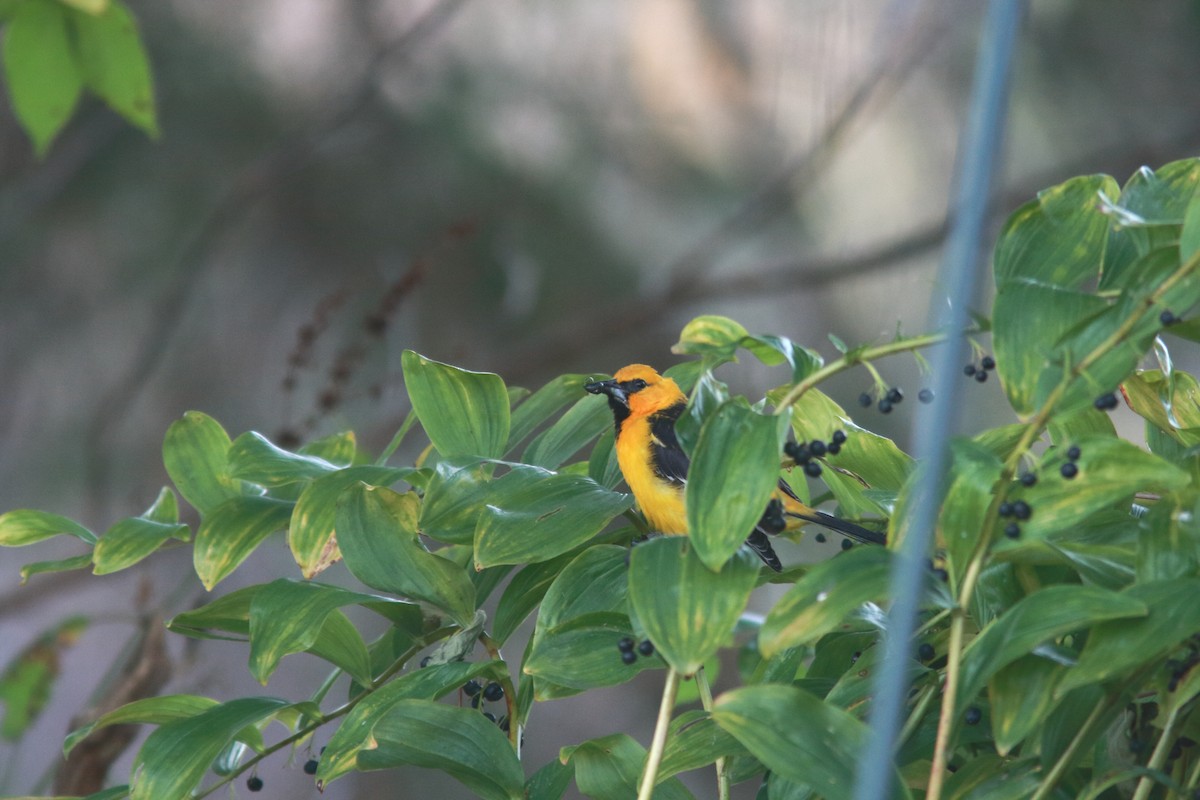
Observé et photographié par André Picard. L'oiseau a été observé les 24 et 25 octobre 2011. Communication d’André Picard avec Peter Pyle, les 26 et 27 octobre 2011 : A. P. : « I am in Quebec canada, this past weekend I have received an unusual visitor in my yard, birders here don’t know exactely the species, because the bird is a mexican and costa rica bird. Two species has been keep, Altamira oriole and Streaked backed Oriole. Does can I sent you 4 pictures for identification? ». P. P. : « Thanks for sending the photos. It looks better for Streak-backed Oriole to me based on the slightly smaller and thinner bill with a lot of blue-gray at the base, and the slight orange streaking or mottling in the back. Altamira should have a thicker bill with less blue-gray and a black back without orange. If you hear it call this could also help with the identification - Streak-backed has generally slightly harsher calls and has a double-noted uprising "cherr-it" call whereas a common call of Altamira is a more-melodic three-noted "choo-wee-oo". It would be a southern Mexican subspecies of Streak-backed Oriole, with this much black in the back, and for an adult male (rather than a young bird) I think then it might be more likely an escaped caged bird than a wild vagrant. The same would be the case for Altamira Oriole. Hope this helps, ». En 2020, un Oriole à dos rayé (groupe sclateri) a été documenté au Texas, indiquant que ce taxon s'égare bel et bien. In 2020, a Streak-backed Oriole (sclateri group) was documented in Texas, indicating that this taxa can be an authentic vagrant. Ssp pustulatus was the only population priorly know to show vagrancy patterns. https://macaulaylibrary.org/asset/245615681
Technical information
- Model
- Canon EOS DIGITAL REBEL XTi
- ISO
- 800
- Focal length
- 420 mm
- Flash
- Flash did not fire
- f-stop
- f/5.6
- Shutter speed
- 1/125 sec
- Dimensions
- 3888 pixels x 2592 pixels
- Original file size
- 6.46 MB