

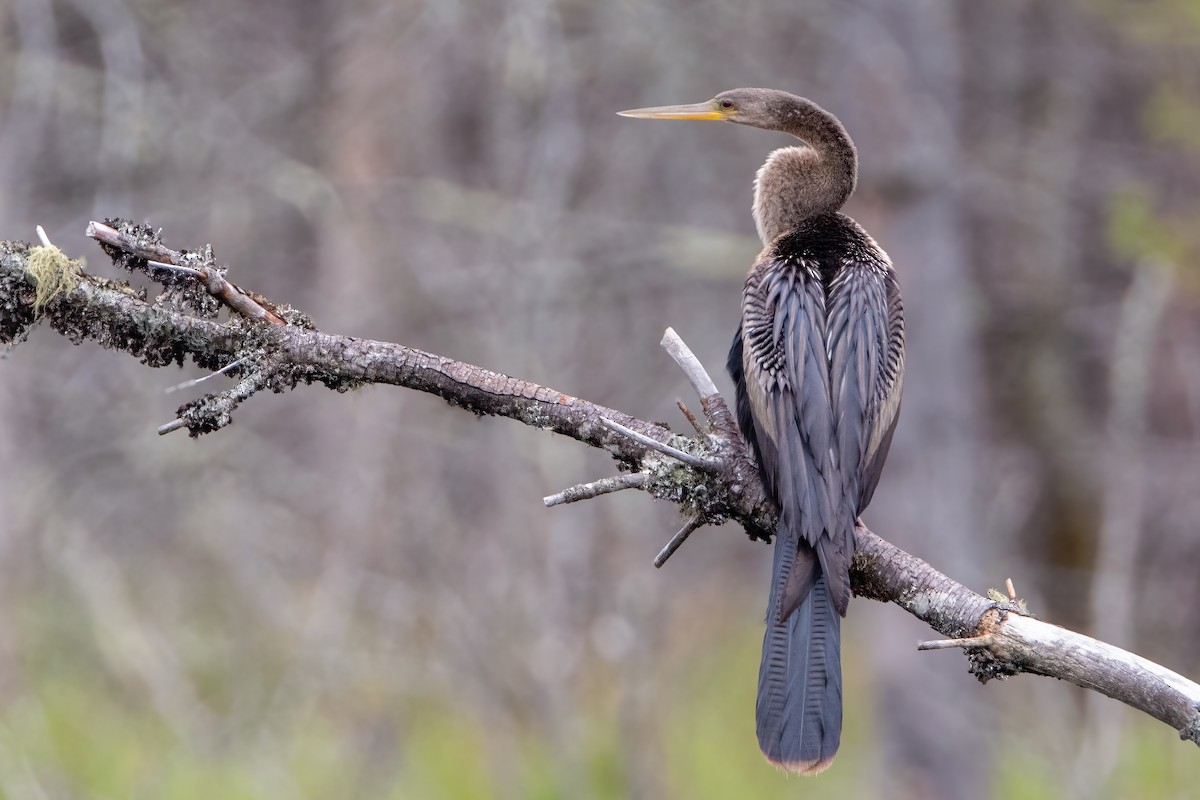
ML621898964
Contributor
Date
Location
- Age
- Not specified
- Sex
- Not specified
Observation details
***MEGA | First state record | reported on MAINE Wildlife Facebook page by Tabatha Holt. Immature or female. More notes to be added. Instructions on access as shared on GroupMe: The ANHINGA is in a flooded meadow on the east side of Hewett Road in Somerville, about 0.4 miles north of Route 17. This is a narrow dirt road and visitors need to be very cautious of their speed (25 mph) and not to trespass on either end of the location. Recommended parking is on the east side of Hewett Road, starting near the little island of pines, here: https://maps.app.goo.gl/E5hCHWmciLByP7KD7 and continuing north. Please do not park past the first telephone pole south of this pin, or go beyond the two north of here. There should be space for ~10 cars at a time, so please don’t stay too long and do your best to carpool. Again, make sure you do not block traffic and beware of the deep culvert on the opposite side of the road. When we arrived, the bird was perched facing us on an arching branch over the flooded beaver pond. According to folks living directly opposite the pond, this bird had been present for about a month. They recognized it as the same but did not know what it was. Moreover, they recognized the low, grating calls that this bird gave at times, knowing it was not like any of the frogs present. This beaver pond is also relatively new. I did not hear how many years, but the area was historically hayed and mowed. This was a cormorant sized bird with a long, skinny neck and small head with long, sharply pointed yellowish bill. The foreneck and breast were grayish-buff and terminated sharply at the belly by a thin and irregular chestnut band. The belly was blackish. The hindneck and upperparts were blackish, with one or two scapulars showing white the length of their short length and some white flecks in the crown. The wing coverts were grayish and showed as a weak panel across the wing. The remiges were blackish, and I did not see any ornamentation or barring on the inner secondaries or subscapulars (maybe slight barring on longest). The tail was very long and blackish with a narrow cinnamon band at the tip. The outer web of the two central rectrices showed bars (corrugations) along most of their length. The skin around the eye was yellowish, and the iris was dull reddish. The gular pouch was pinkish and distended into a rounded bulge at times, especially when the bird uttered its low, grating calls (usually shortly after landing). The feet were dull yellowish with the hind (posterior) side of the tarsi black. The bird flew down to the water, where it swam and foraged, only the skinny neck and head showing above the water. It would pursue prey underwater for extended periods, twice emerging with elongate, thin fish of some sort. After its foray in the water, the bird returned to a perch above the water, where it spread its wings and preened for an extended period. I noticed the alula was large and pronounced and often held extended above the wing, more than I expected. This is the first record for Maine and part of a recent spurt of birds north of their normal range, which recently included nesting as far north as Maryland. As for age and sex, the barring in the tail feathers but not on inner secondaries or scapulars suggests a bird not fully mature but older than first year, probably in its second cycle of plumages. The reddish eye also suggests some maturity as well. The limited and not pronounced pale internal markings on the scapulars and wing coverts as well as apparently all black inner secondaries also suggests an immature. It seems likely it was a female given a male in its second cycle should show black at least mixed in on the breast and foreneck.
Technical information
- Model
- Canon EOS R5
- Lens
- RF100-500mm F4.5-7.1 L IS USM
- ISO
- 1000
- Focal length
- 500 mm
- Flash
- Flash did not fire
- f-stop
- f/7.1
- Shutter speed
- 1/800 sec
- Dimensions
- 4800 pixels x 3201 pixels
- Original file size
- 3.86 MB