

ML621415617
Contributor
Date
Location
- Age
- Not specified
- Sex
- Not specified
Observation details
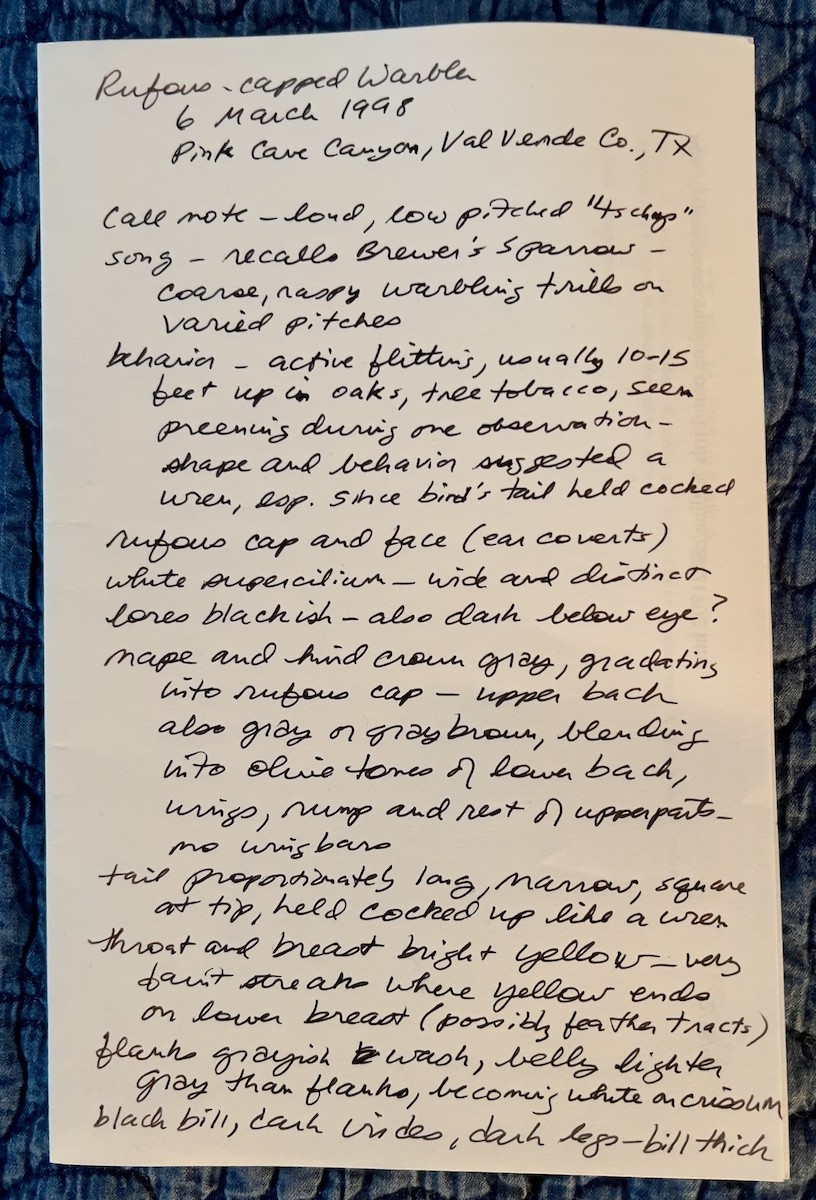
At least one singing male in Pink Creek Cove, just west of Seminole Canyon National Monument. One was first found on the Comfort CBC and relocated by various observers including Willie Sekula (ph.), and Mike Gleason (first report of at least two birds in late February). Seen for a total of about 30 minutes between 1030-1200. Swarovski 10x42, overcast, 30-100 feet. Details to Texas Rare Birds Committee [one individual accepted from 27 December 1997 to 6 March 1998 (CW, SS, WS, J&BRi, PSv; 1998-44; TPRF 1595)]. We traveled by boat on Amistad Reservoir to Pink Creek Cove (just west of Seminole Canyon) with Susan C. Barton, and John & Barbara Ribble. Documentation for Rufous-capped Warbler submitted to Texas Bird Records Committee: "Behavior (flitting quickly) and posture (long, narrow tail, cocked up from body) very wren-like, while song recalled that of Brewer's Sparrow (series of coarse, warbling trills delivered on varying pitches). Nearly always located by call note (dry, low-pitched "tschet") which was sometimes given as a series of introductory notes, followed by song. Sang from exposed perches. Habitat: shallow, dry canyon facing the Rio Grande River to the south, with various shrubs and mixed deciduous trees (live oak, Spanish oak, Mexican buckeye, mountain laurel, hackberry). One was seen feeding in tobacco (Nicotiana sp.) and another was preening while perched in a Spanish oak. First bird located about 50 yards from water's edge, foraging in tobacco, seen by all members of our party (Sue Barton, Barbara & John Ribble, Peder Svingen). After the bird disappeared, PS continued up the canyon, relocating the first bird about 100 yards from water's edge. After about 10 minutes, PS continued on another 150 yards and watched a second bird singing, foraging, and preening. No evidence of nesting despite scrutiny for 20 minutes. Second bird still singing when PS started back towards our boat, with first bird then relocated in same territory as before. Although two birds were never seen together or heard simultaneously, it was most improbable that only one individual was present. We also heard (but never saw) an apparent Rufous-capped Warbler singing from the hillside SE of where our boat was tied up, suggesting the possiblility of up to three birds! Description: "Black bill, dark irides, pale legs. Rufous crown, becoming gray on nape and anterior portion of back, gradually becoming olive on back. Wings olive and without wingbars. Rump same color as back. Tail also olive, proportionately long and narrow, sqaured at tip, and always held cocked up like a wren. Strong white supercilium. Black lores with black extending around eye. Rufous cheek patch (auriculars), same shade as crown. Throat and breast bright yellow, abruptly becoming whitish on belly. Pale gray-brown wash on flanks. Under tail-coverts not seen." Prior experience with this species: none for SB and PS. Barbara & John Ribble had seen and heard one Rufous-capped in this area on two previous trips in 1998. Field notes were completed that same afternoon before consulting any field guides. The NGS field guide was the only reference available to us while in Texas and does not show gray on the nape. It was therefore a relief to return home and review "Warblers of the Americas" (Curson et al. 1994), "Warblers" (Dunn and Garrett 1997), "Birds of Costa Rica" (Stiles and Skutch 1989) and "Birds of South America" (Ridgely and Tudor 1989) which all show varying amounts (depending on the subspecies) of gray on the hindnape. Dunn and Garrett suspect that B. r. jouyi is probably responsible for records in south Texas and possibly Big Bend, since this race is known to occur within 50 miles of Falcon Dam and ranges "from Nuevo Leon and w. Tamaulipas south to Hidalgo and Puebla." However, jouyi is reported to lack a grayish collar (Curson et al. 1994). Egg dates are given as April-July.
Technical information
- Model
- iPhone 13 Pro Max
- Lens
- iPhone 13 Pro Max back triple camera 5.7mm f/1.5
- ISO
- 400
- Focal length
- 5.7 mm
- Flash
- Flash did not fire
- f-stop
- f/1.5
- Shutter speed
- 1/40 sec
- Dimensions
- 2387 pixels x 3510 pixels
- Original file size
- 2.27 MB