

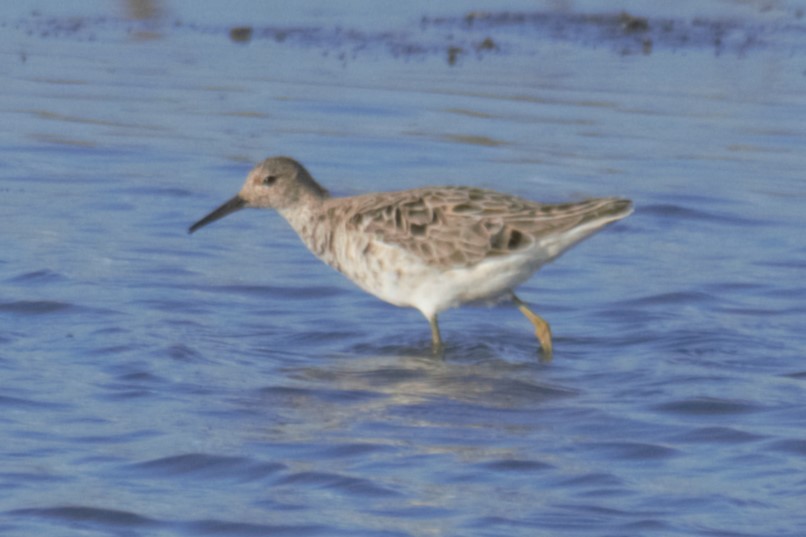
ML619161607
Contributor
Date
Location
- Age
- Not specified
- Sex
- Not specified
Observation details
Found by Peter Mundale and identified by myself (although I think Peter had a pretty good hunch of what he was looking at!). Photos. Size – Slightly larger than nearby Lesser Yellowlegs. Structure – Relatively small, rounded head with small beady eyes and comparatively short, slightly decurved bill. Thick-necked and heavy-breasted, with slightly pot-bellied appearance. Hump at the midpoint of the back. Long, slightly curled tertials extended over the relatively short wings that did not extend past the tail. This was a longer-legged shorebird. Plumage – Female molting into alternate plumage. Fairly plain-faced shorebird with the exception of a small dark mark behind the eyes. Head washed sandy brown except for the whitish forehead, chin, and throat. Nape sandy brown, extending down the dorsal side of the bird, with older basic mantle feathers, scapulars, and secondary coverts appearing an unmarked sandy brown. There were a handful of fresh alternate scapulars, which had black, smoothly marked centers with fine white margins. Tertials were barred sandy brown and blackish. Uppertail coverts dark brown in the center surrounded by the classic white U-shaped pattern. Rectrices brownish. Breast whitish but heavily mottled with dark brown markings. Flanks, belly, vent all whitish. Vocalizations – None detected. Bare parts – Eyes and bill black. Legs a pale yellowish-green. Behavior – loosely associated with a group of Lesser Yellowlegs, Pectoral Sandpipers, and several other shorebird species. Observed feeding in a tipping motion in near belly-deep water. Later seen feeding on the muddy edges and in the vegetation along the shore of the pond. Similar species: This is a straightforward ID for an experienced shorebird observer even as a female bird. Main concerns would be a spring Buff-breasted Sandpiper (rare in Minnesota), but this bird lacked the dark comma in front of the eye that BBSA show, had duller legs, different tertial and rump pattern, and a different feeding pattern (BBSA tend to run along the edges of grass and mud). Stilt Sandpiper easily ruled out by flank pattern (STSA would be barred at this point in the year) different rump pattern (all white on STSA), and different tertial pattern. Both yellowlegs and Pectoral Sandpiper easily ruled out, see photos.
Technical information
- Dimensions
- 806 pixels x 537 pixels
- Original file size
- 62.47 KB