

ML128671301
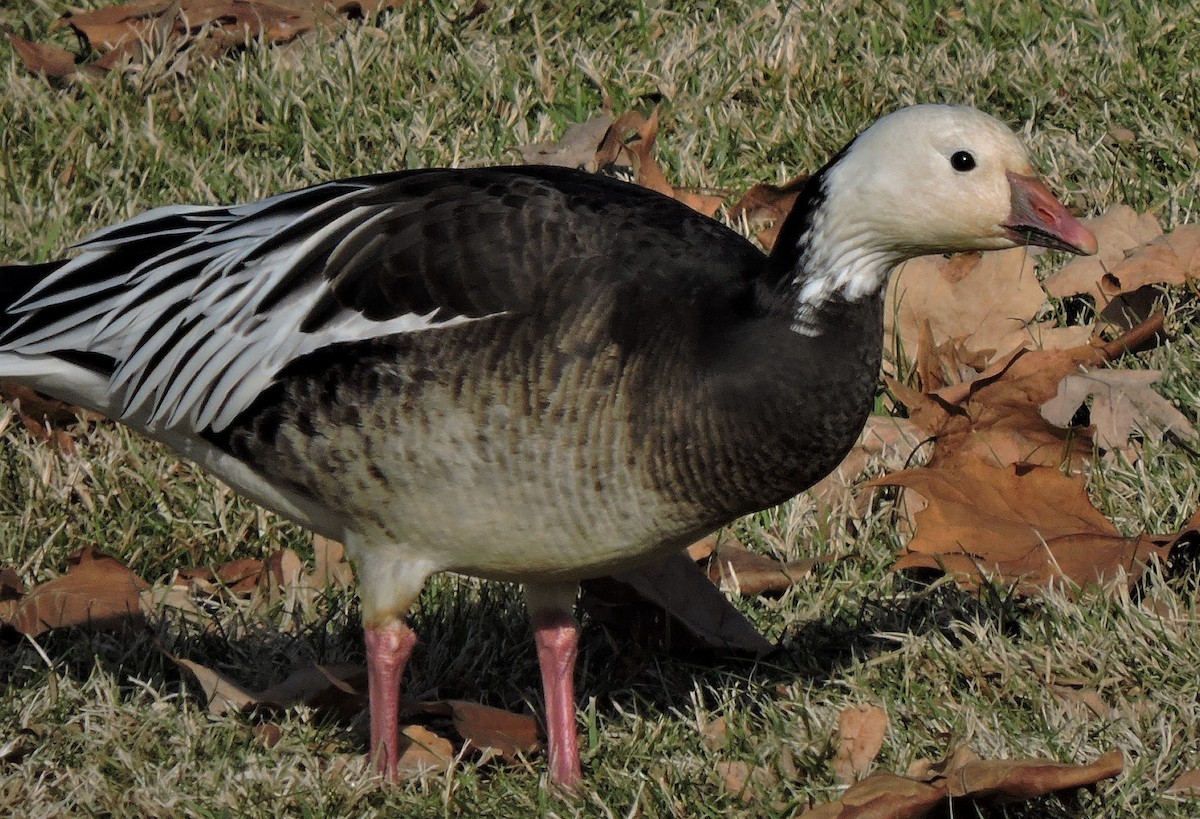
Snow x Ross's Goose (hybrid) Anser caerulescens x rossii
Contributor
Date
Location
- Age
- Not specified
- Sex
- Not specified
Media notes
Showing the iron stained face seen at a closer distance and brownish forebelly, contrasting with the white undertail coverts/rear belly, rather than expected white forebelly of blue phase Ross's.
Observation details
FRS, submitted 12.14.18 Smaller goose than Cackling Geese it was near c just as short of neck, but a proportionately larger bill. However, as noted in the introductory paragraph of this 1979 Auk article Blue-phase Ross's Geese and Other Blue-Phase Geese in Western North America found here https://sora.unm.edu/sites/default/files/journals/auk/v096n03/p0544-p0550.pdf, "Dzubin (1979) has often observed blue-phase geese no larger than Ross' Geese at autumn migration staging areas in southwestern Saskatchewan." As can be seen in Figure 2 of that article the size difference between Ross's Geese and intermediate hybrids can be minimal. So physical gross size should not be a consideration; e.g. https://ebird.org/view/checklist/S22079011 Additionally there is research that Snow Geese hatched from smaller broods or later in the year grow more slowly and can become smaller sized adults. https://www.researchgate.net/publication/229193154_Body_Size_Variation_in_Lesser_Snow_Geese_Environmental_Plasticity_in_Gosling_Growth_Rates The bird had the white primary coverts expected of a blue morph Ross's Goose but other characteristics are in line with a hybrid: 1. When seen at a closer distance the bird's face was stained with iron - something that a Ross's is less inclined to show than a Snow Goose. Kortright notes the adult Blue Goose head and neck are white, with rusty stain suffused over face and cheeks, deepest in color around base of bill, which is what this bird showed. The Kentucky Ornithological Society publication noted in 4. below also notes, "The plumage of Ross's Goose is typically very white and rarely attains the rusty staining which Snow Goose often does, particularly about the head and neck." 2. The crown was not dark in the center, which would be expected of a dark morph Ross's as is illustrated by Sibley and National Geographic and previously documented here https://sora.unm.edu/sites/default/files/journals/auk/v096n03/p0544-p0550.pdf , but was entirely white from behind the eye to the front of the head. 3. The neck was not dark all the way up to just below the head, also as illustrated by Sibley and by National Geographic for a dark morph Ross's and as documented in source 2. above, but instead had white streaking extending further down the neck. 4. The bird did not have the linear non-expansive grin patch of a typical Ross's, but had a definite widened dark grin patch which is suggestive of an intermediate hybrid. As noted within the Sora source cited in 2. above, "The "smile patch," evident on bills of intermediate white geese (Trauger et ai. 1971: 861) and blue-intermediates, is not present on blue-Ross' Geese". The bird's grin patch is most similar to the hybrid Snow Goose X Ross's Goose shown as Image H in this Kentucky Ornithological Society publication Distinguishing Ross's and Snow Geese and Their Hybrids. https://biology.eku.edu/kos/goose_id.htm 5. The bird's bill appeared to be too long for a Ross's. And as Sibley states as a guide here, http://www.sibleyguides.com/2011/12/identification-of-white-geese/ ,the bill was not obviously shorter than the thickness of the neck. For Ross's Goose he states that the bill length is always obviously shorter than the thickness at the top of the neck. That is not the case with this bird. 6. The bird had feathers which formed a curved bill border rather than the expected straight up and down vertical bill border of a Ross's. 7. The bird's head was more of an oval shape than the expected circular head of a Ross's Goose. 8. Bird had a small dark area in the center of the tail, which can be found on blue morph Ross's according to the Sora source in 2. above: " Tail feathers are white with a central area of grayish-fuscous color." Kortright notes that Blue Geese can also have upper tail coverts mottled with blue grey or grayish brown." 9. Hybrids also have the blue area near the bill border. Cont'd in Comments above
Technical information
- Model
- COOLPIX P600
- ISO
- 100
- Focal length
- 412.8 mm
- Flash
- Flash did not fire, auto
- f-stop
- f/6.5
- Shutter speed
- 1/640 sec
- Dimensions
- 2493 pixels x 1701 pixels
- Original file size
- 1.36 MB