

ML115617811
Contributor
Date
Location
- Age and sex
- Juvenile, Unknown sex - X
Media notes
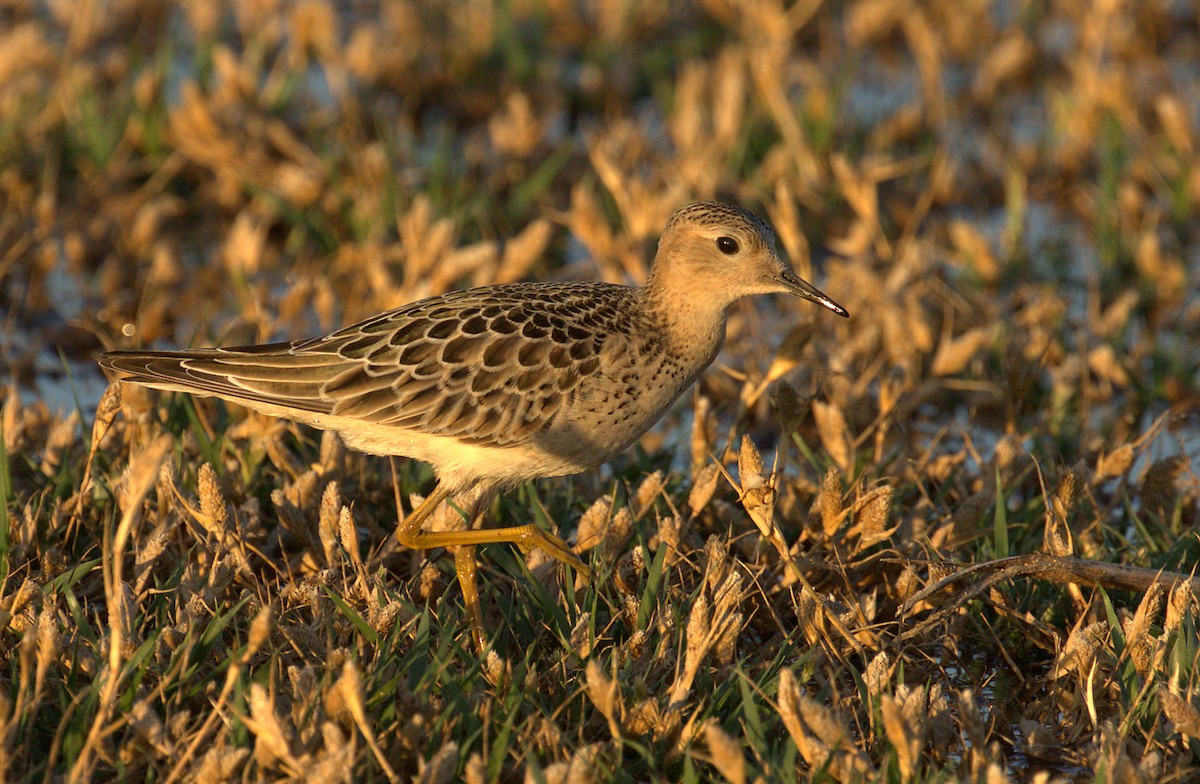
Juvenile Buff-breasted Sandpiper found on 8 September 2018 by Chet McGaugh and photographed here by Curtis A. Marantz on 19 September at the San Jacinto Wildlife Area, Riverside County, California.
Observation details
This bird had boldly marked upperparts, yet the face and underparts were rather uniformly buff. My impression was that the forehead was a rich buff color and at most weakly marked up to its junction with the crown. The crown was dominated by sooty-brown to blackish but with fine streaking of buff to create a conspicuously capped appearance that extended back to the nape, if not slightly beyond. I further noted a wedge of darker coloration extending downward into the supraloral region from the leading edge of the dark cap that created the impression of a broad and diffuse eyering, but closer inspection revealed a pattern that was better described as a plain face that was rich buff in color and with only a faint suggestion of a diffuse eyering and supercilium. The auriculars were subtly darker and browner, but they did not contrast at all strongly with the buffier tones of the superciliary region, lower part of the face, the sides of the neck that framed the rear terminus of the auriculars. In general, the back and sides of the neck were a deeper shade of buff than the face and underparts, yet they contrasted as conspicuously lighter and more weakly marked than both the cap and the back. The mantle feathers were sooty to blackish in color, but each feather had a narrow yet well-defined fringe of buff ot produce a finely scaled pattern in the center of the back. The larger scapulars again had rather dark centers that contrasted sharply with the narrow fringes of white to light gray to create a pattern of coarse scaling. I thought I detected some suggestion of paler markings internally at the bases of some of the scapulars, but I had a hard time making these out in the field. The wing coverts were much smaller than the scapulars and seemingly more tapered distally. These feathers again had dark centers and buffy edges. I thought the centers were narrower and the edges broader, but I was less sure if there were internal markings to these feathers. I further thought the larger greater coverts and tertials had more solidly blackish centers that contrasted with narrow but always well-defined fringes that extended the length of the outer edge of each feather and around the tip. On at least some of these feathers the fringe was a rich-buff color, but on others it was white. I am not sure I was able to see either the primary coverts or the length of the primaries in the closed wing, but the exposed primary tips were black and unmarked. I never clearly saw the rump or tai on this bird, and during my brief views of the bird in flight, I really noted only the lack of a bold wing-pattern, some suggestion of white underwing coverts, and the string buff cast to the underparts. Contrasting with the generally darker and more boldly marked upperparts, the underparts were rather uniformly rich-buff throughout. I cannot now recall if the throat was paler than the face and breast, but I am confident that the breast, belly, sides, and flanks were about the same shade of deep-buff throughout, and I thought the undertail coverts were only subtle paler, but still with a distinct buff cast. On other birds that I have seen this fall, I noted only a few small, rounded spots at the sides of the breast, but my impression was that the dark speckling on the sides of the neck and breast were more extensive and more conspicuous than on other birds that I have seen recently. I did not notice any dark markings continuing onto the flanks, but I easily could have missed such markings. As such, the belly, flanks, and undertail coverts appeared to be unmarked. Given that the undertail coverts reached nearly to the tip of the tail, I never saw the underside of the tail. As far as could determine, the bill was entirely black, the eyes were sufficiently dark as to appear black in the field, and the legs and whatever I could see of the feet, if anything at all, were a dull, straw-yellow in color.
Technical information
- Model
- Canon EOS 7D Mark II
- Lens
- EF100-400mm f/4.5-5.6L IS II USM
- ISO
- 500
- Focal length
- 400 mm
- Flash
- Flash did not fire, auto
- f-stop
- f/6.3
- Shutter speed
- 1/800 sec
- Dimensions
- 2729 pixels x 1782 pixels
- Original file size
- 7.62 MB