

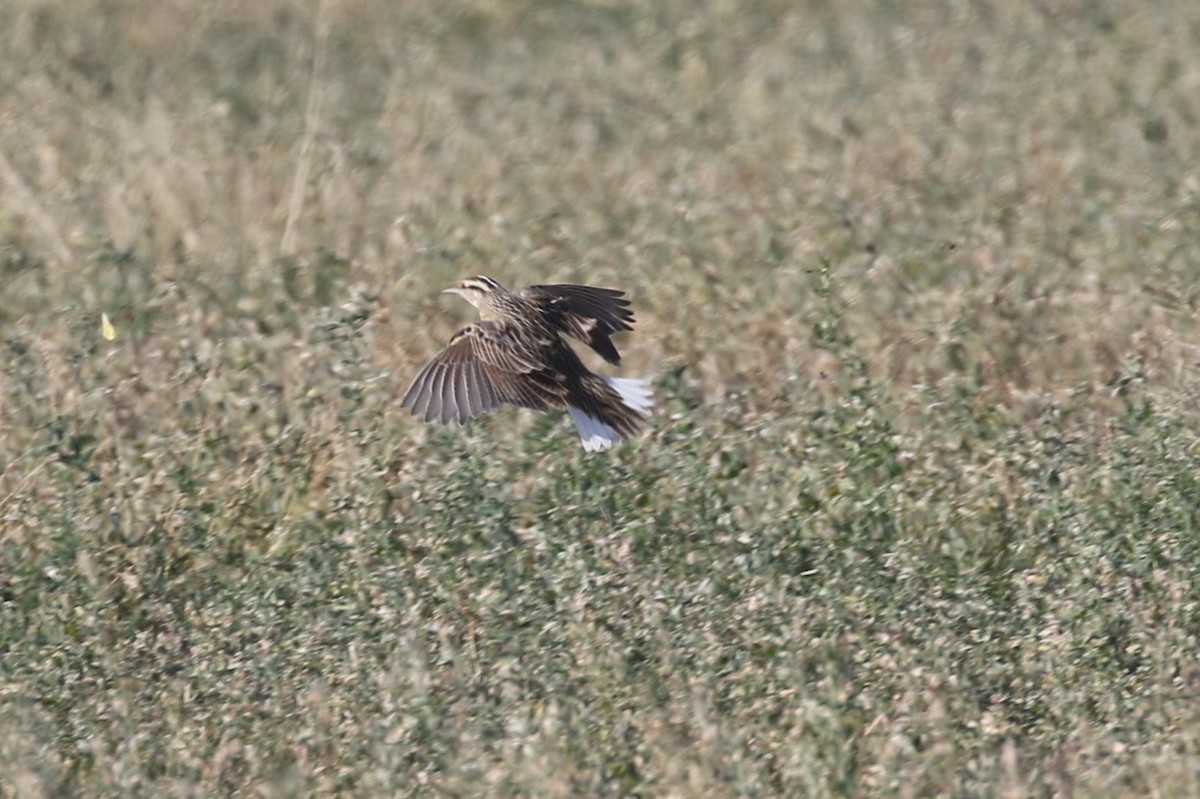
ML645293946
Contributor
Date
Location
- Age
- Not specified
- Sex
- Not specified
- Behaviors
- Flying
Observation details
Continuing putative first state record found by Chris and Adrian Hinkle on Nov 11. Seen and flushed several times, but we never heard it call. R3 mostly white, R4 entirely white. JH notes: the bird(s) were in the two fields initially described by the Hinkles (32.763349, -114.533998) and Logan Kahle (32.762306, -114.538723). Dessi first found it and ultimately we got the entire group into the area and flushed it multiple times. I think the best strategy is to flush the bird and take photos of its spread tail when it lands and then review those photos. Note that it was never with the large group of western meadowlarks (n = ~10) that stayed together in that same field. There were additional Western Meadowlarks spread out throughout the adjacent fields. An obvious Sturnella meadowlark. Very dark crown stripes contrasting with pale brown crown (this seems to be more contrasting than seen in Western). Malar pale (although Western can be pale in winter), paler unstreaked auriculars. Limited flank streaking (best seen on ML645293951) that did not reach into the yellow chest (ML645293951). Black across chest did not extend up to auriculars (as would in Western, at least adults). Extensive white in tail with R4, R5 and R6 (ML645293942, ML645293946, and ML645293951) completely white and R3 all white except for a small part of the outer portion of the distal retrix (best seen on ML645293946). R1 and R2 were dark brown (not light brown as would be expected in Western Meadowlark). It was silent the entire time we were there even to playback of Western and Chihuahuan.
Technical information
- Model
- Canon EOS 7D Mark II
- Lens
- EF100-400mm f/4.5-5.6L IS II USM
- ISO
- 160
- Focal length
- 400 mm
- Flash
- Flash did not fire
- f-stop
- f/8.0
- Shutter speed
- 1/500 sec
- Dimensions
- 1566 pixels x 1043 pixels
- Original file size
- 375.14 KB